
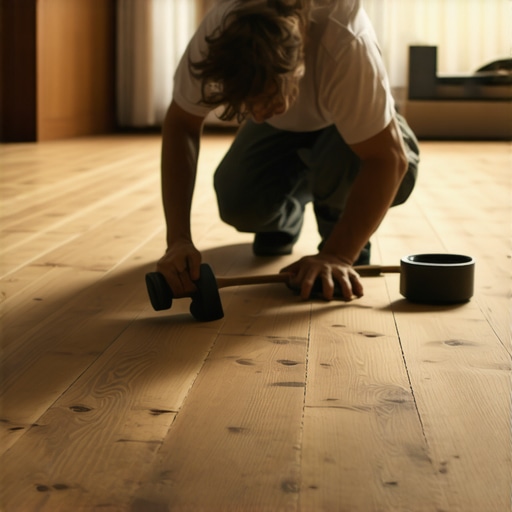
Most guys skip the leveling compound. They think the underlayment will hide the dip. It won’t. I spent three days grinding concrete on a job last month just so the floor wouldn’t click like a castanet. The homeowner wanted it done in a day. I told him he could have a fast floor or a quiet floor. He chose quiet. We ground down three high spots that were barely visible to the naked eye but felt like mountains under a straightedge. When you skip the prep, you are signing a contract with a ghost that will haunt every step you take. I have spent twenty five years with sawdust under my nails and the smell of oak dust in my lungs. I know the sound of a failing locking mechanism from a mile away. It is a sharp, plastic snap that tells me the subfloor was never flat to begin with. You cannot fix a bad foundation with a pretty surface. It is like putting a silk suit on a skeleton. If you want a floor that stays silent, you have to respect the physics of the installation.
The subfloor secret that ruins your peace
Subfloor irregularities are the primary cause of laminate floor creaking because the floating system requires a flat plane to prevent vertical deflection. If the subfloor has dips exceeding 1/8 of an inch over a ten foot radius, the locking joints will rub together and create noise. When a plank bridges over a low spot, it acts like a tiny springboard. Every time you step on it, the tongue and groove joint is forced to move in a way it was never designed to. This mechanical stress causes the high density fiberboard to rub against the adjacent plank. This is not just an annoying sound. It is the sound of your floor slowly destroying itself. Over time, that friction will wear down the milling. Eventually, the locking mechanism will snap entirely. Unlike hardwood floors that are nailed down or tile that is set in a rigid bed of mortar, laminate is a floating entity. It lives and dies by the quality of the surface it rests upon. If you have a concrete slab with a birdbath in the center, the laminate will groan every time the air pressure changes.
“A floor is only as good as the subfloor beneath it; deflection is the enemy of every joint.” – Master Flooring Axiom
Why your locking mechanism is screaming for help
The locking mechanism of a laminate plank relies on tight tolerances and friction to stay connected without glue or nails. When the floor moves vertically due to a poor subfloor, the melamine resin coating on the tongue rubs against the groove, creating a high pitched squeak. I have seen installers try to spray WD-40 into the cracks to stop the noise. That is a disaster waiting to happen. The oils in the lubricant will swell the fiberboard core and ruin the floor. The core of a laminate plank is made of HDF, which stands for high density fiberboard. This material is essentially wood fibers compressed with adhesive under extreme pressure. While it is very stable, it is still hygroscopic. It reacts to moisture in the air. If the joint is moving constantly, it opens up the core to ambient humidity. This causes the edges to swell. Once the edges swell, the creaking becomes a permanent feature of the home. You have to understand the chemistry of the bond. The melamine wear layer is a thermosetting plastic. It is hard and brittle. It does not like to bend. When you force it to bend over a subfloor dip, it protests with a click.
The perimeter gap that saves the center
An expansion gap is required around the entire perimeter of a laminate floor to allow for the natural movement of the material as humidity levels fluctuate. Without a 1/4 inch to 1/2 inch gap, the floor will bind against the walls and create tension that manifests as creaking. Laminate is a wood based product. It expands when the humidity goes up and shrinks when the air gets dry. If you jammed the planks tight against the baseboards, the floor has nowhere to go. It will begin to peak at the seams. This tension makes the floor stiff and prone to noise. I have walked into houses where the installer used a hammer to wedge the last row in. That is a death sentence for the floor. You need to use spacers. You need to respect the gap. Even in areas like bathrooms or near showers, where people worry about water, you still need that gap. You just fill it with a flexible 100 percent silicone caulk. This allows the floor to move while keeping water out of the subfloor. If the floor is pinned by a heavy kitchen island or a radiator pipe, it will buckle. A buckled floor is a noisy floor.
| Subfloor Material | Allowable Deflection | Moisture Tolerance | Preparation Requirement |
|---|---|---|---|
| Concrete Slab | 1/8 inch in 10 feet | Less than 3 lbs per 1000 sqft | Grinding or Leveling |
| Plywood Subfloor | 1/8 inch in 10 feet | Less than 12 percent MC | Sanding Seams |
| OSB Board | 1/8 inch in 10 feet | Less than 12 percent MC | Blocking for Stiffness |
How moisture turns boards into accordions
Moisture levels in the subfloor or the ambient air will cause the wood fibers in the laminate core to expand or contract, leading to structural instability and noise. Using a moisture barrier on concrete is a non-negotiable step to prevent vapor from attacking the underside of the planks. I always carry my moisture meter. If I see a reading above 12 percent on a wood subfloor, I stop. I do not lay a single plank until we find the source of the dampness. On concrete, you need a 6 mil poly film. This prevents the moisture that naturally rises through the slab from reaching the HDF core. If that vapor gets into the core, the floor will crown. The edges will stay down but the center of the plank will hump up. This creates huge air pockets under the floor. When you walk across a crowned floor, it sounds like you are walking on empty soda cans. It is a hollow, clicking mess. This is why acclimation is vital. You cannot bring the flooring from a cold warehouse into a humid house and start clicking it together. The planks need at least 48 hours to reach an equilibrium with the room. If you skip this, the floor will expand after it is installed and bind against the walls.
The myth of the thick underlayment
A thicker underlayment does not necessarily mean a quieter floor and can actually cause the locking mechanisms to fail by allowing too much vertical movement. For most laminate products, a high density 2mm or 3mm underlayment is the industry standard for stability. People think that putting a thick, squishy foam under the laminate will make it feel like carpet. That is a massive mistake. If the underlayment is too soft, the floor will deflect every time you take a step. The tongue and groove joints are only a few millimeters thick. If they are forced to bend more than a fraction of a millimeter, they will snap. You want an underlayment with a high compression strength. It should feel firm to the hand, not like a sponge. In high end apartments, we look at the IIC and STC ratings. These measure how much sound travels through the floor to the neighbors below. A good underlayment will dampen the sound of footsteps, but it will not fix a subfloor that is out of level. If you have a dip, you use floor patch. You do not use extra layers of foam. Adding more foam is just adding more failure points.
“Deflection is the silent killer of the floating floor system.” – Tile Council of North America Standard Reference
Friction points and the science of the click
Friction between the plank edges is the source of the creak, which can sometimes be mitigated by applying a specialized dry lubricant like paraffin wax or graphite to the joints during or after installation. This reduces the surface tension between the HDF components as they move against each other. Some high end laminate manufacturers pre coat their joints with wax at the factory. This is a sign of a quality product. If you have a floor that is already installed and creaking, you can sometimes fix it by puffing a bit of graphite powder into the seams. However, this is a band aid. It does not fix the underlying structural issue. If the floor is creaking because the subfloor is uneven, the graphite will eventually wear away and the sound will return. You also have to be careful with the type of cleaner you use. Many people use too much water. Water seeps into the joints and dissolves the factory wax. This leaves the raw wood fibers exposed. When raw wood fibers rub together, they squeak. Use a damp mop, never a wet one. Your floor is not a tile shower. It cannot handle standing water. If you see grout in a bathroom, you know that area is sealed. Laminate is never truly sealed at the joints unless you use a specific joint sealant during the click process.
The 1/8 inch that ruins everything
Precision in subfloor preparation is the difference between a high performance surface and a failed investment. A straightedge is the most important tool in the kit for identifying the high and low spots that cause noise. I have a ten foot aluminum straightedge that never leaves my truck. I lay it across the floor in a star pattern. If I can slide a nickel under the straightedge, that spot is too low. If the straightedge rocks back and forth, I have found a high spot. I mark the high spots with a red pencil and the low spots with a blue pencil. Then the real work begins. I use a diamond cup wheel on an angle grinder to take down the high spots in concrete. It is a dusty, miserable job, but it is the only way to get the floor right. For the low spots, I use a high strength floor leveler. You have to follow the mixing instructions exactly. If you add too much water, the leveler will be weak and chalky. It will crack under the weight of the floor. This is the structural engineering of flooring. It is not about the color of the wood. It is about the flat surface of the earth beneath it.
- Check subfloor levelness with a 10 foot straightedge
- Ensure a 48 hour acclimation period in the room of installation
- Install a 6 mil moisture barrier over all concrete surfaces
- Maintain a 1/2 inch expansion gap around all vertical obstructions
- Use a high density underlayment with high compression resistance
- Vacuum the subfloor thoroughly to remove all grit and debris
The final verdict on silent walking
If you want to stop the creaking, you have to be honest about your subfloor. You cannot hide a mountain with a rug. Take the time to prep the surface. Use a quality moisture barrier. Respect the expansion gaps at the walls. If you follow the NWFA guidelines and treat the installation like an engineering project, your floor will be as silent as a stone. If you rush it, you will hear about it with every step you take for the next ten years. It is better to spend three days on the prep than three years listening to a squeak. Keep your tools sharp and your subfloor flat. That is the only secret there is.