
I smell of oak dust and WD-40 most days and my knees have the permanent calluses of a man who has spent twenty-five years staring at 1/8 inch gaps. Most guys skip the leveling compound. They think the underlayment will hide the dip. It won’t. I spent three days grinding concrete on a job last month just so the floor wouldn’t click like a castanet. That same shortcut mentality is what leads people to pour a bottle of chlorine bleach over their tile floors. You are reaching for a chemical sledgehammer when you should be thinking like a chemist. Bleach is a caustic salt that is currently eating your floor from the inside out. Stop it. My job is to explain why your subfloor is the real culprit and why oxygen is the only way to save your grout lines.
The chemical reason bleach destroys your home
Sodium hypochlorite based cleaners known as bleach are caustic agents that chemically attack the polymer additives in modern cementitious grout. These cleaners leave behind salt crystals that expand within the capillary structure of the grout, leading to spalling, pitting, and eventual structural failure of the floor joint. You see a white line and think it is clean. I see a porous surface that has been stripped of its structural integrity. When you apply bleach, the high pH level of approximately 12 to 13 begins to break down the latex and acrylic modifiers that installers like me mix into the grout to give it flexibility. Without those polymers, the grout becomes brittle. It starts to crack under the minor shifts of your home. If you live in a region with high humidity like the Gulf Coast, those cracks become highways for moisture to reach your subfloor.
The hidden physics of subfloor deflection
Subfloor deflection refers to the amount of vertical movement or flex in your flooring system, measured as L over 360 for standard tile installations. When a subfloor lacks rigidity or uses improper joist spacing, the grout lines are the first to fracture, creating microscopic reservoirs where mold and grime accumulate. People use bleach because their grout is dirty, but the grout is dirty because it is cracked. I have seen countless DIY jobs where someone laid beautiful porcelain over 5/8 inch plywood with zero cement board. The floor flexes every time they walk to the fridge. That flex creates micro-fissures. Dirt fills those fissures. You bleach it, the bleach weakens the bond further, and suddenly you have a pile of sand between your tiles. You do not have a cleaning problem. You have a structural engineering failure.
“A floor is only as good as the subfloor beneath it; deflection is the enemy of every joint.” – Master Flooring Axiom
The oxygenated trick for deep pore restoration
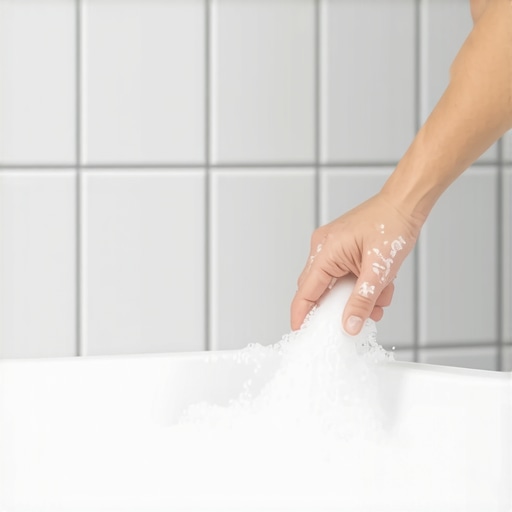
Oxygenated cleaners utilize sodium percarbonate to release active oxygen molecules that penetrate the microporous matrix of grout without leaving behind corrosive residues or damaging the pigment bonds. This is the professional secret. When you mix an oxygen bleach powder with hot water, it creates a bubbling reaction. That effervescence is literally lifting the organic matter out of the grout pores. It does not eat the cement. It does not destroy the polymers. It simply breaks the surface tension of the dirt. In the dry climates of Arizona or Nevada, where grout can become exceptionally dusty and brittle, this hydration and gentle cleaning are vital for maintaining the floor. It is about chemistry, not brute force.
Hardwood and laminate transitions near wet areas
Transition zones between hardwood floors, laminate, and tile require a moisture-neutral cleaning approach because the capillary action of liquid bleach can migrate under T-moldings and cause edge swelling or delamination. If you are bleaching the grout in your bathroom and that liquid touches the edge of your oak planks, you are asking for trouble. Solid wood like white oak has a Janka rating around 1360, but it is no match for the pH of bleach. It will strip the finish and gray the wood instantly. Laminate is even worse. Most laminate cores are high-density fiberboard. They are essentially a sponge made of sawdust. One splash of a bleach-water mix and your laminate edges will peak like the Rocky Mountains. Using an oxygenated solution is safer for these mixed-material environments because it is typically pH neutral once the reaction is finished.
| Cleaner Type | pH Level | Effect on Polymers | Residue Profile |
|---|---|---|---|
| Chlorine Bleach | 11 to 13 | Destructive | High Salt |
| Oxygenated | 9 to 10 | Neutral | Zero |
| Acidic | 1 to 3 | Erosive | Mineral |
| Neutral | 7 | Safe | Low |
Proper grout maintenance for the long haul
Grout sealing is the primary defense against moisture intrusion and should be performed using a penetrating solvent-based sealer rather than a topical coating to ensure the vapor permeability of the floor remains intact. If you do not seal your grout, you are just waiting for a stain to happen. Once you have cleaned the floor with your oxygenated solution and let it dry for at least 48 hours, you must apply a high-quality sealer. This fills the pores I mentioned earlier. It prevents the dirt from getting in, which means you will never need to reach for the bleach bottle again.
- Verify your subfloor is rigid and meets TCNA standards for tile.
- Scrub the grout lines with a stiff nylon brush and oxygenated powder.
- Rinse with clean water to remove any loosened organic debris.
- Allow the floor to dry completely to prevent trapping moisture.
- Apply a penetrating sealer to every grout joint.
“Standard cementitious grout is not waterproof; it is a porous filter that requires chemical sealing to maintain its structural integrity.” – Tile Science Standard
The bottom line is that your floor is a system. From the joists in the crawlspace to the sealer on the surface, every part must work together. When you use bleach, you are breaking a link in that chain. You are sacrificing the long-term health of your grout for a five-minute visual fix. Be smarter than the big-box marketing. Use the oxygenated trick and keep your subfloor dry. Your knees and your wallet will thank you in a decade when you are not ripping up a rotten floor. “