
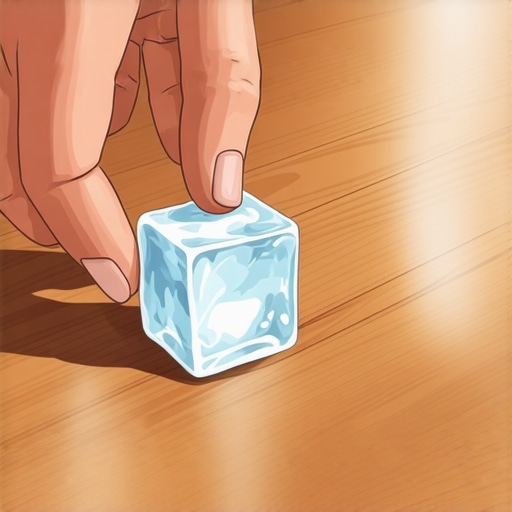
The Ice Cube Trick for Lifting Furniture Dents Out of Hardwood
I once walked into a house where a $15,000 wide-plank walnut floor was cupping so bad it looked like a potato chip because the installer didn’t check the crawlspace humidity. The homeowner was devastated. I was just staring at the grain. Wood is alive. It moves. It breathes. If you do not respect the moisture, the moisture will disrespect your bank account. Last year, I saw a dent from a heavy sideboard that looked like a crater in a custom cherry floor. The owner wanted to sand the whole room. I told him to go to the freezer instead. Most guys would have quoted a full sand and finish. They want the big ticket. I just wanted the wood to do what it was born to do. Wood has memory. It remembers being a tree. It remembers the vertical pull of the forest. When you crush those fibers with a heavy chair leg, you are not necessarily breaking them. You are just compressing the air out of the cellular structure. It is a physics problem, not a cosmetic one. I have spent twenty-five years on my knees with a moisture meter and a level. I have seen every mistake a human can make with a hammer. Fixing a dent with an ice cube is the simplest, most honest repair in the trade. It requires patience. It requires an understanding of the lignin and cellulose that make up every square inch of your home. If you rush it, you fail. If you understand the science, you win.
Physics of the frozen repair
The ice cube trick utilizes thermal expansion and hygroscopic absorption to restore compressed wood fibers in hardwood floors. By introducing controlled moisture to the cellulose structure, the lignin bonds relax, allowing the wood grain to return to its original profile through capillary action and vapor pressure. This process works best on solid wood where the fibers are still intact but merely flattened. It is not magic. It is the application of water molecules into the microscopic voids created by mechanical pressure. When you place an ice cube on a dent, the slow melt ensures that the water does not pool and run across the surface. Instead, it sits directly over the wound. As the water transitions from a solid to a liquid, it seeps into the finish. If the finish is cracked, the water moves faster. If the finish is a thick polyurethane, it takes longer. The cold temperature actually helps to localize the moisture. You want the water to go down, not out. You are targeting the lumen of the wood cell. This is the hollow center where the tree once transported nutrients. When a furniture leg hits the floor, it collapses these hollow tubes like a crushed straw. The water acts as a hydraulic jack. It enters the straw and forces it back into a cylindrical shape. It is a slow, steady pressure. You cannot rush the physics of a cell wall.
“A floor is only as good as the subfloor beneath it; deflection is the enemy of every joint.” – Master Flooring Axiom
Cellular structure and the memory of wood
The biological makeup of hardwood floors consists of cellulose, hemicellulose, and lignin which provide structural rigidity and elasticity. Understanding the S2 layer of the cell wall is essential for dent repair because this layer contains the highest concentration of microfibrils that respond to moisture changes. Wood is a polymer. It is a natural composite material. The lignin acts as the glue, the cellulose acts as the rebar. When you drop a heavy object, you are causing a mechanical deformation of this composite. In most cases, the lignin is not fractured. It is just bent. By adding water, you are lowering the glass transition temperature of the lignin. This makes the wood more plastic. It makes it moveable. The ice cube provides a reservoir of potential energy. As it melts, the water molecules penetrate the amorphous regions of the cellulose. This causes swelling. The swelling is what lifts the dent. This is why hardwood floors are superior to laminate or other synthetic materials. Synthetic floors do not have memory. If you dent a laminate floor, you have broken the melamine resin and the medium-density fiberboard core. There is no coming back from that. You cannot grow a plastic floor back to its original shape. With wood, you are working with a material that spent decades growing in the wild. It knows how to survive. You just have to give it the right tools.
Why some dents refuse to rise
The Janka hardness scale determines how hardwood floors resist indentation and how wood fibers recover from compressive stress. Species like Brazilian Cherry or Hard Maple have dense grain structures that make moisture penetration difficult, whereas Black Walnut or White Pine respond rapidly to vapor-based restoration. If the wood fibers are actually severed, the ice cube will not help. Look closely at the dent. If you see white, jagged edges, the grain is torn. This is common with sharp objects like high heels or dropped tools. An ice cube cannot heal a cut. It can only expand a bruise. Also, the finish of the floor plays a major role. A factory-finished board with an aluminum oxide coating is nearly waterproof. The ice cube might sit there for three hours and never reach the wood. In those cases, you might need to use a pin to make a microscopic hole in the finish. This allows the water to bypass the chemical barrier. It is a surgical approach. You also have to consider the age of the wood. Old-growth timber has tighter growth rings. It is more stubborn. It has seen more seasons. It takes more work to convince an old floor to change its mind. New builder-grade flooring is softer and more reactive. It is often less stable, but it is easier to manipulate.
| Wood Species | Janka Hardness | Expansion Coefficient | Fiber Recovery Rate |
|---|---|---|---|
| Brazilian Cherry | 2350 | High | Low |
| Hard Maple | 1450 | Medium | Moderate |
| White Oak | 1360 | Medium | High |
| Black Walnut | 1010 | Low | Very High |
| Douglas Fir | 660 | High | Moderate |
Comparing hardwood resilience to laminate alternatives
While hardwood floors offer long-term durability through refinishing, laminate flooring relies on a wear layer that cannot be repaired with moisture treatments. If you try the ice cube trick on laminate, you will likely cause peaking or delamination because the MDF core absorbs water like a sponge and stays swollen forever. This is the danger of modern marketing. People hear the word waterproof and they think indestructible. Nothing is indestructible. In a bathroom, you use tile and grout because those materials are inorganic. They do not have cells. They do not have memory. If you put wood in showers, you are asking for a biological disaster. I have seen people try to install engineered wood in wet areas and it always ends in mold. Hardwood belongs in living spaces where the environment is controlled. Laminate is a picture of wood glued to a board. It looks fine from five feet away, but it has no soul. When a chair leg dents laminate, the board is dead. You have to replace the whole plank. With hardwood, you just need a trip to the kitchen. This is why I always tell my clients to invest in the real thing. It is the difference between a tool and a toy. One can be fixed, the other has to be thrown away. The cost of hardwood is higher upfront, but the cost of ownership is lower because of its ability to recover from life.
Beyond the ice cube with steam and heat
For stubborn indentations in oak floors, the steam iron method provides accelerated fiber recovery by forcing hot water vapor into the lignin matrix. This technique requires a damp cotton cloth and a high-heat source to create a pressure-cooker effect within the wood grain. You place the damp cloth over the dent. You set your iron to the highest steam setting. You touch the iron to the cloth for three to five seconds. You are essentially boiling the water inside the wood. This causes an immediate and violent expansion of the cells. It is effective, but it is risky. If you leave the heat on too long, you will cook the finish. You will turn your polyurethane white or cause it to flake off like dead skin. I prefer the slow melt of the ice cube. It is more natural. It is less likely to damage the chemical bond of the finish. However, if the dent is deep and the wood is old, steam is sometimes the only way. You have to watch the grain. As soon as the wood reaches the surface, stop. Over-expanding the wood will create a bump. Then you have the opposite problem. Now you are sanding down a hill instead of filling a valley. Balance is everything in flooring.
Preparation of the finish and surface tension
The surface tension of polyurethane finishes can prevent water molecules from reaching the damaged wood area during the restoration process. Before applying an ice cube, it is necessary to clean the hardwood surface with a pH-neutral cleaner to remove wax buildup or silicone-based polishes. If there is a layer of wax on the floor, the water will just bead up and sit there. It will never do its job. I always take a clean rag and some mineral spirits to the spot first. I want the wood to be thirsty. If the finish is an oil-based penetrating finish, the repair is easy. The oil allows the wood to breathe. If it is a water-based finish, it might be more resistant. You have to understand the chemistry of what you are standing on. Most people have no idea what their floors are coated with. They just buy whatever is on sale at the big-box store. That is a mistake. You need to know your finish like you know your car engine. If you use the wrong cleaner, you can ruin the bond between the wood and the coating. When you apply the ice cube, let it melt completely. Do not touch it. Do not move it. Let the water do the work. Once it is dry, you can see if you need to repeat the process. Sometimes it takes two or three passes to get the wood back to level.
“Wood moves in three directions, but it only breaks in one. Respect the grain or the grain will break you.” – Master Flooring Axiom
Structural integrity of the subfloor assembly
The subfloor system, including the joist spacing and plywood thickness, dictates how hardwood floors distribute point loads from heavy furniture. A deflecting subfloor increases the risk of fiber crushing because the finished floor lacks the rigidity to resist vertical pressure. If your subfloor is bouncy, your hardwood is going to dent more easily. It is that simple. I have seen guys install 3/4 inch oak over 1/2 inch particle board. That is a crime. Particle board has no structural value. It is just sawdust and glue. When you put a heavy piano on that, the whole assembly dips. The oak cannot handle that stress. It starts to compress. Before you worry about the ice cube trick, you need to worry about what is under your feet. I spend three days grinding concrete or sistering joists before I even open a box of wood. If the foundation is wrong, the house is wrong. People think they can hide a bad subfloor with a thick underlayment. They cannot. While most people want the thickest underlayment, too much cushion actually causes the locking mechanisms on LVP or engineered wood to snap under pressure. You want a firm, flat surface. A floor should not feel like a trampoline. It should feel like the earth. When the subfloor is solid, the hardwood can do its job. It can resist the dents. It can stay beautiful for a hundred years.
The checklist for dent restoration
- Verify the floor is solid hardwood and not a synthetic laminate.
- Clean the dented area with a soft cloth and mineral spirits.
- Check the finish for cracks that might allow faster water entry.
- Place one clear ice cube directly in the center of the depression.
- Allow the ice cube to melt completely at room temperature.
- Wait 24 hours for the wood fibers to fully stabilize and dry.
- Lightly buff the area if the grain has raised slightly during the process.
- Reapply a small amount of matching finish if the original coating was damaged.
Moisture management and the hygroscopic loop
The relative humidity of a home environment must remain between 30 and 50 percent to maintain the equilibrium moisture content of hardwood floors. When the air is too dry, wood fibers become brittle and more susceptible to permanent deformation from furniture impacts. This is the part of the job people hate hearing. You have to manage your air. If you live in a place with hard winters, your heater is sucking the life out of your floors. The wood shrinks. The gaps open up. The fibers get thirsty. When they are dry, they are weak. A chair leg that would not have left a mark in July will leave a canyon in January. You need a humidifier. You need to keep the wood in its happy zone. The ice cube trick works because it temporarily spikes the moisture in a localized area. But if the rest of the floor is bone dry, that water is going to dissipate quickly. You are fighting a losing battle against the atmosphere. I always tell my clients that a floor is a living thing. You would not leave a dog in a house without water. Do not do it to your oak. The way that water interacts with the hydrogen bonds in the hemicellulose is a matter of chemical equilibrium. If the air is hungry for water, it will take it from the wood. If the wood is hungry, it will take it from the ice cube. You want to be the one in control of that exchange. That is how you keep a floor looking like the day it was sanded.
Final inspection of the grain
After the ice cube has melted and the wood has dried, the restored grain should be flush with the surrounding surface of the hardwood planks. If a slight ridge remains, a fine-grit sandpaper can be used to level the area before spot-treating with polyurethane. You have to be careful here. Do not go crazy with the sandpaper. You are just knocking off the whiskers. If you sand too deep, you are through the finish and into the raw wood. Then you have a stain matching problem. And let me tell you, matching a five-year-old stain is a nightmare. The sun changes the color of wood every day. It is called photo-oxidation. The wood gets darker or lighter depending on the species. If you sand back to the original color, you will have a bright spot that sticks out like a sore thumb. The ice cube trick is meant to avoid this. It is a non-invasive surgery. If you do it right, you will not even be able to find the dent. I have had customers look at me like I am a magician. I am not. I am just a guy who knows how trees work. I have spent my life in the sawdust. I have breathed it in. I have felt it under my nails. Wood is the greatest building material on earth. It is resilient. It is beautiful. It is honest. If you treat it with respect, it will give it back to you. Just remember to keep the ice in the freezer until you need it. Do not let the furniture win. Your floor has a memory. Help it remember.