
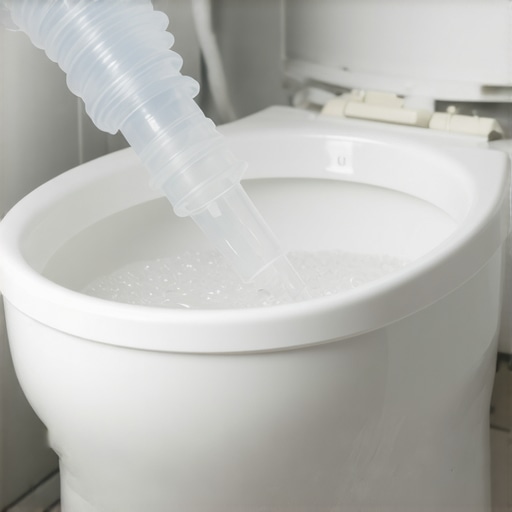
The subfloor secret that kills most tile jobs
Emptying a toilet completely before a tile installation involves using a simple plastic tube to create a vacuum that pulls every drop of water from the trap. Most guys skip the leveling compound. They think the underlayment will hide the dip. It won’t. I spent three days grinding concrete on a job last month just so the floor wouldn’t click like a castanet. If you leave water in that bowl, it will spill. When it spills, it saturates the subfloor. A saturated subfloor prevents your thin-set from curing at the molecular level, leading to bond failure and cracked grout lines within six months. I have seen fifteen thousand dollar projects fail because a plumber got lazy with a sponge. You need to be better than that. We are talking about structural integrity, not just aesthetics.
The physics of the five dollar siphon
A siphon works by utilizing atmospheric pressure and gravity to move liquid from a higher reservoir to a lower one through a tube. You do not need a shop vac that you will have to clean later. You do not need to ruin your wife’s good towels. Go to the hardware store and buy three feet of clear vinyl tubing. Submerge the entire tube in the toilet bowl until it is full of water. Plug one end with your thumb. Pull that end out and over a bucket on the floor. Release your thumb. Gravity takes over. The weight of the water falling into the bucket creates a low-pressure zone in the tube. This pulls the remaining water out of the trap. It is basic fluid dynamics. It is clean. It is efficient. Most importantly, it keeps your work area dry. A dry subfloor is the only subfloor I will ever lay tile on. If I smell damp wood, the job stops until the blowers have been running for twenty-four hours.
Why residual moisture is the enemy of thin-set
Residual moisture in a plywood or OSB subfloor interferes with the hydration process of Portland cement-based mortars and adhesives. When you mix thin-set, you are triggering a chemical reaction. If the wood underneath is wet, it will suck the moisture out of the mortar too fast, or worse, it will introduce contaminants into the bond. I have seen hardwood floors cup because someone did not check the moisture content of the slab. I have seen laminate swell at the seams because of a minor toilet leak that was never fully dried. You are looking for a moisture reading of twelve percent or less on your meter. Anything higher and you are just building a future warranty claim. I do not do warranty claims. I do floors that last until the house is torn down. You have to respect the chemistry. If you do not respect the chemistry, the floor will eventually find a way to punish you.
“A floor is only as good as the subfloor beneath it; deflection is the enemy of every joint.” – Master Flooring Axiom
The 1/8 inch that ruins everything
Floor flatness is measured over a ten-foot radius and must not deviate by more than one-eighth of an inch for large format tile. If your subfloor has a dip, the tile will bridge that gap. When someone walks over it, the tile flexes. Ceramic and porcelain do not like to flex. They are rigid. They are brittle. The moment that tile flexes, the grout cracks. Then the bond breaks. Then you have a hollow-sounding floor. I spend more time with a straight edge and a bag of self-leveler than I do with a notched trowel. People ask me why I charge so much for prep. I tell them they are paying for the floor to stay on the ground. If you want a floor that bounces, go buy a trampoline. If you want a floor for your showers or bathrooms, you follow the TCNA handbook to the letter. No shortcuts. No excuses.
| Floor Type | Janka Rating | Acclimation Time | Max Moisture Content |
|---|---|---|---|
| Solid White Oak | 1360 | 7 to 14 Days | 6 to 9 percent |
| Engineered Maple | 1450 | 3 to 5 Days | 7 to 10 percent |
| Laminate Core | N/A | 48 Hours | 12 percent |
| Porcelain Tile | N/A | None | Concrete slab < 4 percent |
The chemistry of the modified thin-set bond
Modified thin-set contains liquid latex or dry polymer additives that increase bond strength and allow for a microscopic degree of flexibility. This is not the stuff your grandfather used. This is engineered material. When you are working in showers, the bond must be absolute. The polymer chains in the mortar wrap around the crystalline structures of the cement. This creates a matrix that resists water penetration. But here is the catch. If you use too much water in your mix, you weaken those chains. I see guys eyeball the water. They are idiots. Use a measuring bucket. Every ounce matters. The difference between a perfect mix and a soup is less than a pint. I want my thin-set to have the consistency of peanut butter. It should stand up on the trowel without slumping. If it slumps, it is garbage. Throw it out and start over. Your reputation is worth more than a ten dollar bag of mud.
Why your subfloor is lying to you
Subfloors often appear flat to the naked eye while harboring significant structural deflection or localized undulations. Just because it looks okay from the doorway does not mean it is ready for laminate or tile. You need to get on your knees with a laser level. Check for high spots at the seams of the plywood. Check for low spots where the joists have settled. I have found houses where the center of the room was two inches lower than the perimeter. If you try to install hardwood floors over that, you will have gaps big enough to lose a credit card in. You grind the highs and fill the lows. It is a messy, loud, and miserable process. It is also the only way to do the job right. I smell like oak dust and concrete powder every day of my life because I refuse to walk away from a subfloor that is not perfect.
“Wood is a hygroscopic material; it never stops moving in response to its environment.” – NWFA Technical Manual
The ghost in the expansion gap
Expansion gaps are mandatory perimeters left around the edges of a floor to allow for natural thermal and moisture-related movement. I see people jam hardwood floors tight against the drywall. They think it looks cleaner. Then summer hits. The humidity rises. The wood expands. Because there is nowhere for it to go, it goes up. It buckles. It creates a speed bump in the middle of your living room. You need at least half an inch of space. That is what baseboards and shoe molding are for. They are not just decorative. They are masks for the engineering requirements of the material. Even laminate needs room to breathe. It is basically sawdust and glue. It reacts to moisture like a sponge. If you lock it in, you break the locking mechanisms. Once those clicks are snapped, the floor is junk. You cannot glue them back together. You replace the whole thing.
The hidden trap in waterproof marketing
Waterproof flooring labels generally refer to the material itself being impervious to water but do not protect the subfloor from moisture migration. This is the biggest lie in the industry right now. People think they can flood their bathroom because they bought waterproof vinyl. If water gets under that floor, it sits there. It cannot evaporate. It turns into a petri dish of mold and rot. I have ripped up floors that were only two years old where the subfloor had turned into black mush. The showers were leaking behind the walls, and the “waterproof” floor trapped that moisture until the floor joists started to fail. You still need a perimeter seal. You still need to manage your transitions. You still need to empty that toilet with a siphon instead of a spill. Use your head. Water always wins if you do not give it a path out.
Master Flooring Checklist
- Test subfloor moisture with a pinned or pinless meter.
- Siphon the toilet trap to prevent subfloor saturation.
- Check floor flatness with a ten foot straight edge.
- Verify that all fasteners in the subfloor are countersunk.
- Acclimate all wood products to the home environment for at least one week.
- Measure thin-set water precisely with a graduated cylinder or bucket.
- Maintain a half inch expansion gap at all vertical obstructions.
- Vacuum the subfloor three times before the first piece of flooring touches it.
The mechanical reality of grout failure
Grout fails primarily because of structural movement in the subfloor or improper mixing ratios that lead to high porosity. If you see grout cracking, do not just smear more on top. That is a band-aid on a gunshot wound. The crack is telling you that the floor is moving. Maybe the joists are undersized. Maybe the subfloor is only a single layer of five-eighths plywood. You need more stiffness. I often recommend adding a second layer of exterior grade plywood, offset from the first, to create a rigid platform. Then you use a high-quality grout with an antimicrobial additive. In showers, I prefer epoxy grout. It is a nightmare to work with. It sticks to everything. It has a short pot life. But once it cures, it is bulletproof. It does not stain. It does not crack. It is the gold standard for a reason. Do the hard work up front and you will not be back to fix it later. I hate going back to jobs. I want to do it once and forget the house exists. That is the mark of a pro.