
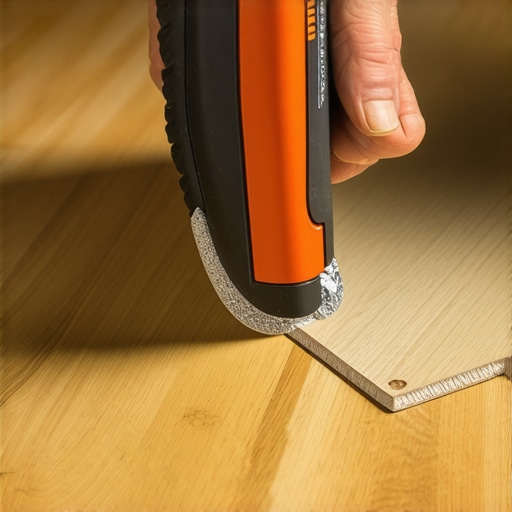
The $5 Tool That Makes Cutting Laminate Corners Actually Easy
Most guys skip the leveling compound. They think the underlayment will hide the dip. It won’t. I spent three days grinding concrete on a job last month just so the floor wouldn’t click like a castanet. That job taught me that the smallest details, the ones most people ignore, are the ones that lead to a professional result. When you are dealing with laminate, hardwood floors, or even the complex grout lines of a shower, precision is not a suggestion. It is the law. Most homeowners struggle with the complex curves of door casings and the jagged edges of floor vents. They waste five planks trying to get a single cut right. The secret is not a expensive laser system or a CNC machine. It is a simple profile gauge, a tool that costs less than a decent lunch but saves a hundred dollars in ruined material.
The shadow behind the door casing
A profile gauge, often called a contour gauge, is a tool comprised of a row of thin plastic or metal pins held tightly together in a frame that allows them to move independently. When you press this tool against a complex shape like a door jamb or a radiator pipe, the pins slide to mimic the exact silhouette of the object. This mechanical template is then placed onto the laminate plank, allowing you to trace a perfect cut line with a pencil. This tool eliminates the need for complex geometric calculations or the frustrating trial and error of paper templates. It is the only way to ensure the necessary expansion gap is maintained while keeping the visual transition tight enough to be covered by a small bead of color matched caulk or the baseboard itself.
“A floor is only as good as the subfloor beneath it; deflection is the enemy of every joint.” – Master Flooring Axiom
Laminate is a floating floor system. It is a layered product consisting of a wear layer, a design layer, a high density fiberboard core, and a balancing layer. The high density fiberboard (HDF) core is the engine of the plank. It is made by compressing wood fibers with melamine resin under intense heat and pressure. The density of a high quality HDF core usually sits between 800 and 900 kilograms per cubic meter. This density provides the structural integrity needed for the click lock mechanism to hold together. However, because it is wood based, it is hygroscopic. It absorbs moisture from the air and the subfloor. If you cut your corners too tight and do not leave an expansion gap, the floor will have nowhere to go when the humidity rises. It will push against the casing, buckle in the center of the room, and eventually snap the locking tongues. The profile gauge allows you to trace the shape exactly and then offset that line by a quarter inch to give the floor the room it needs to breathe.
The geometry of the profile gauge
A contour gauge functions through the physics of displacement and friction to create a temporary mold of a three dimensional surface. Most affordable gauges use plastic pins made of acrylonitrile butadiene styrene (ABS) because they are lightweight and do not scratch the finish of your trim. The friction within the frame must be high enough to hold the pins in place once moved, yet low enough to allow them to slide when pushed against a wall. This balance allows the installer to capture the exact curve of a baseboard or the intricate detail of a Victorian era door casing. When you use this tool, you are essentially creating a physical map of the obstacle. You are not just guessing. You are recording data.
| Tool Type | Precision Level | Cost | Best Use Case |
|---|---|---|---|
| Profile Gauge | High | $5 to $15 | Door casings, pipes, and complex trim |
| Paper Template | Medium | $0 | Simple curves or large radii |
| Tape Measure | Low | $10 to $25 | Straight cuts and simple box outs |
| Freehand Scribing | Variable | $0 | Experienced professionals only |
Why your subfloor is lying to you
The subfloor flatness is the most misrepresented aspect of flooring installation because it is hidden under the finished surface. Most manufacturers require a floor to be flat within 1/8 of an inch over a 6 foot radius or 3/16 of an inch over a 10 foot radius. If there is a dip in the plywood or the concrete, the laminate will flex every time someone walks over it. This constant movement puts immense stress on the melamine resin bonds in the core. Eventually, the friction causes the joints to wear down, leading to gaps or peaking. I have seen floors where the installer thought a thick 6 millimeter underlayment would bridge a half inch hole. It did not work. The underlayment compressed, the joint snapped, and the entire floor had to be ripped up. While people want the thickest underlayment for sound dampening, too much cushion actually causes the locking mechanisms on laminate and LVP to snap under the weight of furniture or foot traffic. You want a high density underlayment that resists compression.
The chemical reality of high density fiberboard
The HDF core is a marvel of industrial chemistry but it has a weakness to hydrostatic pressure. When moisture vapor rises through a concrete slab, it exerts pressure on the underside of the laminate. If you have not installed a 6 mil poly vapor barrier, that moisture enters the fiberboard. The melamine resin, which acts as the glue, can only hold back so much expansion. When the fibers swell, they lose their structural bond. This is why you see the edges of cheap laminate floors curling up. It is not always a spill from the top. Often, it is a failure of the vapor barrier below. When you are cutting your corners with the profile gauge, remember that every cut edge is a vulnerable entry point for moisture. This is why I always recommend a small amount of wax based joint sealant in high traffic areas or near potential water sources like refrigerators or bathroom doors.
“Wood flooring is a living material that responds to its environment; control the environment to control the floor.” – Master Flooring Axiom
The expansion gap rule that everyone ignores
An expansion gap of 1/4 inch to 3/8 inch is mandatory around the entire perimeter of the room. This includes the corners where the profile gauge is used. Many DIY installers make the mistake of cutting the laminate to fit tight against the door jamb because it looks better. This is a mistake that will cost you the floor. The trim should be undercut using a jamb saw, allowing the laminate to slide underneath it. This hides the expansion gap while allowing the floor to move. If you cannot undercut the jamb, you must use the profile gauge to trace the shape and then use a jigsaw to cut the plank, leaving the gap. You then cover that gap with a flexible sealant or a matching trim piece. In regions like the humid Southeast, these gaps are even more important because the seasonal expansion of the wood fibers is significant. If you are in a dry climate like Phoenix, the floor will shrink, making the initial installation gap even more visible if you are not careful with your measurements.
- Step 1: Clean the area of all debris and sawdust to ensure the gauge sits flush.
- Step 2: Press the profile gauge firmly against the casing or pipe until all pins have moved.
- Step 3: Lock the gauge if it has a locking mechanism to prevent pin movement.
- Step 4: Trace the shape onto the laminate plank using a sharp carpenter pencil.
- Step 5: Use a jigsaw with a fine tooth blade to cut along the line, keeping the blade on the waste side.
Saw blade physics for clean laminate edges
The wear layer of laminate is typically made of aluminum oxide, which is one of the hardest minerals on earth. It is designed to resist scratches, but it is incredibly abrasive to saw blades. If you use a standard wood blade, you will find it dulls within ten cuts. For the best results when cutting the intricate shapes traced from your profile gauge, you need a carbide tipped jigsaw blade with a high tooth count, usually 20 to 30 teeth per inch (TPI). A downward cutting blade is often preferred for laminate because it cuts on the downstroke, preventing the decorative paper layer from chipping on the top surface. If you use an upward cutting blade, you must flip the plank over and trace your profile on the back. The heat generated during the cut can actually melt the melamine resin if the blade is dull, leading to a ragged edge that is difficult to hide. Keep your saw speed moderate to prevent overheating and ensure the cleanest possible line for those difficult corner transitions.
Moisture barriers and the vapor pressure gradient
The vapor pressure gradient is the force that moves moisture from a high concentration area to a low concentration area. In a house with a concrete slab, the earth under the house is almost always at 100 percent relative humidity. The air inside the house is usually around 40 to 50 percent. This difference in pressure literally sucks moisture up through the concrete. If you are installing laminate over a slab, a 6 mil polyethylene film is the bare minimum requirement. You must overlap the seams by six inches and tape them with a moisture resistant tape. When you are fitting the floor into corners or around pipes, do not cut the vapor barrier short. Run it up the wall slightly and hide it behind the baseboard. This ensures that moisture cannot escape around the edges and find its way into the HDF core. This is especially true in bathrooms where grout and showers are present, as the ambient humidity is much higher. Even if you have the best profile gauge in the world, a failure in the moisture barrier will lead to a floor that fails within two years. Precision in the cut must be matched by precision in the prep work. This is the difference between a floor that lasts thirty years and one that ends up in a dumpster before the mortgage is paid off. Always check your subfloor moisture levels with a calcium chloride test or an electronic moisture meter before you lay a single plank. If the concrete is reading above 75 percent relative humidity, you have a problem that a $5 tool cannot fix. Stop and address the drainage or use a specialized moisture mitigation epoxy. Only then should you worry about the perfect corner cut.