
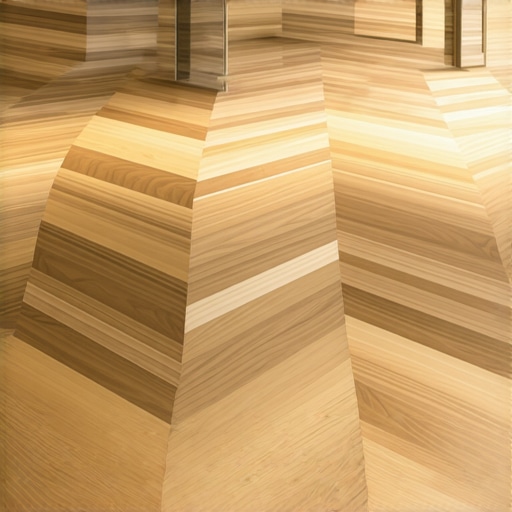
The optical illusion of a continuous plane
To make a room look bigger you should install hardwood planks parallel to the longest wall or towards the primary light source to extend the visual lines of the space. This technique creates a sense of depth and prevents the eye from being cut off by perpendicular seams. If you lay the planks against the width of the room, you are effectively creating a series of visual hurdles that shrink the floor. As an architect who has seen the rise and fall of various flooring fads, I can tell you that the direction of your wood is not a mere preference, it is a structural and optical necessity that dictates the entire energy of the interior. When you walk into a room, your brain naturally seeks the vanishing point. By aligning the boards with that point, you are tricking the human eye into perceiving a vastness that may not actually exist on the blueprints. I once walked into a house where a $15,000 wide-plank walnut floor was cupping so bad it looked like a potato chip because the installer didn’t check the crawlspace humidity. The tragedy was not just the moisture, but the fact that they had laid the planks across the narrow width of a long hallway. Not only was the floor failing physically, but it also felt like walking through a series of railroad ties. It was claustrophobic, dark, and technically incompetent. A floor is a performance surface, and every degree of its orientation matters. We must discuss the physics of the subfloor and the microscopic behavior of wood cells before you even think about opening a box of material. Wood is a hygroscopic material, meaning it is constantly breathing, expanding, and contracting based on the moisture in the air. If you ignore the structural joists beneath your feet, you are asking for a mechanical failure that no amount of aesthetic planning can fix. When we talk about hardwood floors, we are talking about an organic product that responds to the environment of your home like a living thing. This is why the directionality is tied to the stability of the entire house frame.
The fundamental physics of subfloor deflection
Subfloor deflection is the amount of vertical movement a floor system experiences under load and it determines the maximum allowable span for your hardwood planks. To prevent the floor from bouncing or squeaking, planks should ideally run perpendicular to the floor joists for maximum structural integrity. If you find that the longest wall of your room runs parallel to your joists, you have a conflict between aesthetics and engineering. In these cases, you must add a second layer of 3/8 inch or 1/2 inch plywood to stiffen the subfloor before you can safely lay the planks in the direction that makes the room look larger. Most guys skip the leveling compound. They think the underlayment will hide the dip. It won’t. I spent three days grinding concrete on a job last month just so the floor wouldn’t click like a castanet. This is the difference between a floor that lasts a century and a floor that fails in five years. You have to understand that the wood is resting on a system of fasteners and adhesives. If the subfloor has even a 1/8 inch dip over a 10 foot span, the tongue and groove joints will rub against each other every time you take a step. This creates a friction point that eventually snaps the locking mechanism or causes the wood to splinter. Whether you are dealing with solid oak or high-end laminate, the rules of physics do not change. You cannot hide a bad subfloor with expensive wood. It is like putting a silk dress on a skeleton. In areas near showers, the moisture levels in the subfloor are even more volatile. If the grout in your bathroom tile is cracking, it is a sign that your subfloor is moving too much, and if you transition that movement into a hardwood floor, you are in for a world of pain. Structural rigidity is the only thing that allows for the visual expansion of space.
“A floor is only as good as the subfloor beneath it; deflection is the enemy of every joint.” – Master Flooring Axiom
The vanishing point and the behavior of light
Natural light from windows acts as a highlighter for floor seams and when you lay planks parallel to the light path it minimizes the appearance of shadows between boards. This creates a smoother and more expansive visual field that removes the cluttered look of high-contrast joints. If the light hits the planks at a perpendicular angle, every tiny variation in height or gap will cast a long shadow, making the floor look like a series of individual sticks rather than a unified plane. This is especially true with hand-scraped or distressed textures. As an architect, I look at the way photons hit the wood grain. The cellular structure of the wood, specifically the difference between earlywood and latewood, reflects light differently. When the planks are aligned with the light, the reflection is more uniform. This is why I always tell my clients to look at the primary window in the room. If that window is at the end of a long room, the decision is easy. You run the boards toward that window. This creates a visual runway that pulls the eye outward. It is the same logic used in classical gallery design. If you are dealing with a room that has no windows, you have to create your own light logic using the main entrance. You want the person entering the room to feel as though the floor is welcoming them in, not blocking their path. We often see homeowners try to mix directions at the doorway using T-moldings. I despise bulky T-moldings. They are a sign of a lazy installer. A true master will use a zero-threshold transition or a header board to change direction with grace. The goal is to maintain the architectural flow of the home, not to create a series of speed bumps for the eyes. When you transition from a hardwood area into a tiled space, like a kitchen or near showers, the grout lines should be considered part of the overall geometry. A floor is a map of the room, and the direction of the planks is the compass.
| Wood Species | Janka Hardness Rating | Dimensional Stability | Recommended Max Plank Width |
|---|---|---|---|
| White Oak | 1360 | High | 7 Inches |
| Red Oak | 1290 | Medium | 5 Inches |
| Black Walnut | 1010 | Low | 4 Inches |
| Hickory | 1820 | Medium-Low | 5 Inches |
| Hard Maple | 1450 | Medium | 4 Inches |
The ghost in the expansion gap
The expansion gap is a mandatory 1/2 inch to 3/4 inch space left around the perimeter of the room to allow for the natural swelling of the wood during high humidity cycles. Failure to provide this gap will cause the floor to buckle or push against the walls until the planks crown. In regions with extreme humidity, like the coastal areas or the deep south, this gap is the only thing keeping your floor from exploding. You have to remember that wood expands much more across its width than along its length. This is a critical piece of information when choosing the direction of your planks. If you lay the wood so that the width expansion happens across a 30 foot span, you are going to see a lot more movement than if you lay it the other way. This is why we use spacers during installation. I have seen floors that were pinned against a kitchen island or a heavy stone fireplace. When the summer humidity hit, the floor had nowhere to go. It lifted four inches off the subfloor in the middle of the room. Homeowners always ask why their waterproof vinyl is buckling. Usually, it is because they locked it under a heavy kitchen island, killing the floor’s ability to breathe. Even though manufacturers call it waterproof, it is not immune to the laws of thermal expansion. The same applies to hardwood floors. You need to let the floor float or move as a single unit. This is why I am cautious about using too much adhesive or nailing too close to the walls. The architecture of the home must allow for the natural life cycle of the materials. When you are planning the direction to make a room look bigger, you must also plan for where that expansion will occur. If you are running the planks the long way, you have more linear feet of wood expanding across the narrow dimension. This is often easier to manage at the baseboards. We also need to talk about underlayment. While most people want the thickest underlayment, too much cushion actually causes the locking mechanisms on laminate or LVP to snap under pressure. You want a firm, high-density pad that supports the joint while providing a thermal and sound barrier. A floor should feel solid, not like a trampoline.
The 1/8 inch that ruins everything
A floor must be flat to within 1/8 inch over a 10 foot radius to meet industry standards for almost all hardwood and laminate products. Any deviation greater than this will result in hollow spots, joint failure, and an audible clicking sound when walked upon. I have spent years explaining this to people who think they can save money by skipping the prep work. They spend $20 per square foot on reclaimed elm and then complain when it sounds like a bag of potato chips. The prep is 70 percent of the job. You have to use a straightedge. You have to identify the high spots and the low spots. If you have a concrete slab, you are likely going to need a self-leveling underlayment. If you have a wood subfloor, you might need to sand down the seams of the plywood. This level of detail is what separates a professional from a handyman. When you are trying to make a room look bigger, a perfectly flat floor helps the light travel across the surface without interruption. Any dip or hump creates a shadow that breaks the illusion of a vast space. We also need to consider the moisture content of the wood versus the subfloor. You cannot just bring the wood from the warehouse and install it the same day. It needs to acclimate. The NWFA recommends that the wood reach a moisture equilibrium with the home’s environment. This usually takes at least three to seven days, depending on the species. If you install wood that is too dry into a humid house, it will swell and buckle. If you install wood that is too wet into a dry house, it will shrink and leave huge gaps. These gaps are visual killers. They make the floor look old, neglected, and small. A tight, well-fitted floor with no visible gaps is what creates that high-end, expansive feel. This is why I am a stickler for the moisture meter. If I see more than a 4 percent difference between the subfloor and the hardwood, the tools stay in the truck. I don’t care how much the homeowner is screaming about their move-in date. I will not be responsible for a failed floor.
“Wood flooring will perform best when the environment is controlled to stay within a relative humidity range of 30 to 50 percent.” – NWFA Technical Guidelines
The regional reality of hardwood engineering
Environmental conditions in your specific geographic region dictate the species and installation method required to ensure the floor remains stable enough to maintain its visual appeal. In dry climates, engineered wood is often superior to solid wood because the cross-ply construction resists shrinking better than solid planks. If you live in a place like Phoenix, the dry heat will shrink your baseboards until they show a gap and it will do the same to your hardwood. In a swampy environment like Houston, solid wood is a death wish; you need engineered cores that can handle the massive swings in humidity. I’ve seen architects specify solid 5 inch white oak for a beachfront property with no crawlspace vapor barrier. That floor was ruined before the first coat of finish was even dry. You have to understand the regional building codes and the local climate. If you are installing over radiant heat, the direction of the planks and the species selection become even more critical. Some woods, like Hickory, are notoriously unstable when subjected to the dry heat of a radiant system. They will check and split. You want something stable like White Oak or Teak. The direction you lay the boards should also consider the heat distribution. You want the wood to expand and contract evenly across the floor. If you ignore the climate, your floor will shrink and the room will look smaller because of the dark lines created by the gaps. It is about the chemistry of the wood and the physics of the air. When you integrate these technical realities with the aesthetic goal of making a room look bigger, you get a result that is both beautiful and permanent. This is not about choosing a color from a showroom. This is about engineering a surface that will withstand the test of time and the whims of nature.
- Check the subfloor for levelness using a 10 foot straightedge.
- Ensure the moisture content of the hardwood is within 4 percent of the subfloor.
- Identify the longest wall and the primary light source to determine layout.
- Run planks perpendicular to floor joists unless the subfloor is reinforced.
- Leave a 1/2 inch expansion gap around all vertical obstructions.
- Acclimate the wood in the room where it will be installed for at least 5 days.
- Use a high-quality moisture barrier if installing over a concrete slab.
- Avoid overly thick underlayments that can cause joint deflection.