
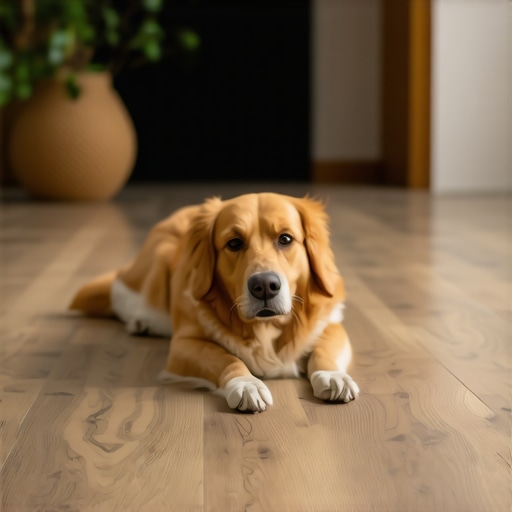
I once walked into a house where a $15,000 wide-plank walnut floor was cupping so bad it looked like a potato chip because the installer didn’t check the crawlspace humidity. The homeowner also had two 100-pound Great Danes that had turned the surface into a topographical map of scratches. It was a total loss. That job taught me that most people do not understand the physics of wood or the chemistry of finishes. They buy for the color and ignore the structural reality of their home. If you have big dogs, you are not just choosing a floor, you are choosing a wear surface that must withstand thousands of pounds of concentrated pressure per square inch from those claws.
The potato chip floor tragedy
The secret to a successful hardwood floor with large dogs starts with understanding the equilibrium moisture content of the wood and the cellular density of the species. Wood is a hygroscopic material, meaning it constantly exchanges water with the environment. When a large dog runs across the floor, their claws exert a mechanical force that can crush the cellular walls of the wood. This is why species choice is the difference between a floor that lasts forty years and one that needs replacement in four. You need a wood with a high Janka rating and a grain pattern that can hide the inevitable micro-abrasions that occur during high-velocity canine activity.
The physics of the canine claw
A dog claw is not a flat object. It is a point-load. When a seventy-pound Labrador pushes off to chase a ball, the force is concentrated on a tiny fraction of an inch. This pressure can exceed several hundred pounds per square inch, which is often higher than the compressive strength perpendicular to the grain of many soft hardwoods. I have seen floors where the finish held up, but the wood beneath it collapsed, creating a dent. This is why we look at the Janka hardness scale, but it is only one piece of the puzzle. You also need to consider the finish chemistry and the subfloor deflection. If your subfloor moves, your finish will crack, and once the finish cracks, moisture from paws or showers can penetrate the wood fibers.
“A floor is only as good as the subfloor beneath it; deflection is the enemy of every joint.” – Master Flooring Axiom
The Janka scale and its practical limits
The Janka hardness test measures the force required to embed a 0.444-inch steel ball to half its diameter into the wood. While a high number like 1820 for Hickory is impressive, it does not tell the whole story. Wood is an organic polymer. Hickory is hard, but it is also unstable when the humidity shifts. If you live in a region with high humidity, that hard Hickory floor might shrink and swell more than a slightly softer White Oak. You have to balance the hardness against the dimensional stability of the species. For homes with large dogs, I generally point people toward White Oak or Hickory, but never toward Walnut or Cherry, which are too soft for significant impact.
Why white oak survives where walnut dies
White oak has a unique anatomical feature called tyloses. These are outgrowths on the parenchyma cells that plug the vessels of the wood, making it nearly impermeable to liquids. This is why white oak is used for wine barrels and ships. In a home with large dogs, this natural resistance to moisture is a critical secondary defense. If a dog comes in with wet paws, the white oak is less likely to absorb that moisture and swell. Walnut, while beautiful, has a much lower Janka rating and a more open pore structure. A Great Dane will turn a walnut floor into shredded wheat in less than a year. I have seen it happen, and it is a painful sight for anyone who appreciates fine woodworking.
The microscopic reality of the wear layer
The finish is your first line of defense. Most modern pre-finished floors use an aluminum oxide finish. This is a microscopic layer of ceramic particles suspended in a UV-cured resin. It is incredibly hard, but it can be brittle. If the wood beneath it is too soft, the wood will dent and the finish will shatter like glass. Site-finished floors usually use a water-based or oil-based polyurethane. Water-based finishes like Bona Traffic HD are my go-to for dog owners. They cure harder than oil-based poly and do not amber over time. More importantly, they have better elasticity, which allows them to flex slightly when a dog claw hits the surface rather than chipping off.
The subfloor and its hidden moisture
Every floor is a system. If you ignore the subfloor, you are wasting your money. I spend more time on my knees with a moisture meter and a level than I do actually laying planks. If your concrete slab is pushing moisture, it will eventually delaminate your floor. I require a moisture barrier on every ground-level job. Even in bathrooms or near showers, the humidity must be managed. If you have tile in those areas, the grout must be sealed to prevent water from migrating under the hardwood in the adjacent hallway. Capillary action is a powerful force, and it will pull water through the smallest gaps, causing the edges of your hardwood to lift and catch on dog claws.
The comparative durability of modern surfaces
| Species/Material | Janka Rating | Stability | Dog Suitability |
|---|---|---|---|
| White Oak | 1360 | High | Excellent |
| Hickory | 1820 | Medium | Very High |
| Black Walnut | 1010 | Medium | Low |
| Laminate (High End) | N/A | High | High |
| Engineered Oak | 1360 | Very High | High |
Maintenance for the high impact household
- Trim dog nails every two weeks to reduce the PSI of the claw impact.
- Use walk-off mats at every entrance to catch grit and sand that act like sandpaper.
- Maintain indoor humidity between 30 and 50 percent to prevent wood shrinkage.
- Use only manufacturer-approved cleaners to avoid breaking down the finish chemistry.
- Never wet-mop a hardwood floor, as standing water ruins the lignin bonds.
The grout and tile alternative
Sometimes the best hardwood floor is actually tile that looks like wood. If you have three massive dogs and a backyard that is mostly mud, you might want to look at porcelain plank. These are fired at such high temperatures that they are nearly vitrified. The grout lines can be kept to 1/16th of an inch with rectified edges, creating a look that mimics real wood without any of the scratching risks. However, for those who insist on the warmth of real timber, you must be prepared for the maintenance. Hardwood is a living product. It will age, and it will develop a patina. If you cannot handle a few scratches, you are better off with a hard surface that doesn’t breathe.
The laminate versus hardwood debate
Laminate has come a long way since the 1990s. High-end laminate is essentially a photographic layer over a high-density fiberboard core, topped with a wear layer of melamine and aluminum oxide. It is technically harder than wood, but it cannot be refinished. Once it is scratched or water-damaged, it is trash. Hardwood, on the other hand, can be sanded and refinished multiple times. For a long-term investment, I always advocate for solid or thick-wear-layer engineered wood. While most people want the thickest underlayment for comfort, too much cushion actually causes the locking mechanisms on LVP or laminate to snap under pressure. You want a firm, flat base. Stability is the foundation of longevity.
“True craftsmanship is found in the preparation, not the presentation; if the subfloor is flat within 1/8 inch over 10 feet, the floor will sing.” – Master Flooring Axiom
The 1/8 inch that ruins everything
If your subfloor has a dip, your hardwood will flex. That flex creates friction. Friction creates heat and noise. Over time, that friction will break the tongue and groove joints. If you add the weight of a large dog running over that dip, you are accelerating the failure. I have seen guys try to fill those dips with cardboard or extra underlayment. It never works. You need a self-leveling compound or you need to grind the high spots of the concrete. It is dusty, miserable work, but it is the only way to ensure the floor doesn’t click like a castanet every time the dog walks across the room. We are building a structural surface, and the physics of load-bearing apply to every square inch of that installation.