
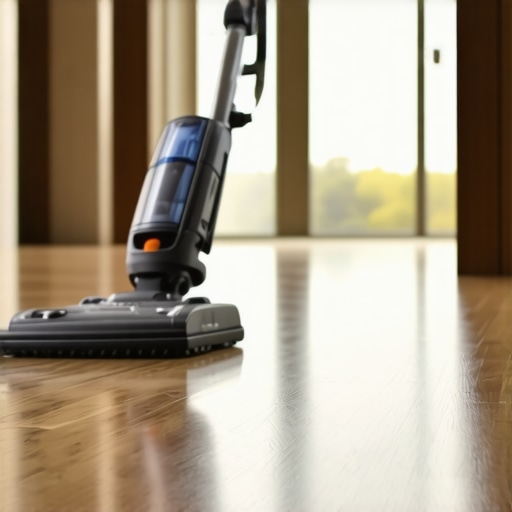
I once walked into a house where a $15,000 wide-plank walnut floor was cupping so bad it looked like a potato chip because the installer didn’t check the crawlspace humidity, but that was only half the tragedy. The homeowners had been trying to fix the ‘look’ of the floor by using a heavy-duty upright vacuum meant for thick shag carpet. By the time I arrived, the beautiful, deep chocolate tones of the walnut were covered in a hazy web of micro-scratches. The smell of mineral spirits and fresh-cut oak usually signals a new beginning, but that day it felt like an autopsy. That is the reality of hardwood maintenance. If you use the wrong tools, you are not cleaning your floor, you are sanding it down one microscopic layer at a time. This guide is about the physics of suction and the chemistry of floor finishes. We are going to look at why most vacuums are weapons of destruction for your poly-coated surfaces.
The microscopic war against your floor finish
Hardwood floor finishes rely on a delicate chemical bond to protect the organic cellular structure of the wood. Whether you have a site-finished polyurethane or a factory-applied aluminum oxide coating, the primary threat is abrasion. Gritty particles like silica and quartz act as sandpaper under vacuum wheels. When a vacuum cleaner moves across your floor, it is not just the suction at work. There is a mechanical interaction between the machine and the surface. Most people think their floor is ‘hard’ because it is wood, but the finish is a thin film, often only a few mils thick. If your vacuum lacks the proper clearance or uses stiff nylon bristles, it will penetrate that film. This creates paths for moisture to enter the wood cells. Once moisture gets in, the wood expands. This causes the edges to lift, a process known as cupping. I have spent years explaining to clients that their ‘clean’ house is actually a construction site because their vacuum is actively stripping the luster from their expensive investments. You need a machine that respects the Janka hardness of the species while managing the airflow required to lift heavy grit from the grain.
Why your vacuum brush roll acts as a weapon
The rotating brush roll is designed to agitate carpet fibers to release trapped soil, but on a hardwood surface, it becomes a high-speed abrasive tool. Most brush rolls use stiff synthetic fibers that spin at thousands of revolutions per minute. This constant impact creates friction heat. When you spin a brush roll on a wood floor, you are essentially buffing it with coarse grit. The National Wood Flooring Association is very clear about this. You want a vacuum that allows you to completely disable the brush roll or one that uses a ‘soft roller’ head. A soft roller uses felt or microfiber to gently sweep the floor while maintaining a seal for suction. Without this, you are just throwing dirt around and scratching the finish. I always tell my apprentices that if you hear a ‘tapping’ sound while vacuuming, you are damaging the floor. That sound is the bristles hitting the wood. It is a sound that signifies the slow death of your floor’s refractive index.
“A floor is only as good as the subfloor beneath it; deflection is the enemy of every joint.” – Master Flooring Axiom
The physics of suction and the Pascal rating
Suction power is measured in Pascals or Air Watts, and for hardwood, you need consistent airflow rather than raw vertical lift. Too much suction can actually be a problem if the vacuum head creates a perfect seal against the floor. This creates a vacuum lock effect. When a vacuum locks to the floor, it can scrape the surface as you try to pull it. You want a machine with adjustable suction or a head design that allows for ‘bleed air.’ This ensures that the vacuum is lifting the dust without dragging its baseplate across the finish. We often talk about ‘water lift’ in the industry, which is the ability of a vacuum to pull a column of water up a tube. For wood floors, high water lift is less important than high CFM (cubic feet per minute). You need the air to move fast enough to carry heavy sand and grit into the canister before it can be ground into the wood by the movement of the vacuum itself.
The Janka scale and surface vulnerability
The Janka hardness test measures the force required to embed a small steel ball halfway into a piece of wood, which dictates how easily your floor will dent. Softwoods like pine or cherry are far more susceptible to vacuum damage than hardwoods like hickory or oak. Understanding where your floor sits on this scale is the first step in choosing maintenance tools. A floor made of American Cherry is beautiful, but it is soft. If you drop a heavy vacuum on it, it will leave a permanent compression mark. A hickory floor is much tougher, but the finish on top is still vulnerable to scratching. No matter the hardness of the wood, the coating is what you are actually cleaning.
| Wood Species | Janka Hardness (lbf) | Vulnerability Level |
|---|---|---|
| Hickory | 1820 | Low |
| Hard Maple | 1450 | Medium-Low |
| White Oak | 1360 | Medium |
| American Cherry | 950 | High |
| Douglas Fir | 660 | Very High |
The ghost in the expansion gap
Every hardwood floor requires an expansion gap at the perimeter to allow the wood to breathe as humidity levels change throughout the year. These gaps are usually hidden by baseboards or shoe molding, but they are prime collectors of fine dust and allergens. A vacuum with poor edge cleaning capabilities will leave these gaps full of debris. Over time, this debris can become compacted, preventing the floor from expanding. I have seen floors buckle and lift off the subfloor because the expansion gaps were clogged with years of pet dander and grit. You need a vacuum with a specialized crevice tool that can reach deep into these margins. It is not just about the middle of the floor. It is about the edges where the structural integrity of the installation is maintained. If you ignore the edges, you are asking for trouble when the summer humidity hits and your floor has nowhere to go.
Why rubber wheels are the only option
Plastic wheels are the primary cause of ‘tracking’ marks on high-gloss hardwood finishes because they tend to skid rather than roll. Over time, plastic wheels can develop flat spots or pick up tiny shards of glass that act like a diamond-tipped scribe. Always look for vacuums with large, soft rubber wheels. Rubber provides the necessary friction to roll consistently without sliding. It also provides a degree of shock absorption. If you have a slightly uneven floor, rubber wheels will glide over the high spots. Plastic wheels will bounce and strike the surface. In my twenty five years of installing, I have never seen a rubber wheel damage a floor. I have seen plenty of plastic wheels leave white streaks that require a full screen and recoat to fix.
“Hardwood floor maintenance is an exercise in preventing the mechanical breakdown of the surface film.” – Master Flooring Axiom
The checklist for a finish safe machine
Selecting a vacuum requires looking past the marketing fluff and focusing on the mechanical specifications of the unit. You are looking for a machine that prioritizes gentle contact and high-velocity airflow over aggressive agitation. Use this checklist before you spend a dime on a new vacuum for your home.
- Rubberized or non-marking wheels to prevent tracking and scratching.
- A dedicated hard floor tool with soft natural bristles like horsehair.
- The ability to manually switch off the brush roll or a soft roller head.
- Adjustable suction power to prevent the vacuum from sealing to the floor.
- High-efficiency particulate air filtration to keep fine dust out of the grain.
- Lightweight design to reduce the force exerted on the wood fibers.
- Long, flexible crevice tools for cleaning expansion gaps and transitions.
The problem with heavy uprights
Heavy upright vacuums exert a tremendous amount of localized pressure on the floor through their small wheels and baseplates. This pressure can cause the wood fibers to compress, especially in softer species like walnut or pine. I prefer canister vacuums for hardwood. A canister vacuum keeps the weight of the motor and dust bin on a separate carriage, while the cleaning head is lightweight and easy to maneuver. This distribution of weight is much safer for the floor. When you use a heavy upright, every time you turn the machine, you are pivoting that weight on a tiny point. That is where the damage happens. If you must use an upright, ensure it has a very low weight profile and excellent weight distribution across its wheelbase.
Filtration and the invisible dust cycle
Standard vacuums often exhaust fine dust back into the air, which eventually settles into the grain of your hardwood and the grout of your tile transitions. This fine dust acts as an abrasive the next time you walk across the floor. HEPA filtration is not just for people with allergies. It is for the health of your floor. When you keep the air clean, you keep the floor clean. Fine silica dust is common in many homes, especially if you have tile or stone nearby. If that dust is not captured by a 99.97 percent efficient filter, it stays in the room. I always check the seals on a vacuum. If air is leaking out of the sides of the machine, the filter is useless. A sealed system ensures that every bit of grit picked up stays in the canister.
The grout and tile transition challenge
Hardwood often meets tile in kitchens and bathrooms, creating a transition point where grout lines can act as traps for debris. A vacuum designed for wood must also be able to pull dirt out of these lower grout channels. Grout is porous and rough. If your vacuum head is too soft, it won’t be able to agitate the dirt out of the grout. This is where a vacuum with high suction and a specialized brush tool comes in. You need to be able to clean the grout without scratching the adjacent wood. It is a balancing act. I have seen many transitions where the wood is scratched because the owner was trying to scrub the grout with a vacuum head. The right tool will have enough ‘reach’ with its bristles to get into the grout while keeping the hard parts of the vacuum head away from the wood. This is the hallmark of a professional-grade cleaning system.
Maintaining the luster for decades
The goal of vacuuming is to extend the time between professional refinishing projects, which can cost thousands of dollars and create a massive mess. By using the right vacuum, you are preserving the chemical integrity of the polyurethane. Think of your vacuum as a maintenance tool, not just a cleaning tool. Every time you remove grit without scratching, you are adding life to your floor. I tell my clients that a three hundred dollar vacuum is a cheap insurance policy for a thirty thousand dollar floor. Do not skip the details. Check your wheels for debris before every use. Clean your brush rolls. Replace your filters. If you treat your vacuum like a precision instrument, your floors will look like they were installed yesterday, even twenty years from now. The sawdust under my nails is a reminder that wood is a living material. It deserves respect. It deserves a tool that won’t tear it apart.