
I once walked into a house where a $15,000 wide-plank walnut floor was cupping so bad it looked like a potato chip because the installer didn’t check the crawlspace humidity. The homeowner was devastated. They thought the floor was ruined forever. I spent three weeks monitoring the moisture levels and slowly bringing the environment back to equilibrium. It taught me that wood is not just a building material. It is a living, breathing organic structure that responds to every change in its environment. When you drop a heavy cast iron skillet on a beautiful white oak plank, you aren’t just making a mark. You are crushing the microscopic cellular architecture of the wood. My hands have felt thousands of these craters over the last twenty-five years. I have spent more time on my knees with a moisture meter than I have at my own dinner table. If you understand the physics of wood, you can fix things that look permanent. Most people think a dent is a permanent loss of material. They are wrong. It is usually just a localized compression of the wood fibers. With the right application of thermodynamics and moisture, you can often bring those fibers back from the dead.
The tragic reality of compressed cellulose
Hardwood floor dents are localized compressions of the cellulose fibers that make up the wood grain. When an object drops, it crushes these microscopic tube-like structures without necessarily breaking them. Using an ice cube and heat creates steam that re-hydrates and expands these fibers back to their original position. Wood is essentially a bundle of straws. These straws are made of cellulose, hemicellulose, and lignin. When you dent the floor, you are folding those straws. As long as the straws are not snapped or torn, they have a memory. They want to return to their original shape. The challenge is that the finish on top of the wood acts as a barrier. It keeps moisture out. To fix the dent, you have to get moisture through that finish and into the wood cells themselves. This is where the ice cube method comes into play. It is a precise way to deliver a controlled amount of water to the exact point of the injury. If you just pour water on the floor, you risk staining the wood or causing the grain to raise in areas that were not damaged. The ice cube provides a slow release that stays exactly where you need it.
Why an ice cube fixes the invisible void
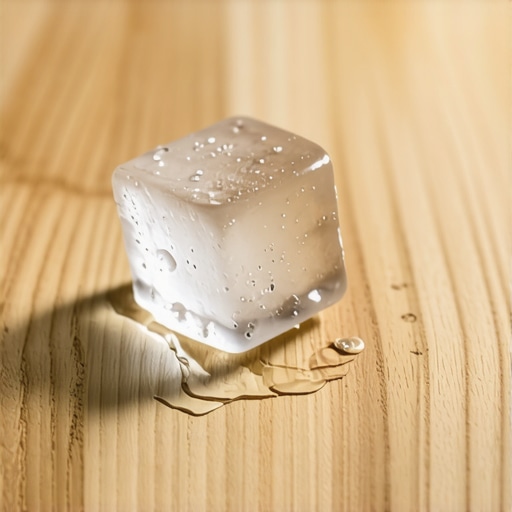
The ice cube trick works because it leverages the phase change of water to drive moisture into the compressed lignin of the wood. By placing an ice cube on a dent, you allow a small amount of liquid water to pool in the depression. When heat is applied, that water turns to steam and penetrates the wood fibers. You have to understand the chemistry of the wood finish. Most modern floors are coated in aluminum oxide or polyurethane. These are plastic-like layers. They are tough, but they are not completely impermeable to gas. When we apply an iron to the wet spot, we are creating a localized steam chamber. This steam has smaller molecules than liquid water. It can wiggle through the microscopic cracks in the finish. Once the steam hits the dry, compressed cellulose, the cells absorb the moisture. This causes them to swell. It is the same principle as a sponge expanding when it gets wet. In a humid place like Houston, the wood is already nearly saturated, so this trick might take longer. In the dry air of Phoenix, the wood is thirsty and will often respond much faster. You are essentially performing a microscopic surgical expansion of the wood grain.
“A floor is only as good as the subfloor beneath it; deflection is the enemy of every joint.” – Master Flooring Axiom
The procedure for steam based recovery
To perform the ice cube trick, place a single ice cube on the dent and let it melt slightly. Place a damp cotton cloth over the spot and apply a hot clothes iron in a circular motion for thirty to sixty seconds. The resulting steam forces the wood fibers to expand and level out. You must be careful with the heat. If the iron is too hot, you can burn the finish or cause it to delaminate from the wood. I always tell people to use a clean white t-shirt. Do not use a colored towel because the heat can transfer the dye from the towel into your floor finish. That is a nightmare you do not want to deal with. You also need to check the dent every few seconds. You are looking for the wood to rise. Sometimes it happens instantly. Sometimes it takes three or four passes. If the wood grain has been severed, meaning the straws are actually broken, this trick will not work perfectly. You will still have a scar. But for a smooth dent where the wood is just pressed down, the results can be near-miraculous. It is about patience and precision. You are a mechanic of the forest floor, and you are using heat to reset the mechanical properties of the plank.
Comparing wood hardness and resilience
| Wood Species | Janka Hardness Rating | Compression Recovery Potential | Acclimation Time Required |
|---|---|---|---|
| White Oak | 1360 | High | 7 to 14 Days |
| Black Walnut | 1010 | Moderate | 10 to 14 Days |
| Brazilian Cherry | 2350 | Low | 14 to 21 Days |
| Sugar Maple | 1450 | Moderate | 7 to 10 Days |
| Douglas Fir | 660 | Very High | 5 to 7 Days |
The Janka scale measures the force required to embed a small steel ball into the wood. This is a direct indicator of how easily a floor will dent. A softer wood like Douglas Fir or Pine will dent if you even look at it wrong. However, because the fibers are less dense, they are much easier to steam back into place. A wood like Brazilian Cherry is so dense that the fibers are packed tight. Once you crush them, they are very stubborn. They do not want to let the steam in. This is why I always prefer working with White Oak. It is the perfect balance of durability and repairability. It is a workhorse. It has large pores that take the steam well. If you have a dent in a very hard wood, you might need to use a needle to make a few microscopic pricks in the finish to help the steam reach the wood cells. It sounds scary, but it is better than looking at a crater in the middle of your living room.
Where the ice cube trick hits a wall
The ice cube trick is completely ineffective on laminate floors because laminate is made of melamine resin and pressurized paper rather than solid wood fibers. Laminate does not have a cellular structure that can expand with moisture; instead, moisture causes laminate to swell and blow out permanently. People often confuse laminate with hardwood. This is a mistake that leads to ruined floors. If you put an ice cube and an iron on a laminate floor, you will destroy the decorative layer. The core of a laminate floor is high-density fiberboard. When that gets wet, it expands in all directions and loses its structural integrity. It will never go back down. The same goes for luxury vinyl plank or LVP. These materials are plastic. Plastic does not have a hygroscopic memory. If you dent LVP, you are stuck with it. You might be able to use a heat gun to soften the plastic and hope it pulls back, but it usually just melts. This is why I always advocate for real wood. Real wood is a legacy product. It can be healed. It can be sanded. It can be steamed. A plastic floor is a disposable product. Once it is damaged, it is garbage.
- Check the finish type before applying heat to avoid clouding.
- Ensure the cloth is damp but not dripping wet to prevent water spots.
- Use a circular motion with the iron to avoid concentrated heat damage.
- Vacuum the dent first to remove any grit that could be pressed into the wood.
- Apply a small amount of wood floor polish after the area dries to restore the sheen.
The ghost in the expansion gap
Floor movement is governed by the relative humidity of the home and the expansion gaps left at the perimeter of the room. When you perform a steam repair, you are introducing a localized spike in moisture that can cause a temporary swell beyond the repair site. Most homeowners do not realize that their floor is moving every single day. In the summer, the planks swell as they soak up moisture from the air. In the winter, they shrink. If your installer did not leave a proper expansion gap under the baseboards, the floor has nowhere to go. It will buckle. When you use the ice cube trick, you are adding water. If you do this on fifty different dents in a small area, you could actually cause the floor to tight-joint. You have to be mindful of the total moisture content. I always keep my hygrometer handy. If the room is already at 60 percent humidity, I am very hesitant to add more water. I might wait for a drier day. The physics of the subfloor also matter. If you have a concrete slab, that moisture you are adding has nowhere to go but up. On a wood subfloor, the moisture can dissipate through the bottom of the plank. These are the things you learn after twenty years of making mistakes.
“Moisture content must be stabilized within 2 percent of the subfloor before any technical repair is attempted.” – NWFA Standard Guidelines
The 1/8 inch that ruins everything
A subfloor that is out of level by more than 1/8 inch over a ten foot span will cause even the best hardwood to flex and eventually crack or dent. This deflection creates air pockets under the wood that make the planks more susceptible to impact damage from falling objects. When a floor is properly supported by the subfloor, it can absorb energy. It is like a drum head. If there is a gap underneath the plank, that plank is unsupported. When you drop something on it, the wood has to take all that force without any backing. This is why most dents happen in the middle of rooms where the subfloor has dipped. I spend more time grinding concrete and pouring self-leveling compound than I do actually laying wood. It is the invisible work that matters. If your floor feels bouncy, it is only a matter of time before you have a dent that an ice cube cannot fix. The structural engineering of the floor system is what determines the longevity of the aesthetic surface. Do not skip the leveling. Do not skip the moisture barrier. And do not think that a thick underlayment will fix a bad subfloor. Too much cushion actually makes the problem worse because it allows the tongue and groove joints to rub together and snap. It is about stability. A stable floor is a repairable floor.