
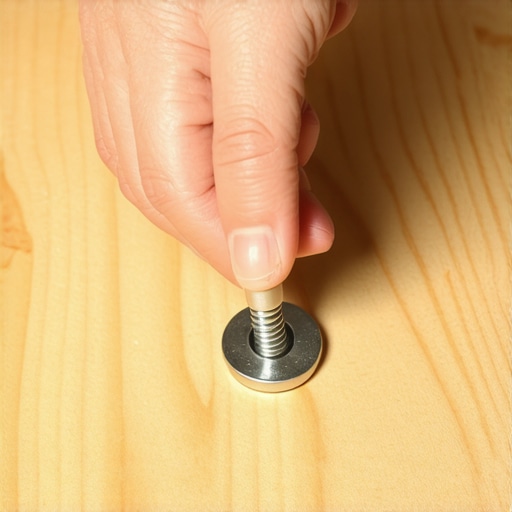
The Magnet Trick for Finding Floor Joists Through Thick Subfloors
Most guys skip the leveling compound. They think the underlayment will hide the dip. It won’t. I spent three days grinding concrete on a job last month just so the floor wouldn’t click like a castanet. That job taught me that shortcuts in the subfloor phase are just expensive mistakes waiting to happen. If you can’t find your joists, you can’t secure your subfloor. If the subfloor moves, your hardwood floors will squeak and your grout will crumble into dust. This is the reality of structural flooring architecture. We do not guess. We measure. We verify. We use physics to solve what the eyes cannot see through two layers of three quarter inch plywood.
The physics of the magnetic fastener hunt
To find floor joists through thick subfloors using the magnet trick, you must locate the steel fasteners that connect the subfloor to the framing. Neodymium magnets detect the screw or nail heads through layers of wood or underlayment, providing a precise map of the underlying structural joist positions. This method relies on the magnetic field of rare earth elements to penetrate dense cellulose fibers. A standard stud finder often gets confused by the density of high quality subfloor materials or the presence of radiant heat loops. The magnet does not lie. It finds the steel. Once you find one fastener, you have found the center of your joist. Then you follow the line. It is simple. It is effective. It saves hours of frustration.
Why standard stud finders fail on heavy timber
Density and thickness are the primary reasons electronic stud finders fail when searching for joists beneath thick subfloors or multiple layers of flooring. Electronic sensors measure changes in capacitance which become scattered and unreliable when the material thickness exceeds three quarters of an inch or contains moisture. When I am prepping a room for solid hardwood floors, I am often dealing with a layer of old pine boards topped with new plywood. No battery operated sensor is going to penetrate that with any degree of accuracy. You will get ghost readings. You will get false positives. You will end up drilling holes in your subfloor like a madman trying to find wood. The magnet trick bypasses the limitations of capacitance. It focuses solely on the ferrous metal of the floor screw. If there is a screw, there is a joist. It is a binary reality. Zero or one. Steel or wood.
“A floor is only as good as the subfloor beneath it; deflection is the enemy of every joint.” – Master Flooring Axiom
The selection of neodymium for structural mapping
Choosing the right magnet strength is the difference between success and a waste of time when mapping out a room for heavy installations. Neodymium magnets with an N52 rating are the industry standard for penetrating thick subfloor materials because they offer the highest magnetic energy product available. I keep a stack of these in my truck. They are small but they can pull the skin off your finger if you are not careful. When you slide an N52 magnet across a subfloor, you will feel a distinct tug when it passes over a fastener head. This is the moment of truth. You mark that spot with a pencil. You move six inches and find the next one. Pretty soon, you have a straight line that tells you exactly where your structural support sits. This is vital when you are installing heavy tile or preparing a base for showers where weight distribution is a matter of life and death for the grout lines.
Hardwood floors and the necessity of joist alignment
Proper alignment of hardwood floors with the underlying joists is critical for preventing board cupping and long term structural noise. Fasteners for solid wood flooring should ideally be driven into the joists to ensure maximum withdrawal resistance and to minimize the vertical movement of the subfloor panels. If you are nailing into just the plywood, you are relying on the grip of a two inch cleat in half an inch of wood. That is not a recipe for success. That is a recipe for a callback in six months when the seasons change and the humidity hits. The NWFA has strict guidelines about this. You need that mechanical bond to the framing. The magnet trick allows you to snap chalk lines across the entire room. You see exactly where the meat of the wood is. You don’t guess where to fire your nail gun. You know.
| Subfloor Material | Thickness (Inches) | Required Magnet Strength | Detection Reliability |
|---|---|---|---|
| Plywood Single Layer | 0.75 | N35 Neodymium | High |
| OSB Double Layer | 1.25 | N52 Neodymium | Moderate |
| Hardwood over Plywood | 1.50 | N52 (Large Surface) | Low to Moderate |
| Cement Board over Plywood | 1.125 | N52 Neodymium | High (Fastener Focus) |
Laminate installations over uneven transitions
Laminate flooring requires a flat substrate to prevent the click lock mechanisms from snapping under the weight of foot traffic. Finding joists allows an installer to pull the subfloor tight to the framing, eliminating the micro-bounces that cause laminate joints to separate over time. People think laminate is easy. They think it is a DIY Sunday project. Then they walk on it and it sounds like a hollow drum. Or worse, the short ends start to gap. This happens because the subfloor has a crown or a dip. You cannot fix a dip with just foam underlayment. You need to screw that subfloor down. You need to find the joists. I have seen guys try to use a hammer to find joists by sound. It is a joke. Use a magnet. Find the fastener. Sink a three inch deck screw. Watch the gap disappear. That is how a pro does it.
The structural chemistry of subfloor adhesives
When we talk about subfloors, we have to talk about the bond. It is not just about the screws. It is about the polyurethane adhesive. When you are building a floor for a high end client, you are looking for a monolithic structure. You want the joist, the glue, and the plywood to become one single unit. This reduces deflection to almost zero. If you are retrofitting an old floor, finding the joists with a magnet allows you to inject adhesive or add sister joists from above if you have to. The chemistry of modern subfloor glue is incredible. It expands to fill gaps. It remains flexible enough to handle the expansion and contraction of the wood fibers. But it only works if the mechanical fasteners are holding the materials in place while the glue cures. The magnet trick ensures your fasteners are actually hitting the joists instead of just hanging in the air of the joist bay.
- Identify the likely joist direction by looking at the exterior foundation or heat registers.
- Clear the subfloor of all debris and sawdust to ensure a smooth sliding surface for the magnet.
- Use a rare earth magnet with at least 25 pounds of pull force for best results.
- Mark every fastener found to reveal the pattern of the framing.
- Cross reference the marks with a tape measure to ensure they follow standard 16 inch or 24 inch spacing.
- Check for doubled joists or headers around stairwells and load bearing walls.
Grout and tile stability on plywood substrates
Tile and grout require a rigid surface with a deflection rating of L/360 or better to prevent cracking and debonding of the ceramic units. Finding joists with magnets is the first step in reinforcing a plywood subfloor to meet these stringent TCNA requirements for stone or tile. If that subfloor moves even a hair, the grout is going to fail. I have walked into too many bathrooms where the grout looks like a spiderweb. The installer just slapped down some cement board and hoped for the best. You have to secure that plywood to the joists. You have to stop the bounce. The magnet trick lets you see the framing through the underlayment. You can add a grid of screws directly into the joists every six inches. This creates the rigidity needed for a high performance tile installation. Without this, you are just throwing money away.
“Deflection is the silent killer of tile installations; if the joist moves, the grout loses.” – Master Flooring Axiom
Shower pans and the structural integrity of the base
Shower installations represent the most technically demanding area of a floor because they must manage both weight and water without structural shifting. Locating the joists ensures that the shower curb and the drain assembly are supported by the primary framing of the house rather than just the subfloor sheathing. Think about the weight of a person, the water, and the mortar bed. It is hundreds of pounds concentrated in a small area. If your joists are spaced too far apart, or if you don’t know where they are, you risk a catastrophic failure of the waterproof membrane. I use magnets to find the joists before I ever lay down a pre-sloped tray or a mud bed. I want to know exactly where the support is. If I need to add blocking, I do it now. The magnet trick gives me the x-ray vision I need to ensure that shower stays leak free for thirty years. No shortcuts. Just physics.
The math of deflection and joist spacing
Understanding the span rating of your joists is the final piece of the puzzle. Most residential floors are built on 16 inch centers. But in older homes, you might find 24 inch centers or even irregular spacing. The magnet trick reveals the truth of the builder’s work. If you find fasteners at 12 inches, you know you have a rock solid base. If you find them at 24 inches, you know you have work to do before you can even think about laying hardwood floors or tile. You have to calculate the load. You have to understand how the wood will react to the weight of your materials. It is a structural engineering challenge. We are not just decorators. We are architects of the walking surface. We use tools that work. We use methods that are proven. We use the magnet trick because it is the most reliable way to bridge the gap between the visible surface and the hidden skeleton of the home.