
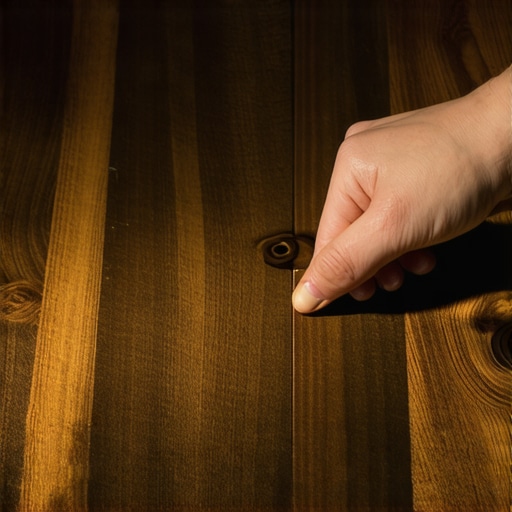
The science of white rings on dark wood
White rings on dark hardwood floors indicate that moisture has become trapped within the protective finish layer rather than the wood itself. When a cold glass or a wet cloth sits on a surface, condensation penetrates the polyurethane or wax, creating a cloudy appearance as it disrupts the refractive index of the coating. This is a surface level issue that differs significantly from black stains, which signal that moisture has reached the cellulose fibers of the timber and reacted with the tannins. Most homeowners panic when they see these milky blemishes, but the physics of the finish often allow for a non-destructive remedy if the moisture can be displaced by oil.
I once walked into a house where a $15,000 wide-plank walnut floor was cupping so bad it looked like a potato chip because the installer didn’t check the crawlspace humidity. The homeowner was focused on a single water ring from a flower pot while the entire structural integrity of the room was failing from below. It is a classic case of missing the forest for the trees. I spent three decades with a moisture meter in my pocket, and I have learned that while the surface matters, the chemistry of the finish determines how you fix it. You cannot treat a site-finished oil floor the same way you treat a factory-finished aluminum oxide coating. One accepts oil, the other repels it. Knowing the difference saves you a sanding bill. It will save your floor.
Why mayonnaise actually works on a molecular level
Mayonnaise serves as a lipid-based solvent that works to displace trapped moisture molecules within a hardwood finish through a process of osmotic equilibrium. Because mayonnaise is an emulsion of oil and egg yolks, it possesses the right viscosity to sit on the surface without evaporating, allowing the non-polar fatty acids to seep into the microscopic pores of the finish. As the oil enters these gaps, it pushes out the water vapor that caused the cloudiness. This is not magic. It is basic hydrophobic displacement. If the finish is too hard, such as a high-build acid-cure finish, the mayo trick will fail because the molecules cannot penetrate the shield.
“A floor is only as good as the subfloor beneath it; deflection is the enemy of every joint.” – Master Flooring Axiom
The tragedy of the unacclimated wide plank
I remember a job in the humid heat of a coastal summer where the contractor rushed the acclimation period for a solid hickory installation. Hickory is a stubborn species with a Janka hardness that makes it a nightmare to sand, but it is also incredibly sensitive to ambient relative humidity. They slapped the planks down, nailed them tight, and within two weeks, the floor was screaming. Every joint was tight as a drum until the air conditioning kicked on. Then the shrinkage started. You could see the tongue and groove gaps from the hallway. This is why the moisture content of the subfloor must be within 2 percent of the hardwood before the first nail is driven. If you ignore the equilibrium moisture content, no amount of mayonnaise or surface buffing will save the structural failure happening at the fastener level.
| Wood Species | Janka Hardness (lbf) | Stability Rating | Common Finish Type |
|---|---|---|---|
| White Oak | 1360 | High | Polyurethane |
| Black Walnut | 1010 | Medium | Oil/Wax |
| Hickory | 1820 | Low | Aluminum Oxide |
| Brazilian Cherry | 2350 | High | Conversion Varnish |
Distinguishing between finish types and moisture depth
Polyurethane and oil-based varnishes react differently to hydrostatic pressure and topical spills depending on their cross-linking density. Modern water-based finishes are thinner and more breathable, which sometimes allows moisture to escape on its own, but they are also more prone to tannin pull if the sealer was not applied correctly. To test your finish, find an inconspicuous spot and drop a small amount of water. If it beads, you have a hard finish. If it soaks in, you have a penetrating oil or a worn-out wax. The mayo trick is most effective on lacquer and older shellac finishes where the moisture is caught in the upper 1/1000th of an inch of the coating.
- Inspect the ring for color, white is surface moisture, black is deep rot.
- Clean the area with a pH-neutral hardwood cleaner to remove wax buildup.
- Apply a full-fat mayonnaise to the ring, covering it completely.
- Let the emulsion sit for at least four hours, or overnight for stubborn spots.
- Wipe clean and buff with a microfiber cloth to restore the sheen.
Hardness and resilience on the Janka scale
The Janka Hardness Scale measures the force required to embed a 0.444-inch steel ball halfway into a piece of wood, which is the primary metric for dent resistance. While many believe a harder wood is always better, structural stability often decreases as hardness increases. For instance, Brazilian Cherry is incredibly hard but can be a nightmare to keep stable in environments with fluctuating HVAC settings. When you are dealing with water rings, the hardness of the wood is secondary to the elasticity of the finish. A brittle finish will crack under the micro-expansion of the wood fibers, creating more pathways for moisture to enter and cause those white clouds. While most people want the thickest underlayment, too much cushion actually causes the locking mechanisms on LVP to snap under pressure, and similarly, too many layers of finish make hardwood more prone to visible scratching and moisture trapping.
“Wood is a hygroscopic material that constantly seeks balance with its environment; ignore the humidity, and you ignore the life of the floor.” – Master Flooring Axiom
The ghost in the expansion gap
Every floor needs to breathe, but most installers treat the perimeter expansion gap as an afterthought. I have seen baseboards installed so tight against the wood that the floor has nowhere to go when the humidity rises. This leads to buckling and end-joint peaking. If your floor cannot move horizontally, it will move vertically. This stress creates micro-fissures in the finish. When you spill water or even just mop with too much liquid, the water travels through these fissures. This is often the hidden cause of water rings that seem to appear out of nowhere. It is not always a glass of water. Sometimes it is the vapor pressure coming up from a damp crawlspace, pushing through the wood and getting trapped under the film. You must ensure the subfloor moisture barrier is rated for the specific perm rating required by the NWFA standards. Otherwise, you are just masking a systemic problem with a kitchen condiment.