
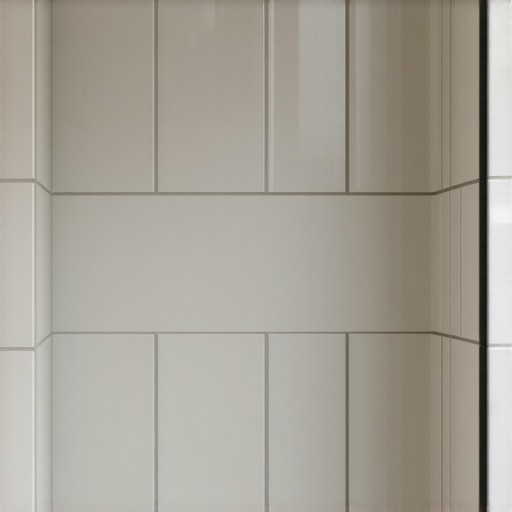
The 1/8 inch that ruins everything
To tile a shower niche without raw edges you must master the 45 degree miter cut or use factory finished bullnose tiles. Mitering involves removing the clay or porcelain body from the back of the tile at an angle. This allows two finished faces to meet at a sharp corner. Most guys skip the leveling compound. They think the underlayment will hide the dip. It won’t. I spent three days grinding concrete on a job last month just so the floor wouldn’t click like a castanet. The same logic applies to your shower walls. If your studs are out of plumb by even a fraction of an inch, your niche will look like a trapezoid. You cannot hide bad framing with expensive tile. I have seen fifteen thousand dollar marble installs ruined because the installer did not take a power plane to the studs. You have to get the skeleton right before you worry about the skin. A shower niche is a structural engineering challenge disguised as a shelf. It must slope exactly one eighth of an inch toward the drain to prevent standing water. If water sits, the grout will eventually soften and the bond will fail at a molecular level.
The geometry of a leak proof niche
Achieving a clean shower niche edge requires a diamond blade wet saw and a steady hand for back-buttering. The physics of water tension means that any flat surface in a shower will hold moisture. Mitering the edges creates a tight joint that reduces the area where grout can erode. When you are cutting a 45 degree angle on a porcelain tile, you are essentially performing surgery. Porcelain is dense. It is fired at temperatures exceeding 2000 degrees Fahrenheit. This makes it brittle. If your saw blade is dull, it will vibrate. That vibration causes micro-fractures in the glaze. Those fractures will eventually absorb body oils and soap scum, turning your beautiful white edge into a gray mess. You need a continuous rim diamond blade and a constant flow of cold water to keep the friction heat from cracking the edge. I always tell my apprentices that if they can’t see their reflection in the water on the saw bed, the water is too dirty to cut finishing pieces. Dirt in the water acts like sandpaper on the glaze.
“A floor is only as good as the subfloor beneath it; deflection is the enemy of every joint.” – Master Flooring Axiom
The chemical bond of modified thin set
The success of a mitered edge depends entirely on the polymer content of your thin set mortar. High performance mortars use long chain polymers to create a flexible bridge between the tile and the substrate. This prevents the mitered point from snapping during house settling or thermal expansion. You cannot use standard mastic for this. Mastic is an organic adhesive that will re-emulsify in the presence of moisture. For a niche, you need an ANSI A118.4 or A118.15 compliant mortar. This stuff is engineered. It contains dry resins that activate when you add water. These resins wrap around the microscopic pores of the tile. When the water evaporates, those resins harden into a plastic-like lattice. This is what holds your miter together. If you use cheap mud, your miter will open up within two years. You will see a hairline crack. Then you will see mold. Then you will be calling me to rip out your shower. I hate ripping out showers because someone wanted to save twenty dollars on a bag of thin set.
| Edge Method | Durability | Complexity | Visual Impact |
|---|---|---|---|
| Mitered Edge | High | Extreme | Invisible/Clean |
| Bullnose Tile | High | Low | Traditional |
| Metal Profile | Medium | Medium | Modern/Industrial |
| Polished Edge | Medium | High | Minimalist |
Why wood floors fail near wet rooms
Hardwood floors and laminate require a strict moisture barrier when they sit adjacent to a tiled shower area. The vapor pressure from a hot shower can migrate through the wall and condense on the underside of the wood planks. This leads to cupping and crowning of the hardwood. I have seen beautiful oak floors ruined because the installer forgot to use a silicone transition at the door. If you are running laminate, you need to understand that it is essentially a photograph of wood glued to sawdust. It hates water. If your shower niche leaks through the wall, your laminate will swell like a sponge. You must maintain an expansion gap of at least one quarter inch at every vertical obstruction. Do not fill this gap with grout. Grout does not move. If the house shifts, the grout will crush the edge of the laminate or hardwood. Use a color matched 100 percent silicone sealant. It remains elastic. It allows the floor to breathe while keeping the water out. This is basic physics that most weekend warriors ignore.
The role of the substrate and waterproofing
A shower niche must be integrated into the primary waterproofing membrane to prevent subfloor rot. Whether you use a liquid applied membrane or a sheet membrane, the niche must be a continuous part of the envelope. Any break in this seal will allow water into the wall cavity. I prefer a topical sheet membrane. It has a specific perm rating that measures how much water vapor can pass through it. You want that number to be as close to zero as possible. When you are wrapping the corners of a niche, you cannot have a build up of material. If you have three layers of membrane overlapping in the corner, your tile will kick out. It will look like a hack job. You have to be surgical with your folds. Think of it like gift wrapping a box from the inside out. If the corners are bulky, your mitered tile will never sit flush. You will be fighting the physics of the material for the rest of the day. I have spent hours with a razor knife just trimming excess membrane so my tiles would lay flat. It is the difference between a pro and a guy with a truck.
“Tile is a decorative wear layer; the waterproofing is the actual shower.” – Master Flooring Axiom
- Check studs for plumb using a six foot level before niche installation.
- Slope the bottom shelf of the niche exactly 1/8 inch for drainage.
- Use a 200 grit diamond polishing pad to smooth mitered edges.
- Apply waterproofing membrane to all niche surfaces and corners.
- Ensure a 95 percent mortar coverage on the back of every tile.
- Clean grout joints thoroughly before the mortar sets to prevent staining.
The ghost in the expansion gap
Expansion gaps are the most misunderstood part of flooring and tile installations. In a shower niche, the joint where the niche meets the main wall is a change of plane. According to TCNA guidelines, every change of plane must be a movement joint. This means you do not put grout in the corners of the niche. You use caulk. If you put grout there, it will crack. It is not a matter of if, it is a matter of when. The wood framing behind the tile expands and contracts with the seasons. It moves at a different rate than the tile and the mortar. If the joint is rigid, something has to break. Usually, it is the grout. Then water gets behind the tile. Then the mold starts. People think caulk looks cheap. I tell them that a crack looks cheaper. You can find high quality siliconized acrylics that match your grout color perfectly. It is a small price to pay for a shower that lasts thirty years. I am a stickler for this because I have seen the damage that a tiny crack can do to a subfloor over a decade. It is slow and it is silent.
The 200 grit diamond polish secret
Polishing the edge of a mitered tile with a diamond pad removes the micro-burrs left by the wet saw. This creates a soft, factory-like edge that is safe to the touch. Without polishing, a mitered corner can be as sharp as a razor blade. You start with a lower grit like 50 if you need to move material. But for finishing, you want 200 or 400 grit. You run the pad at a slight angle along the sharp point. This is called ‘easing the edge.’ It makes the joint look like a single piece of stone. It also gives the grout or sealant a better surface to bond to. If you leave the edge sharp, the glaze is unsupported. It will chip if you hit it with a shampoo bottle. I have spent whole afternoons just polishing edges. It is tedious work. My hands are usually numb by the end of it. But when the light hits that niche and you can’t see where one tile ends and the other begins, it is worth the effort. That is the mark of a master. It is not about speed. It is about the chemistry and the physics of the build. Don’t let anyone tell you otherwise.