
The drum effect in your living room
A hollow sounding laminate floor occurs when an air pocket exists between the plank and the subfloor. This is caused by subfloor unevenness, improper underlayment, or lack of expansion gaps. Fixing it involves injecting specialized floor repair adhesives or re-leveling the subfloor to eliminate the resonant chamber.
Most guys skip the leveling compound. They think the underlayment will hide the dip. It won’t. I spent three days grinding concrete on a job last month just so the floor wouldn’t click like a castanet. The homeowner thought I was crazy until they saw the white dust covering my respirator. But that dust is the price of a silent floor. When you walk across a floor and it sounds like a hollow drum, you are hearing the failure of prep work. It is the sound of a shortcut. Laminate is a floating floor system, which means it relies on the gravity and the flatness of the substrate to maintain its integrity. Unlike hardwood floors that are nailed or glued directly to the joists, laminate sits on a thin cushion. If that cushion is spanning a canyon, even a canyon only an eighth of an inch deep, you will hear it every time your heel hits the surface. This is not just an acoustic annoyance. It is a mechanical stressor that will eventually snap the click-lock tongues and grooves, leading to board separation and moisture intrusion.
Why your subfloor is lying to you
Subfloor flatness is the most ignored variable in flooring. Most manufacturers require a flatness of 1/8 inch over a 10-foot radius. If your concrete or plywood has a dip deeper than this, the laminate planks will bridge the gap, creating a pocket of air that resonates when stepped on.
You need to understand the physics of the bridge. When a laminate plank, which is composed of high-density fiberboard, or HDF, is suspended over a low spot, it becomes a structural member under tension. The weight of a human body deflects that HDF downward into the void. This creates a puff of air that escapes the joints, often carrying fine dust with it. Over time, this repeated deflection weakens the chemical bonds of the resin holding the wood fibers together. If you have ever seen grout in showers crack because of subfloor flex, you know that rigidity is a lie. Everything moves. But in flooring, we control where that movement happens. We want movement at the expansion joints at the walls, not vertically in the middle of the room. I have seen million-dollar homes where the installer didn’t bother to check the slab with a straight edge, and the resulting floor felt like walking on a trampoline. It is a disgrace to the trade. You must use a 10-foot straight edge to identify these valleys before the first plank ever touches the ground.
“A floor is only as good as the subfloor beneath it; deflection is the enemy of every joint.” – Master Flooring Axiom
The 1/8 inch that ruins everything
Precision measurements are the difference between a high-end installation and a DIY disaster. Using a laser level or a long box level to find high and low spots is mandatory. Any deviation beyond the 1/8 inch threshold must be addressed with self-leveling underlayment or grinding.
Let’s talk about the molecular reality of these gaps. When we speak of 1/8 of an inch, we are talking about the thickness of two pennies. That is all it takes to ruin the acoustic profile of a room. If you are working on a concrete slab, you are dealing with moisture vapor transmission rates. Concrete is a sponge. It breathes. If you have a hollow spot, that air pocket can trap moisture, leading to mold growth and the softening of the HDF core. While hardwood floors might be more forgiving of slight undulations because of their mass, laminate is light. It is a high-frequency resonator. If the subfloor is plywood, you might have a joist that has crowned or a subfloor sheet that has delaminated. These are structural failures that a thin piece of foam underlayment will never fix. You have to get down on your knees and find the source of the lie.
Surgical repairs with adhesive injections
Injecting a specialized, low-expansion floor repair adhesive is the most effective way to fix a hollow spot without ripping up the entire floor. You drill a tiny 1/16 inch hole in the tongue of the plank and pump in the resin to fill the void.
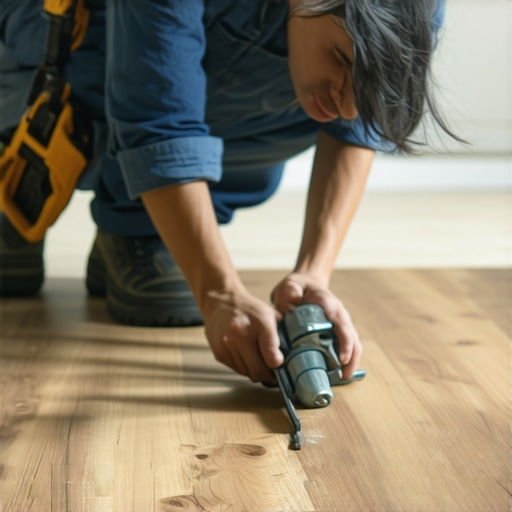
This is where the chemistry comes in. You cannot just use wood glue or construction adhesive. You need a polyurethane-based resin that remains slightly flexible after it cures. Why? Because a floating floor must be allowed to expand and contract with the seasons. If you create a rigid pillar of glue, you have created a hard point. When the humidity hits 70 percent in the summer, the rest of the floor will expand, but that glued spot will stay put. This causes the floor to buckle or peak around the repair. I use a 14-gauge needle and a high-pressure syringe. You find the center of the hollow sound, apply blue painter’s tape to prevent surface damage, and drill through the tape. As you inject the resin, you will feel the resistance change as the void fills. Once the resin is in, you must weight the area down with at least 40 pounds of weight for 24 hours. I usually use boxes of flooring or buckets of joint compound. This forces the plank into the adhesive and ensures a solid bond to the substrate. [IMAGE_PLACEHOLDER_1]
| Repair Method | Tool Required | Effectiveness | Cost Factor |
|---|---|---|---|
| Adhesive Injection | Syringe and 1/16 Drill | High for spots | Low |
| Perimeter Trimming | Oscillating Saw | Medium | Low |
| Full Re-installation | Floor Pull Bar | Absolute | High |
Expansion gaps and the perimeter pinch
A hollow sound is often caused by the floor being pinned against a wall or a heavy kitchen island. If the floor cannot move horizontally, it will bow upward, creating a gap between the plank and the subfloor. Trimming the edges restores the floor’s flat profile.
I have lost count of how many times I have seen a beautiful floor ruined because the installer didn’t leave a 1/2 inch gap at the drywall. They think the baseboard will cover it, so they push the planks tight against the plate. Then the humidity changes. The wood fibers in the HDF core absorb microscopic water droplets and expand. Since the floor has nowhere to go horizontally, it goes up. It becomes a bridge. This is why your floor sounds hollow near the walls or transitions. You take an oscillating saw and you cut back that edge. You give the floor room to breathe. It is like a lung. If you constrict it, it will fail. This is especially true in regions with high seasonal swings in humidity. A floor installed in the dry winter will grow significantly by July. If you don’t account for that, you will be calling me to fix your hollow clicks and your popped seams.
- Check the perimeter for contact with walls.
- Verify that heavy cabinets are not sitting on top of the floating floor.
- Ensure T-moldings have at least 1/4 inch of play on either side.
- Use a moisture meter to check for HDF swelling.
- Inspect the locking mechanisms for signs of stress whitening.
When the underlayment fails the pressure test
Too much cushion is just as bad as no cushion. If you use an underlayment that is too thick or too soft, it will compress under load, creating a temporary hollow sound and putting immense pressure on the click-lock joints.
People always want the thickest, softest underlayment because they think it will feel like carpet. That is a fundamental misunderstanding of flooring engineering. A floating floor needs a high-density, low-compressibility underlayment. If the underlayment is too squishy, the tongue of the plank acts like a lever every time you step on it. It pries against the groove of the neighboring plank. Eventually, that tongue will snap. Once the tongue snaps, the boards move independently, and you get a clicking sound that is even worse than a hollow sound. You want an underlayment with a high PSI rating. It should be firm to the touch. In high-rise condos, we often have to use cork or specialized rubber mats to meet sound-dampening codes, but even those are dense. They don’t give like a sponge. If your floor feels like a marshmallow, you have the wrong underlayment, and no amount of glue injection will fix a systemic failure of the cushion layer.
“Moisture vapor emission rate must not exceed 3 pounds per 1,000 square feet per 24 hours for most laminate installations.” – NWFA Technical Standard
Structural chemistry of flooring repairs
The molecular composition of the HDF core determines how it reacts to these repairs. The core is made of wood fibers compressed with urea-formaldehyde or melamine-formaldehyde resins. These resins are sensitive to heat and moisture. When you drill into a plank, you are breaking those bonds. This is why the hole must be as small as possible. The adhesive you inject must have a low VOC content and be compatible with the resins used in the manufacturing of the board. If you use a solvent-based adhesive, you risk melting the core or delaminating the wear layer. The wear layer itself is usually an aluminum oxide coating, which is incredibly hard but also brittle. If the floor is flexing too much, the aluminum oxide will develop micro-fractures. You can’t see them with the naked eye, but they will allow dirt and moisture to penetrate the decorative paper layer, leading to staining. Fixing the hollow sound is about protecting the chemistry of the entire stack, from the wear layer down to the vapor barrier on the slab. It is an engineering challenge that requires a precise, calculated approach to ensure the longevity of the installation.