
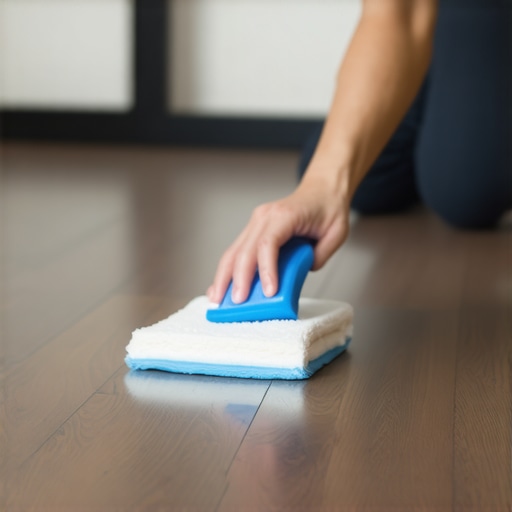
I spent twenty years looking at floors that homeowners ruined with so called miracle cleaners found on the internet. Last month, I walked into a kitchen where the owner used a steel wool pad on a high gloss laminate to try and remove a heel mark. It looked like someone had dragged a snowplow across the surface. People forget that laminate flooring is not wood. It is a photograph of wood glued to a high density fiberboard core and then soaked in melamine resin. When you scratch that, you are scratching plastic and aluminum oxide. I once saw a homeowner try to buff out a scratch on a cheap laminate with a wire brush and they ended up eating right through the decorative layer into the sawdust core. You have to understand the chemistry of what you are walking on before you start rubbing chemicals into it.
The hidden science of surfactants and laminate surfaces
Shaving cream works on laminate floor scuffs because it contains mild surfactants and stearic acid that emulsify the rubber or plastic residue left by shoes. The foam lifts the foreign material away from the aluminum oxide wear layer without dissolving the melamine resin or damaging the photographic decorative layer beneath. Most people think a scuff is a scratch. It is not. A scuff is an additive mark where material from a shoe sole or furniture leg has transferred onto the floor. To remove it, you need a substance that can break the bond between that rubber and the floor surface. Shaving cream is essentially a very concentrated, pH balanced soap with a high air content. The surfactants in the foam surround the molecules of the scuff mark. This allows the rubber to be lifted into the foam structure. Because most shaving creams are designed to be gentle on human skin, they lack the harsh solvents that would otherwise dull the finish of your floor. You are looking for emulsification, not abrasion.
Why your subfloor determines the life of your wear layer
A stable subfloor prevents the microscopic shifting that makes laminate floors more susceptible to surface scuffs and joint failure over time. When a subfloor has more than three sixteenths of an inch of deflection over ten feet, the locking mechanisms rub together and create friction heat. This heat can actually soften the melamine top coat, making it easier for rubber boots or furniture to leave permanent marks. I always tell my clients that a floor is only as good as what is under it. If your subfloor is wavy, your laminate is going to flex. That flexing causes the planks to rub against each other. This is why you see those white lines at the edges of old laminate. It is not dust. It is the floor literally grinding itself into powder. If you want your laminate to last, you stop the bounce before you lay the first plank. We use self leveling compounds and grinders to ensure a flat plane because flat floors do not move, and floors that do not move do not scuff as easily.
“A floor is only as good as the subfloor beneath it; deflection is the enemy of every joint.” – Master Flooring Axiom
The mechanical action of the aluminum oxide wear layer
Laminate flooring utilizes a wear layer made of aluminum oxide which ranks just below diamond on the Mohs scale of mineral hardness. This layer is designed to resist scratching but its crystalline structure can trap rubber particles from shoes which creates the appearance of a scuff. When you apply shaving cream to this surface, the foam penetrates the microscopic valleys of the aluminum oxide. The surfactants lower the surface tension of the water in the cream, allowing it to get under the rubber mark. You must use a white, foaming shaving cream rather than a gel. Gels contain different polymers that can leave a hazy film on the melamine. The goal is to let the foam sit for approximately three minutes. This gives the stearic acid time to soften the rubber. Then, you use a microfiber cloth to buff the area in a circular motion. The microfiber acts as a collection of tiny hooks that grab the softened rubber and pull it away from the floor.
A comparison of wear layers and durability ratings
| AC Rating | Usage Environment | Wear Layer Thickness | Durability Level |
|---|---|---|---|
| AC1 | Home Bedrooms | Lower Density | Low |
| AC2 | Dining Rooms | Medium Density | Moderate |
| AC3 | Heavy Residential | High Density | High |
| AC4 | General Commercial | Reinforced | Very High |
| AC5 | Heavy Commercial | Industrial Grade | Maximum |
How to apply the foam without ruining your HDF core
Applying shaving cream to a laminate floor requires precision to ensure that no moisture seeps into the expansion gaps or the click lock joints between the planks. If water from the cream reaches the high density fiberboard core, the wood fibers will swell and cause permanent peaking. Laminate is essentially a sponge wrapped in plastic. The top is waterproof, but the sides and bottom are extremely vulnerable. When you apply the shaving cream, you only put it on the center of the plank where the scuff is located. Do not spray it directly onto the seams. Use a small amount, about the size of a golf ball. Use your finger to spread it over the mark. If you get moisture into those joints, the HDF core will expand. Once that core swells, it never goes back down. You will end up with raised edges that will catch on your socks and eventually chip away. This is why we never recommend laminate for showers or wet rooms. The humidity levels in a bathroom will destroy the structural integrity of the floor within months.
The danger of moisture in the expansion gap
The expansion gap at the perimeter of a room is the most critical part of a laminate installation because it allows the floor to breathe during seasonal humidity changes. Blocking this gap or allowing moisture to sit in it will cause the floor to buckle or the joints to snap. I have seen people try to caulk their laminate floors to make them waterproof. That is a death sentence for the floor. The floor needs to move. In a high humidity environment like Houston, that floor might expand a quarter of an inch across a room. In a dry climate like Phoenix, it will shrink. If you use too much liquid when cleaning scuffs, that liquid migrates to the edges. It gets under the baseboards and into the expansion gap. From there, it attacks the raw HDF core from the side. This leads to the floor lifting off the subfloor. Always keep your cleaning methods dry or damp at most.
Laminate versus hardwood floors in high traffic zones
Hardwood floors offer a longevity that laminate cannot match because they can be sanded and refinished multiple times to remove deep scratches and gouges. Laminate is a disposable floor that relies entirely on its thin wear layer for protection against the elements and foot traffic. While you can buff a scuff out of laminate with shaving cream, you cannot fix a deep scratch. If a rock gets caught in your shoe and you gouge a hardwood floor, I can sand that out and make it look new. If you do that to laminate, you have to replace the entire plank. This is why the subfloor preparation is even more vital for laminate. Any movement in the subfloor increases the risk of the wear layer cracking. Hardwood floors are more forgiving of subfloor imperfections because the wood itself has structural strength. Laminate is just a shell. It relies on the concrete or plywood beneath it to provide all the support.
Essential checklist for removing floor scuffs
- Identify if the mark is a scuff or a deep scratch in the melamine.
- Select a white foaming shaving cream with no added dyes or perfumes.
- Apply a golf ball sized amount of foam directly to the scuff mark only.
- Wait exactly three minutes for the surfactants to emulsify the rubber residue.
- Use a clean microfiber cloth to buff the area in a firm circular motion.
- Wipe the area with a dry cloth immediately to remove any residual moisture.
- Check the seams of the planks to ensure no foam or water entered the joints.
The relationship between grout and laminate transitions
Transitions between laminate flooring and tiled areas require a T molding that allows for independent movement of the two different floor systems. Using grout to fill the gap between laminate and tile is a common mistake that leads to cracked joints and moisture intrusion. Grout is a rigid material. It does not flex. Laminate is a floating floor system that is constantly shifting. When you put grout against laminate, the floor will eventually push against the grout and crack it. Or worse, the grout will hold the laminate in place, preventing it from expanding. This causes the floor to bubble up in the middle of the room. Always use a proper transition strip. If you are worried about the look of a bulky molding, look for slim profile metal transitions that anchor to the subfloor. This keeps the laminate edges protected while allowing the floor to move as the temperature changes.
“A floor is a performance surface; if you treat it like a rug, it will fail you when the seasons change.” – Master Flooring Axiom
The physics of the aluminum oxide wear layer
Aluminum oxide is added to the melamine resin during the manufacturing process to create a surface that is incredibly resistant to the friction of daily foot traffic. This mineral is what gives laminate its AC rating and determines how many thousands of revolutions it can withstand before the pattern is worn away. The thickness of this layer is measured in mils. A high end commercial laminate might have a wear layer that is significantly thicker than a budget apartment grade product. When you are buffing out a scuff, you are interacting with these microscopic mineral crystals. They are jagged on a molecular level, which is why they grab rubber so easily. The shaving cream acts as a lubricant. It fills the gaps between the crystals, allowing the rubber to slide off. If you use something too abrasive, you actually round off the edges of those crystals, which dabs the finish and makes it look dull. Shaving cream is just soft enough to clean without damaging that mineral shield.