
Most guys skip the leveling compound. They think the underlayment will hide the dip. It won’t. I spent three days grinding concrete on a job last month just so the floor wouldn’t click like a castanet. While I was there, the homeowner showed me the shower. Black mold was eating the corners. They thought it was a cleaning issue. I knew it was a structural failure of the grout and a lack of proper moisture management. That is when I pulled out the tea tree oil. This job is about more than just what looks good on the surface. It is about the physics of the home. I have spent 25 years on my knees with a moisture meter. I have seen what happens when a 15,000 dollar wide plank walnut floor cups because someone ignored a shower leak. You have to treat the shower corner like a structural joint, not a decorative line.
The microscopic war inside your shower corners
Tea tree oil and fungicidal properties of terpinen-4-ol provide a natural barrier against mold spores and mildew growth in grout lines and silicone joints within high-moisture shower environments. Mold is not just a stain, it is a biological organism that feeds on the organic matter trapped in your grout. When you use tea tree oil, you are attacking the mold at a cellular level. The oil penetrates the porous surface of the grout, which is essentially a hardened sponge. Most homeowners do not realize that grout is cementitious. It has tiny holes, or voids, created during the hydration process of the cement. These voids are the perfect breeding ground for mold if they are not properly treated or sealed. If you let mold take root, it will travel through the grout and reach the backer board. Once it hits that substrate, you are looking at a full tear-out.
Why grout is a porous betrayal of your subfloor
Cementitious grout acts as a capillary network that allows moisture migration to reach the waterproofing membrane or the subfloor structure if sealants are compromised. I have seen guys use standard sanded grout in a shower and then wonder why the subfloor in the hallway is rotting. The water moves through the grout via capillary action. It is the same physics that allows a tree to pull water from its roots to its leaves. In a shower, the water moves from the wet surface into the dry wall cavity. Tea tree oil acts as a hydrophobic agent. It helps repel the water while the antiseptic properties kill the spores. You cannot just spray it on and walk away. You need to integrate it into a maintenance routine that respects the chemistry of the tile installation. If the grout is cracked, the tea tree oil is just a band-aid on a bullet wound. You need structural integrity first.
“A floor is only as good as the subfloor beneath it; deflection is the enemy of every joint.” – Master Flooring Axiom
Tea tree oil as a chemical barrier for tile joints
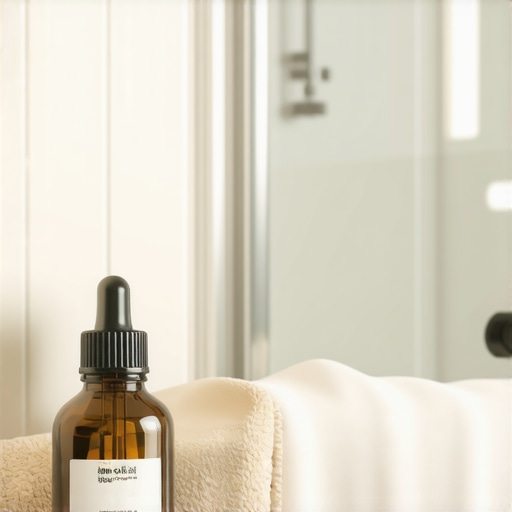
Natural fungicides like Melaleuca alternifolia oil serve as an effective alternative to harsh chemical cleaners and bleach when maintaining shower hygiene and grout longevity. Bleach is actually the enemy of grout. It breaks down the polymer chains in modified thin-sets and grouts, making them more brittle over time. Tea tree oil is different. It is an essential oil that does not degrade the cement matrix. I recommend a mixture of two teaspoons of tea tree oil to two cups of water. You put this in a spray bottle and hit the corners after every shower. The goal is to keep the concentration of terpinen-4-ol high enough to prevent the germination of mold spores. It smells better than a public pool, and it actually works with the materials instead of against them. I have seen shower corners stay pristine for a decade using this method, even in the humid climates of the South where the air is thick enough to drink.
The physics of moisture migration through laminate transitions
Laminate flooring requires a silicone-filled expansion gap at shower thresholds to prevent hydrostatic pressure from causing core swelling or joint peaking. People buy this stuff thinking it is waterproof. It is not. The top layer is a plastic wear layer, but the core is usually high-density fiberboard, which is just fancy talk for compressed sawdust and glue. If you have a shower leak and that water travels under the transition strip, your laminate floor is done. It will swell like a sponge. I always tell clients to treat the area between the tile and the laminate as a critical failure point. You need a 1/4 inch expansion gap, and you need to fill that gap with 100 percent silicone. Adding a few drops of tea tree oil into the cleaning solution for the surrounding floor can help keep any stray moisture from becoming a mold farm under the transition molding. It is about layers of protection.
Hardwood floors and the splash zone reality
Solid hardwood and engineered wood flooring are highly hygroscopic materials that react to ambient humidity and direct water contact by cupping or crowning near bathroom entries. If you are determined to have oak or maple right up against your shower, you are playing a dangerous game. Wood is a living material. Even after it is cut and finished, it breathes. When you step out of a shower and drip water on the floor, that moisture goes straight for the end-grain. If the shower corners are moldy, that mold can migrate to the wood. Tea tree oil is safe for most finishes, but you have to be careful. You do not want to drench the wood. The focus should be on keeping the shower itself a closed loop of moisture. In dry climates like Phoenix, the wood will shrink and open up gaps that collect hair and skin cells, which mold loves. In the Pacific Northwest, the wood will expand until it buckles. You need to maintain a consistent 35 to 55 percent humidity level in the home to keep those floors stable.
| Material Type | Porosity Rating | Mold Resistance | Maintenance Level |
|---|---|---|---|
| Sanded Grout | High | Low | Daily Mist |
| Epoxy Grout | Low | High | Weekly Wipe |
| Natural Stone | Medium | Low | Bi-Annual Seal |
| Ceramic Tile | None | High | Standard Clean |
The ghost in the expansion gap
Expansion gaps are mandatory structural requirements for all floating floors and fixed tile installations to accommodate thermal expansion and building movement. If you tight-cut your tile to the wall, the grout will crack. It is a mathematical certainty. Buildings move. They settle. They breathe. When the grout cracks, water enters. This is where the tea tree oil method becomes a lifesaver. By keeping the joints clean and flexible, you allow for that movement without creating a dark, wet cavern for mold to grow. I see guys skip the perimeter gap all the time because they want a clean look without baseboards. It is a mistake. You need that 1/4 inch to 3/8 inch space. Cover it with a shoe mold or a baseboard, but do not fill it with hard grout. Use a color-matched caulk that has antifungal properties built-in, and supplement it with your tea tree oil spray. This prevents the ghost of moisture past from coming back to haunt your subfloor.
Why your subfloor is lying to you
Subfloor levelness and moisture content are the primary indicators of long-term installation success for large format tiles and luxury vinyl planks. You might think your floor is flat because it looks flat. It isn’t. Take a 10-foot straight edge and you will see the dips. If you install tile over a dip, the grout will eventually fail under the weight of people walking on it. A cracked grout line is a highway for water. I always use a self-leveling underlayment if the floor is more than 3/16 of an inch out of level over 10 feet. This creates a monolithic surface. When you combine a flat floor with a proper tea tree oil maintenance routine, you are building a system that lasts. You are not just slapping down some pretty pieces of stone. You are engineering a surface that can handle the daily abuse of a wet environment. Don’t listen to the guys who say the underlayment will hide the flaws. They won’t be there in five years when the mold is growing behind the baseboards.
“The maximum allowable moisture content for a wood subfloor is 12 percent before the installation of any finish material.” – NWFA Technical Guidelines
- Inspect all grout lines for hairline fractures weekly.
- Apply a tea tree oil spray (2 tsp oil per 2 cups water) after the final shower of the day.
- Ensure the bathroom fan runs for at least 20 minutes post-shower to reduce ambient humidity.
- Check the silicone bead in the corners for peeling or loss of adhesion.
- Maintain a 1/8 inch gap at all vertical transitions for proper caulking.
- Use a squeegee on tile walls to move bulk water toward the drain.
- Never use acidic cleaners on natural stone tile.
- Monitor the subfloor from the crawlspace or basement for signs of water tracking.
- Keep the tea tree oil solution in an opaque bottle to prevent light degradation.
- Re-seal grout every six to twelve months depending on usage.
The 1/8 inch that ruins everything
Precision measurements in tile layout and joint spacing determine the hydrodynamic efficiency of a shower floor and its drainage capabilities. If your slope is off by just a fraction, water will pool in the corners. Standing water is the primary catalyst for mold. Even the best tea tree oil method cannot overcome poor drainage. You need a minimum of 1/4 inch per foot of slope toward the drain. If the water stays on the grout for hours, it will eventually saturate the material. I have seen beautiful walk-in showers that were basically petri dishes because the installer did not know how to pitch a mud bed. You have to be a surgeon with the level. Once the pitch is correct, the tea tree oil acts as the secondary defense, ensuring that the remaining moisture film does not turn into a biological hazard. It is a system of parts. The slope moves the bulk, the towel moves the rest, and the oil kills the spores. That is how you keep a bathroom clean for twenty years without ever touching a bottle of bleach.