
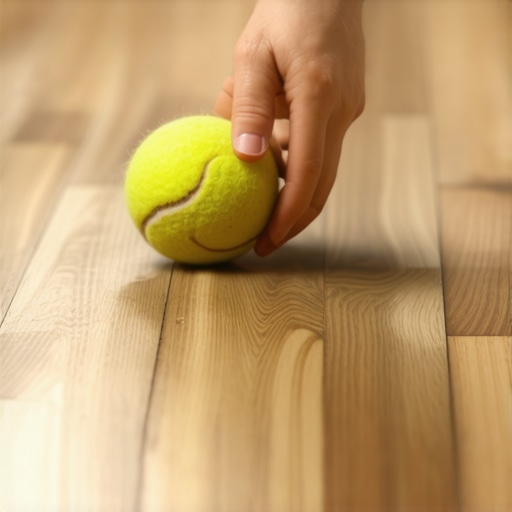
The smell of WD-40 and oak dust has been my constant companion for twenty-five years. I have spent more time on my knees checking the levelness of concrete slabs than most people spend sleeping. When someone walks into my shop and asks about the tennis ball trick to remove scuffs, they expect a simple life hack. They do not expect a lecture on the coefficient of friction or the molecular density of melamine-formaldehyde resins. But that is how you treat a floor if you want it to last. A floor is a performance surface. It is a structural engineering feat that you happen to walk on. If you treat it like a cheap piece of plastic, it will fail you. I have seen it a thousand times. The homeowner thinks they can slide a refrigerator across a floating floor because it is waterproof. It is not indestructible. I spent three days grinding concrete on a job last month just so the floor would not click like a castanet. Most guys skip the leveling compound. They think the underlayment will hide the dip. It won’t. If your subfloor has a 3/16 inch deviation over 10 feet, your locking mechanisms are already screaming under the stress. Surface scuffs are just the visible symptom of how we treat these complex composites.
The chemical interaction between rubber and resins
Laminate flooring scuffs occur when thermoplastic elastomers from shoe soles or furniture glides transfer onto the aluminum oxide wear layer of your floor. This is not a scratch; it is a deposit. The tennis ball works because its high-friction rubber core and synthetic felt cover create the perfect thermal balance to lift these deposits without compromising the AC rating of the laminate surface. When you rub a tennis ball against a scuff, you are generating localized heat. This heat softens the rubber deposit from the shoe or furniture leg. The felt fibers of the tennis ball then act as a microscopic hook-and-loop system to pull that material away from the melamine surface. You are essentially using the physics of friction to reverse a molecular transfer. This is significantly safer than using solvent-based cleaners that can seep into the HDF core board and cause edge swelling. If you use a harsh chemical, you risk breaking down the phenolic resins that hold the decorative paper layer in place. The tennis ball is a mechanical solution to a mechanical problem.
The structural reality of the melamine wear layer
Laminate wear layers are engineered using aluminum oxide particles suspended in melamine resin to provide a surface that resists abrasion, impact, and UV degradation. Most people assume laminate is just a picture of wood glued to a board. In reality, a high-quality laminate is a high-pressure composite. The wear layer must meet specific ISO 438-2 standards for abrasion resistance. When we talk about the AC3, AC4, or AC5 ratings, we are talking about how many revolutions a Taber abrasion machine can complete before it wears through that clear shield. A scuff mark is a nuisance, but it does not represent a failure of the wear layer unless the aluminum oxide grit has been physically removed. This is why you never use steel wool or abrasive pads on laminate. You will create a dull spot by micro-scratching the resin. The tennis ball trick is effective because the felt is softer than the aluminum oxide but firmer than the rubber scuff. It is a matter of Mohs Scale hardness. Your floor is harder than the ball, but the scuff is softer. This allows for selective removal without surface degradation. Underneath that wear layer sits the decorative print film, which is protected by the very resin you are cleaning. Any liquid cleaner introduces the risk of hydrostatic pressure pushing moisture into the tongue and groove joints.
“A floor is only as good as the subfloor beneath it; deflection is the enemy of every joint.” – Master Flooring Axiom
Why your subfloor is lying to you
Subfloor levelness is the single most ignored factor in laminate floor longevity and surface appearance. If your floor has vertical deflection because the subfloor is uneven, every step you take causes the planks to shift slightly. This micro-movement increases the likelihood of scuffs because the floor is not a stable target for your footwear. I have seen beautiful 12mm laminate ruined because the installer didn’t check for moisture vapor emission rates in the concrete. If the slab is pushing moisture, the high-density fiberboard (HDF) will expand. This expansion puts the wear layer under tension. A floor under tension scuffs and scratches more easily than a relaxed, properly acclimated floor. You need to verify that your slab is within 3 percent moisture content or that your vapor barrier is a minimum of 6-mil polyethylene. Do not trust the guy who says the underlayment is enough. Underlayment is for sound dampening and minor compression; it is not a structural fix for a bad slab. If your floor clicks when you walk on it, your locking systems are failing. No amount of tennis balls will fix a broken click-lock joint caused by subfloor dips.
The friction physics of yellow felt
Tennis ball felt is typically a blend of wool and nylon designed to withstand the high-velocity impact of a racket. This fibrous matrix is ideal for cleaning laminate because it reaches into the micro-texture of the floor. Many modern laminates have EIR (Embossed in Register) textures that mimic the grain of real wood. A flat cloth often slides over the top of these micro-grooves, leaving the scuff material trapped in the “grain.” The long-chain polymers in the tennis ball felt are flexible enough to penetrate those grooves. By cutting a small “X” in the ball and placing it on a broom handle, you can apply downward pressure without straining your back. This pressure is concentrated on a small contact patch, increasing the PSI (pounds per square inch) applied to the scuff. This concentration of force is what makes the trick so effective compared to a foot-rubbed rag. You are essentially creating a precision friction tool that targets the scuff while leaving the surrounding wear layer untouched. It is a brilliant example of low-tech engineering solving a high-tech material problem.
| AC Rating | Application Type | Wear Layer Thickness (approx) | Usage Environment |
|---|---|---|---|
| AC1 | Residential | 0.15 mm | Low traffic bedrooms |
| AC2 | Residential | 0.20 mm | Living rooms and dining rooms |
| AC3 | Residential/Light Commercial | 0.25 mm | High traffic areas and hotel rooms |
| AC4 | Commercial | 0.30 mm | Offices, boutiques, and cafes |
| AC5 | Heavy Commercial | 0.35 mm+ | Department stores and public buildings |
The ghost in the expansion gap
Expansion gaps are the most misunderstood 1/4 inch in the entire flooring industry. Every floating laminate floor is a living, breathing entity that expands and contracts with relative humidity changes. If you do not leave a perimeter gap of at least 1/4 to 3/8 of an inch, the floor will eventually bind against the drywall. When a floor binds, it creates peaking at the joints. These peaks are the first places to get scuffed because they sit higher than the rest of the floor. You think you have a scuff problem, but you actually have a thermal expansion problem. The tennis ball can remove the mark, but it cannot fix the fact that your floor is too tight. I always tell clients to look at their baseboards. If the quarter-round is nailed into the flooring instead of the baseboard, you have effectively locked the floor in place. This prevents the natural kinetic movement of the planks. A floor that cannot move will eventually break its own locking tabs. This leads to gapping, where dirt and moisture can enter the unprotected HDF core. Once moisture hits that core, the edges will swell, and the floor is toast. No amount of cleaning will fix edge-blown laminate.
Regional climate impact on surface durability
Humidity and weather logic dictates how a laminate floor performs in different regions. If you are in the swampy humidity of Houston, your laminate floor is constantly fighting to absorb moisture from the air. In these environments, the MDF or HDF core is under constant stress. This makes the wear layer more susceptible to delamination if you use wet cleaning methods. In the dry heat of Phoenix, the opposite happens. The floor shrinks, and the locking mechanisms can become brittle. In dry climates, a scuff mark might be accompanied by static electricity build-up, which attracts more dust and grime to the mark. Understanding your local climate is essential for floor maintenance. You should always maintain a consistent indoor environment between 35 and 55 percent humidity. This stability ensures that the dimensions of the planks remain constant, which in turn keeps the surface tension of the wear layer at its optimal level for resisting scuffs and scratches. A stable floor is a durable floor. If your house swings 30 degrees in humidity every season, your floor is basically a slow-motion accordion.
“Laminate flooring is a floating system; any restriction to its movement is a recipe for catastrophic joint failure.” – TCNA Installation Manual (Adapted)
- Step 1: Identify the scuff mark as a deposit rather than a physical scratch into the HDF.
- Step 2: Obtain a clean tennis ball. Avoid used balls with embedded sand or grit.
- Step 3: Use a utility knife to cut a small X in the ball for a broom handle attachment.
- Step 4: Apply firm, consistent pressure directly to the scuff mark.
- Step 5: Use short, rapid strokes to generate the necessary friction heat.
- Step 6: Wipe the area with a dry microfiber cloth to remove any felt residue.
- Step 7: Inspect the area for any remaining residue and repeat if necessary.
The 1/8 inch that ruins everything
Subfloor deflection is the measurement of how much a floor bends under a load. If your joist spacing is too wide or your subfloor panels are too thin, the floor will bounce. This bounce is the enemy of laminate longevity. Every time the floor deflects, the tongue and groove joints rub against each other. This creates internal friction that can eventually lead to squeaking and joint separation. When the joints separate, the raw core of the plank is exposed. This is why I am so obsessive about subfloor prep. I have spent days using self-leveling underlayment to fill dips that were only 1/8 of an inch deep. People think I am crazy until they see a floor that has been down for ten years and still looks brand new. The tennis ball trick is a great tool for surface maintenance, but it cannot compensate for poor structural integrity. If you want a floor that doesn’t scuff, doesn’t click, and doesn’t gap, you have to start with the physics of the foundation. You have to treat the installation like a science project, not a weekend DIY task. Surface marks are easy to fix; structural failure is expensive. Always check your leveling, always check your moisture, and always leave your expansion gaps. That is the only way to ensure your floor performs as the high-tech composite it was engineered to be. It is not just a floor; it is a system. Treat it with the respect that structural engineering deserves. Keep your tennis balls handy for the scuffs, but keep your level and moisture meter handy for the health of the entire system.