
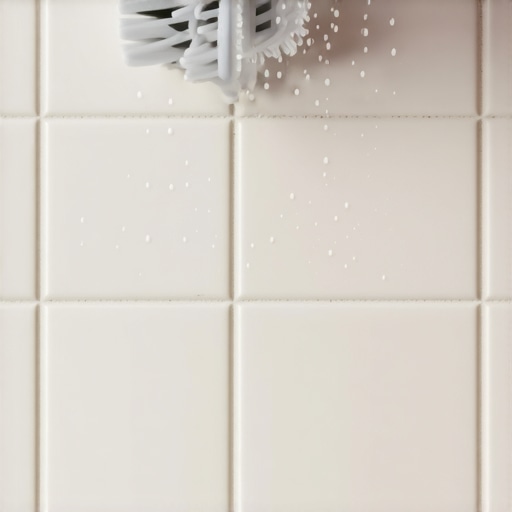
Most guys skip the leveling compound. They think the underlayment will hide the dip. It won’t. I spent three days grinding concrete on a job last month just so the floor wouldn’t click like a castanet. This same logic of cutting corners is exactly why your shower tile looks like a chalk factory. Those white calcium deposits are not just an aesthetic nuisance. They are a chemical footprint left behind by hard water and poor drainage. I have seen countless homeowners scrub until their fingers bleed without realizing they are fighting a battle against the physics of evaporation and mineral bonding. To win, you have to understand the chemistry of the deposit and the structural integrity of the surface.
The chemistry of mineral evaporation in wet environments
White calcium deposits on shower tile are the remnants of dissolved minerals like calcium carbonate and magnesium left behind after hard water evaporates. Removing these deposits effectively requires an acidic agent that can break the ionic bond between the mineral and the tile surface without etching the ceramic or stone glaze. Most people assume the white haze is soap scum. It is usually not. If you live in an area with high mineral content in the municipal water supply, every shower session is essentially a geological event. When the water hits the tile, it begins to evaporate immediately. The liquid turns to vapor, but the calcium solids cannot fly away. They stay behind, bonding to the microscopic pores in your grout and the surface of your tile. Over months, these layers stack up like stalactites in a cave. This build up is exceptionally hard because it is literally rock. You cannot just wipe it away with a sponge and a smile. You need a chemical intervention that shifts the PH balance.
Why the subfloor is the real culprit behind your grout haze
Subfloor deflection and poor pan sloping are the primary structural causes of persistent calcium buildup because they allow water to pool in stagnant zones. When water cannot reach the drain due to improper pitch or subfloor movement, the evaporation cycle is concentrated in specific areas, leading to heavy mineral crystallization.
“A floor is only as good as the subfloor beneath it; deflection is the enemy of every joint.” – Master Flooring Axiom
If your tile was installed on a subfloor that flexes, the grout lines are going to develop micro-fractures. You might not see them with the naked eye, but they are there. These cracks act like straws. They suck water deep into the setting bed. This is called capillary action. Once the water is trapped under the tile, it slowly works its way back to the surface as the bathroom dries. As it migrates, it picks up even more minerals from the cementitious grout and the mortar bed itself. This is often called efflorescence. If you keep cleaning the surface but the white stains keep coming back in the same spots, your problem is not just your water. Your problem is the moisture trapped in the assembly.
Mechanical vs chemical removal methods for stubborn scale
Removing calcium requires a calculated choice between mechanical abrasion and chemical dissolution based on the Mohs hardness of the tile material. For ceramic and porcelain, a mild acid like white vinegar or sulfamic acid is preferred, while natural stone requires non-acidic chelating agents to avoid permanent etching of the surface. I have seen guys go into a shower with a razor blade and a hammer. That is a good way to ruin a three thousand dollar tile job. You have to respect the material. If you have porcelain, you are dealing with a very dense, non-porous surface. You can usually get away with a fifty-fifty mix of distilled white vinegar and water. The acetic acid in the vinegar reacts with the calcium carbonate. It turns the solid rock into a liquid salt and carbon dioxide gas. You will see it bubble. That is the sound of victory. However, if you have marble or limestone, vinegar is your enemy. Those stones are made of calcium. If you put acid on them, the acid will eat the tile just as fast as it eats the deposit. For stone, you need a specialized alkaline cleaner and a soft nylon brush. Never use steel wool. It leaves behind tiny metal particles that will rust and turn your shower orange.
The danger of water migration to adjacent laminate and hardwood
Water migration from a poorly sealed shower can travel through the subfloor and destroy adjacent laminate or hardwood floors by causing hydrostatic pressure and moisture expansion. Ensuring the shower transition is watertight is mandatory to prevent the warping, cupping, and buckling of luxury flooring materials in the hallway or bedroom. I once walked into a house where a walnut floor was cupping so bad it looked like a potato chip because the shower pan was leaking behind the baseboard. People think of the bathroom as an island. It is not. It is part of a structural system. If your grout is failing and calcium is building up, it means water is staying in the system too long. That moisture will eventually find a path of least resistance. If that path leads to your laminate flooring, you are in trouble. Laminate is essentially compressed sawdust and glue. Once it gets wet, it expands and never goes back. Hardwood is even more finicky. It has a cellular structure that drinks moisture.
The technical data of surface protection
| Material Type | Janka Hardness (Ref) | Porosity Level | Recommended Acid PH | | :— | :— | :— | :— | | Porcelain Tile | 7+ (Mohs) | < 0.5% | 2.5 - 3.5 | | Ceramic Tile | 5 - 7 (Mohs) | 3% - 7% | 3.0 - 4.0 | | Travertine | 3 - 4 (Mohs) | High | 7.0 (Neutral) | | White Oak | 1360 (Janka) | Medium | N/A | | Laminate | N/A | High (Core) | N/A |
The maintenance checklist for the meticulous homeowner
- Squeegee the walls after every single use to remove 90% of the mineral-heavy water.
- Apply a high-quality penetrating sealer to the grout lines every six months to block the pores.
- Ensure the bathroom ventilation fan runs for at least twenty minutes after a shower to stop the slow evaporation cycle.
- Check the caulk lines at the floor transition for any signs of peeling or mold.
- Use a water softener system if your grains per gallon (GPG) rating is above seven.
“The Tile Council of North America emphasizes that grout is not waterproof; it is a filter that must be managed through proper sealing and drainage.” – TCNA Technical Manual
The secret trick for heavy buildup
If the white crust is thick, the trick is dwell time. You cannot just spray and wipe. You need to soak a paper towel in your cleaning solution and stick it to the tile. Let it sit there for thirty minutes. This keeps the acid in contact with the calcium. It gives the chemistry time to work. After thirty minutes, the crust should be soft. Use a plastic scraper to gently lift it. If you do this regularly, you will never have to deal with the heavy stuff. It is about being smarter than the rock. I have spent my life looking at floors. The best ones are the ones where the owner pays attention to the small things. A clean shower is a sign of a dry subfloor. A dry subfloor is a sign of a floor that will last a lifetime. Don’t let a little calcium turn into a full-scale renovation. Scrub the grout. Seal the pores. Keep the water moving toward the drain. That is the only way to protect your investment.