
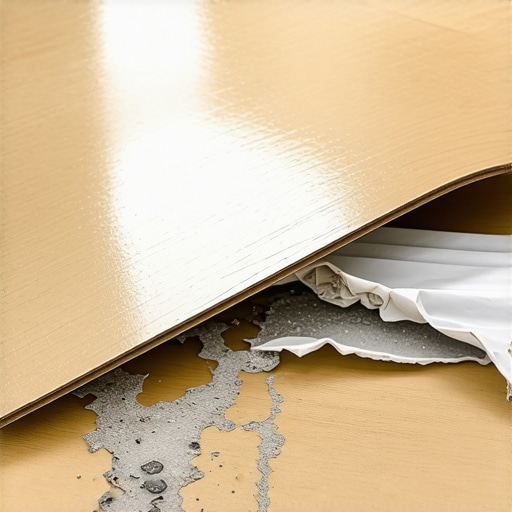
Most guys skip the leveling compound. They think the underlayment will hide the dip. It won’t. I spent three days grinding concrete on a job last month just so the floor wouldn’t click like a castanet. I remember the look on the client’s face when they realized that their high-end laminate felt like walking on a cheap cooler. They had paid for the best planks, but they bought a bargain-bin foam underlayment that was four millimeters thick and as soft as a sponge. Every step caused the floor to deflect, the air underneath to compress, and the locking joints to groan. That is not just a sound. That is the sound of a floor failing from the bottom up. If you want a floor that feels like solid hardwood floors and doesn’t sound like a plastic toy, you have to stop treating the subfloor as a suggestion. It is the foundation of the entire system.
The hollow plastic sound of a failed installation
The hollow plastic sound in laminate flooring occurs when the underlayment is too thick or the subfloor flatness exceeds 1/8 inch over 10 feet. High vertical deflection causes air pockets to compress, creating a drum effect that ruins the perceived quality of the floating floor system. When the tongue and groove mechanisms move too much, they create friction that mimics the sound of plastic snapping. This is almost always a failure of the installer to address the substrate. You can buy the most expensive Swiss-made laminate, but if it is floating over a valley in the concrete, it will sound like junk. The sound is actually the physical manifestation of energy being lost into an air gap rather than being absorbed by a dense substrate.
Why the thickness trap destroys your locking joints
Thick underlayment is not better underlayment because excessive cushion allows the locking mechanisms to flex beyond their engineered limits, eventually leading to joint fatigue and plank separation. People think a 6mm foam pad will make the floor soft. It does, but it also makes it weak. Laminate is a floating system. It relies on the integrity of the click-lock joint. When you walk on a floor with too much squish, the joint bends. Do that ten thousand times, and the HDF core of the plank will snap. You need high-density underlayment, not high-thickness underlayment. The goal is to provide a firm, flat base that only offers enough give to prevent the floor from grinding against the subfloor.
“A floor is only as good as the subfloor beneath it; deflection is the enemy of every joint.” – Master Flooring Axiom
The molecular dance of moisture and HDF
The High-Density Fiberboard (HDF) core of a laminate plank is basically compressed wood fibers and melamine resin that react violently to changes in relative humidity and vapor pressure. If you do not have a proper 6-mil poly vapor barrier on a concrete slab, moisture will migrate into the core. This causes the edges of the planks to swell. This swelling changes the geometry of the locking joint. Once that joint is no longer perfectly flush, it starts to rub. That rubbing produces the clicking sound that drives homeowners crazy. This is especially true in humid environments where the air is thick enough to choke a mule. You must manage the vapor drive from the ground up or the floor will move like it is alive.
Concrete slabs and the invisible vapor drive
A concrete slab is never truly dry, as hydrostatic pressure and capillary action continuously move moisture toward the surface where it can trapped by non-breathable flooring. I have seen guys pull up a floor that was only two years old and find a swamp underneath. The moisture had no place to go, so it saturated the foam underlayment and turned it into a moldy sponge. This is why a moisture meter is not an optional tool. It is a requirement. If the slab is over 3 lbs per 1,000 square feet per 24 hours on a calcium chloride test, you cannot just throw down a pad. You need a dedicated moisture barrier that is taped at every seam with waterproof tape. Any gap in the tape is a highway for water vapor.
Precision leveling and the 1/8 inch rule
The subfloor flatness requirement for most major laminate manufacturers is 1/8 inch over a 10-foot radius to ensure the floating floor remains in constant contact with the underlayment. This is the part that everyone hates because it takes time and sweat. You have to take a long straightedge and find the dips. If you find a hole, you fill it with a high-strength, cement-based floor patch. If you find a hump, you grind it down. Using a diamond cup wheel on an angle grinder is a dusty, miserable job, but it is the difference between a floor that sounds like solid oak and one that sounds like a temporary stage. No underlayment in the world can fix a subfloor that looks like a topographical map of the Andes.
Comparing underlayment density and acoustic ratings
| Underlayment Type | Density (lbs/ft³) | IIC Rating | STC Rating | Best Use Case |
|---|---|---|---|---|
| Standard PE Foam | 2.0 | 50-55 | 50-52 | Low traffic areas |
| High-Density Rubber | 25.0 | 68-72 | 65-67 | Multi-story condos |
| Cork Underlayment | 12.0 | 60-62 | 60-61 | Natural sound dampening |
| Felt/Fiber Pad | 15.0 | 65-66 | 64-65 | Luxury laminate feel |
Beyond laminate in wet environments
When you transition from a laminate living room to a bathroom with showers, the rules of physics change because grout and thin-set create a rigid, bonded assembly that does not allow for the same expansion. You cannot run a floating floor right up to a shower base and expect it to survive. The humidity in a bathroom is too high. The steam will find the expansion gap, get under the transition strip, and ruin the laminate core. I always tell people to keep the laminate in the dry zones. In wet zones, you want a bonded tile system. If you try to mix the two without a proper T-molding and a silicone-sealed perimeter, you are asking for the laminate to buckle. The expansion gap is not a suggestion. It is a requirement. If the floor hits a wall or a cabinet, it will hump up in the middle of the room.
“Wood-based flooring must have room to breathe; a floor locked against a wall is a floor waiting to buckle.” – NWFA Installation Guidelines
The ghost in the expansion gap
Most installers cut the expansion gap too small because they want to use thin baseboards without adding quarter-round molding. This is a fatal error for the floor. A laminate floor can move up to a quarter of an inch in either direction depending on the season. If you pin that floor down with heavy kitchen islands or run it tight against the drywall, the tension has to go somewhere. It goes into the joints. This creates the ‘ghost’ sounds you hear at night. It is the floor literally trying to move but being held back by friction. You need at least a 3/8 inch gap around the entire perimeter. If you don’t like the look, buy thicker baseboards. Don’t compromise the engineering of the floor for a cosmetic preference.
A checklist for a silent floor
- Check subfloor for flatness using a 10-foot straightedge or laser level.
- Grind high spots in concrete and fill low spots with cementitious leveler.
- Verify moisture content of the subfloor with an electronic moisture meter.
- Select a high-density underlayment with an IIC rating above 60.
- Install a 6-mil polyethylene vapor barrier on all concrete substrates.
- Maintain a 3/8 inch expansion gap around all vertical obstructions.
- Acclimate the flooring in the room of installation for at least 48 hours.
- Avoid running the floor under heavy, fixed cabinetry or kitchen islands.
The regional impact of humidity on expansion gaps
In the humid Southeast, the air is a constant threat to laminate and hardwood floors because the equilibrium moisture content stays high year-round. If you install a floor in a house without climate control in Georgia or Florida, you have to leave even larger gaps. The floor will grow. In the dry heat of Phoenix, the opposite happens. The boards will shrink. If you don’t acclimate the material to the local environment, the floor will fail within six months. I have seen floors that were installed in the summer gap-out in the winter because the installer didn’t account for the seasonal drop in humidity. You have to understand the climate you are working in. The floor is a living, breathing thing. It responds to the air just like we do. If you ignore the humidity, you are just waiting for a disaster.