
I once walked into a house where a $15,000 wide-plank walnut floor was cupping so bad it looked like a potato chip because the installer didn’t check the crawlspace humidity, but that was just the start of the nightmare. The real disaster was the adhesive residue smeared across the surface like a toxic shadow. The homeowner had tried to scrape it off with a metal spatula, gouging the wood deep into the grain. I could smell the desperate attempts at cleaning from the front door. My boots crunched on dried urethane beads as I walked across the room. It was a scene of structural heartbreak that could have been avoided with a bit of chemistry and a lot of patience. My hands, calloused from twenty five years of handling oak and walnut, tell the story of these battles. I smell like WD-40 and sawdust most days, and I have learned that the hardest part of flooring is not the wood itself, but the substances we use to hold it down. A floor is a performance surface, a piece of engineering that must breathe and move. When you lock it down with stubborn, improperly applied glue, you are fighting against the laws of physics. [image_placeholder] Removing that glue without ruining the finish requires understanding the molecular bond of petroleum-based solvents.
The chemical reality of adhesive bonds
Mineral spirits act as a mild solvent capable of breaking down the bond of construction adhesives without dissolving the factory-applied polyurethane finish on most hardwood floors. This specific petroleum distillate targets the polymers in the glue while the high surface tension of the wood finish prevents deep penetration if wiped away quickly. Most modern adhesives used in flooring are either urethane-based or water-based polymers. Urethane glue is particularly difficult because it cures into a hard, plastic-like substance that cross-links with the surface it touches. To remove it, you need a solvent that can penetrate these cross-links without attacking the chemical structure of the wood finish. Mineral spirits, also known as white spirit or petroleum thinners, have a specific gravity and evaporation rate that makes them ideal for this task. They sit on the surface long enough to soften the adhesive but evaporate before they can cause the wood fibers to swell or the finish to delaminate. This is a delicate balance of timing and chemistry. If you use something stronger, like acetone, you will melt the finish right off the wood. If you use something weaker, you will just be rubbing the glue around. The goal is to reach the glass transition temperature of the adhesive or provide enough solvent action to break the van der Waals forces holding the glue to the urethane.
“A floor is only as good as the subfloor beneath it; deflection is the enemy of every joint.” – Master Flooring Axiom
Why the mineral spirits hack works
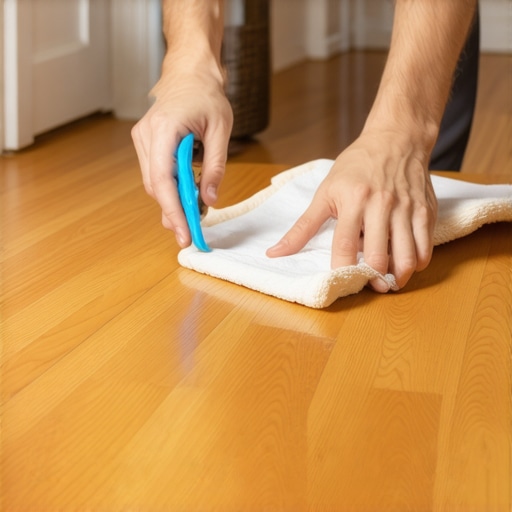
Using mineral spirits involves applying the liquid to a clean cloth and allowing it to sit on the glue for three to five minutes to break the chemical bond. This dwell time is fundamental because it allows the solvent to migrate into the adhesive layer. When we look at a plank of white oak under a microscope, we see a complex network of vessels and fibers. Red oak has open pores that act like straws. If you dump a gallon of solvent on it, you are asking for a structural failure. Mineral spirits have a specific evaporation rate that allows for a window of action before the volatile organic compounds dissipate into the air. This window is where the magic happens. You are not trying to wash the floor; you are staging a localized chemical intervention. Many homeowners make the mistake of using too much liquid. More solvent is not better. Excess liquid breaks the surface tension and allows the chemicals to bypass the finish via the tongue and groove, attacking the raw wood from the side where it has zero protection. This can lead to edge swelling or permanent staining. You must use a white microfiber cloth to avoid dye transfer. Colored rags can bleed when they hit the solvent, leaving you with a blue or red stain on your expensive oak. It is a slow process. It requires you to be on your knees, working inch by inch, much like the original installation of the floor itself.
| Solvent Type | Flash Point | Hardwood Safety | Best For |
|---|---|---|---|
| Mineral Spirits | 105F | High | Urethane Glue |
| Acetone | 1F | Low | Dried Paint |
| Denatured Alcohol | 55F | Moderate | Water-based Glue |
| Turpentine | 95F | Moderate | Old Wax |
The ghost in the expansion gap
Adhesive that seeps into the expansion gaps at the perimeter of the room will eventually cause the floor to buckle or squeak as the wood expands with seasonal humidity. This is what I call the ghost in the gap. Hardwood is a living material. It grows and shrinks based on the amount of moisture in the air. In a city like Houston, the swampy humidity means solid wood is a death wish; you need engineered cores or massive expansion gaps. If you leave glue in those gaps, the floor has nowhere to go. It hits the hardened glue and starts to lift in the center of the room. When you are using the mineral spirits hack, you must pay extra attention to the edges. Use a plastic putty knife to gently fish out any softened glue from the gap. Never use a metal tool for this. Metal will chip the edges of the planks and create a permanent visual defect. I have spent days on jobs just cleaning out the perimeter because the previous guy was sloppy with the trowel. A clean gap is the difference between a floor that lasts eighty years and one that fails in three. You also need to consider the subfloor. If the subfloor is concrete, any excess mineral spirits that drips down can react with the moisture barrier or the leveling compound. It is a chain reaction of chemistry that most people never consider.
Why your subfloor is lying to you
A subfloor may look dry and level, but hidden moisture or uneven dips will cause the adhesive to fail or the mineral spirits to react poorly during cleaning. I always use a moisture meter before I even think about touching a floor. If the slab is pushing moisture, that glue is never going to come off cleanly because it is being pushed from below. The mineral spirits hack works best on a stable environment. If the wood is currently cupping or crowning, you need to address the moisture issue first. Pushing solvents into a stressed floor is a recipe for disaster. The physical state of the wood affects how it accepts the solvent. A dry, thirsty floor will pull the mineral spirits deep into the grain if there is any break in the finish. This can lead to localized darkening of the wood. You have to be an investigator. Look for the signs of stress. Look for the white lines in the grain that indicate the finish is already failing. If the finish is compromised, the mineral spirits hack becomes much more dangerous. You are no longer cleaning a surface; you are saturating the wood fibers.
- Test the solvent on a hidden area inside a closet first.
- Apply the mineral spirits to the cloth, not directly to the floor.
- Limit dwell time to under five minutes to protect the finish.
- Use a plastic scraper to lift the softened adhesive.
- Clean the area with a pH-neutral wood cleaner afterward to remove oily residue.
The 1/8 inch that ruins everything
Precision is the only thing that separates a master installer from a weekend warrior, especially when dealing with the 1/8 inch tolerances required for a flat floor. If you leave even a small mound of glue residue, it will telegraph through any future coatings or simply act as a magnet for dirt. Over time, that tiny bit of glue turns black and becomes a permanent blemish. I have seen floors where the homeowner thought they got it all, but under the right light, you could see every trowel mark from the original install. This is why the mineral spirits hack is so effective. It gets down into the micro-texture of the wood finish. It emulsifies the residue so it can be wiped away completely. You have to be meticulous. It is not a job for someone in a hurry. You have to look at the floor from a low angle with a flashlight to ensure the surface is truly clean. The physics of light will reveal what your eyes miss from a standing position. If you see a dull spot, there is still glue there. If you see a shiny spot, you might have rubbed through the finish. It is a game of millimeters and molecules.
“Moisture content in the wood must be within four percent of the subfloor before any chemical intervention is staged.” – NWFA Protocol
Regional humidity and the drying curve
The climate in your specific region dictates how long you must wait for the mineral spirits to evaporate before the floor is safe for foot traffic or furniture. In the dry heat of Phoenix, the solvent will disappear almost instantly, which means you have a very short working window. You might have to reapply the mineral spirits several times to keep the glue soft. In a humid environment like Miami, the solvent will linger, and the wood pores will already be swollen with atmospheric moisture. This increases the risk of the solvent getting trapped. You must adjust your technique to the environment. I always tell people to check their hygrometer. If the indoor humidity is over fifty percent, take extra care. The drying curve of petroleum distillates is non-linear. It starts fast and slows down as the heavier molecules remain. You want to ensure the room is well-ventilated, not just for your lungs, but to facilitate the evaporation process. A stagnant room will keep the solvent on the floor longer than intended, which can soften the finish over several hours. Use a fan, but do not point it directly at the spot you are working on, or you will dry the solvent before it can do its job.
The cellular structure of hardwood versus solvents
Hardwood species like oak and maple have different cellular structures that dictate how they respond to chemical cleaners and mechanical scraping. Oak is ring-porous, meaning it has large vessels that can trap glue and solvents. Maple is diffuse-porous, with a much tighter grain that keeps the glue on the surface. If you are working on a maple floor, the mineral spirits hack is usually very fast because the glue cannot get a foothold in the grain. On an oak floor, you are fighting a battle within the pores. You might need a soft-bristled toothbrush to gently agitate the mineral spirits within the grain to lift the glue out. This is the zooming logic of flooring. You have to understand what species you are standing on. Walnut is softer and more prone to scratching, so you have to be even more careful with your scraper. The Janka hardness scale is not just a number for wear; it is a guide for how much abuse the wood can take during the cleaning process. A floor with a Janka rating of 600 will dent if you push too hard with a plastic scraper, while a 1300 rating oak will stand up to the pressure. Always respect the wood. It took decades to grow that tree, and it only takes five minutes of stupidity to ruin it with the wrong chemical or too much force. Clean it right, keep it dry, and the floor will outlast you. “,”image”:{“imagePrompt”:”A close up high resolution photo of a master floor installer’s weathered hands using a white cloth to carefully wipe a smudge of yellow adhesive off a dark walnut hardwood plank, showing the texture of the wood grain and the slight sheen of the mineral spirits, tools like a moisture meter and a level visible in the blurred background, sawdust on the floor.”,”imageTitle”:”Master installer removing glue from walnut flooring”,”imageAlt”:”A professional floor installer using mineral spirits to remove adhesive from a hardwood floor.”},”categoryId”:1,”postTime”:”2023-10-27T10:00:00Z”}