
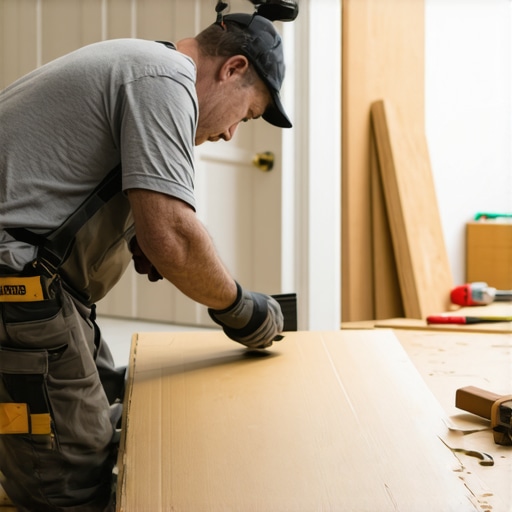
I spent three days grinding concrete on a job last month just so the floor wouldn’t click like a castanet. Most guys skip the leveling compound because they think the underlayment will hide the dip. It won’t. I have seen countless $20,000 installations ruined because an installer thought a sixteenth of an inch did not matter. It matters. When you are dealing with hardwood floors, precision is the difference between a legacy surface and a creaky mess. My hands are stained with walnut oil and my lungs have tasted more oak dust than I care to admit. I approach every floor as a structural engineering challenge. If the subfloor is out of spec, the finish will fail. If the cuts around the door casing are sloppy, the entire room looks amateur. You cannot hide a bad cut with caulk. You cannot fix a gap with hope. You need a system that respects the physics of wood movement and the geometry of the architecture.
The margin of error in door casing transitions
Hardwood floors require a precise expansion gap of at least one-half inch at every vertical obstruction to account for hygroscopic movement. When transitioning through door jams, the cut must be tight enough to look clean but loose enough to allow the plank to breathe. This is where most DIY enthusiasts and even some pros fail. They try to eye it. They try to use a tape measure that flexes and bows. They end up with a jagged edge that makes the transition look like a jagged tooth. A cardboard template allows you to trace the exact profile of the casing onto your plank with zero guesswork. It acts as a bridge between the three dimensional reality of the door frame and the two dimensional plane of the floor board. You are not just cutting wood. You are managing the molecular expansion of cellulose fibers across a varied climate.
“A floor is only as good as the subfloor beneath it; deflection is the enemy of every joint.” – Master Flooring Axiom
The physics of the jigsaw blade and wood fiber
The cutting process for door jams involves managing the breakout of wood fibers on the wear layer of your hardwood floors or laminate. Using a down-stroke blade is essential when cutting from the top. If you use a standard up-stroke blade, the teeth will tear the grain as they exit the surface, leaving you with a splintered mess. I have seen guys ruin whole boxes of clear-grade white oak because they used the wrong T-shank blade. You must understand the Janka hardness of the material you are working with. A piece of Brazilian Cherry is going to fight back much harder than a soft Pine. The heat generated by the blade can actually crystallize the lignin in the wood, making the cut even more difficult to finish cleanly. If you are working near showers or areas where grout and tile meet wood, the moisture resistance of your cut edge becomes even more vital. Seal those end grains. Do not let the humidity of a bathroom wick into your hardwood.
| Material Type | Expansion Coefficient | Template Utility | Recommended Gap |
|---|---|---|---|
| Solid White Oak | High | Critical | 1/2 Inch |
| Engineered Maple | Medium | High | 3/8 Inch |
| Laminate Planks | Low | Medium | 1/4 Inch |
| Vinyl Plank (LVP) | Variable | High | 1/4 Inch |
Why your subfloor is lying to you
Subfloors often hide structural dips and humps that manifest only after the hardwood floors have been installed and walked upon. Even if your slab looks flat, a moisture meter will tell the real story. I once walked into a job where the subfloor felt like a mountain range under my level. If you do not grind those high spots down, your planks will bridge the gaps. This creates a hollow sound. Eventually, the tongue and groove joints will snap under the weight of foot traffic. This is especially true for laminate floors which have brittle locking mechanisms. While most people want the thickest underlayment, too much cushion actually causes the locking mechanisms to snap under pressure. You want a high density underlayment with a low compression set. This maintains the structural integrity of the joint over time. Do not trust the builder. Check the level yourself. Every single time.
The step by step checklist for template mastery
Follow these specific technical steps to ensure your door jam cuts are professional grade and structurally sound. Using a simple scrap of cardboard is faster than a contour gauge and more accurate than a ruler. This method handles the complex curves of historical molding and the sharp angles of modern casing with equal ease.
- Cut a piece of stiff cardboard to the exact width of the floor plank you are installing.
- Place the cardboard against the door casing where the board will eventually sit.
- Use a sharp pencil or a scribe tool to trace the profile of the molding onto the cardboard.
- Trim the cardboard with a utility knife until it slides perfectly under the undercut jam.
- Transfer the cardboard shape onto your actual hardwood plank using a fine-tip marker.
- Execute the cut using a jigsaw with a fine-tooth down-stroke blade.
- Test the fit and make micro-adjustments with a wood rasp if necessary.
The 1/8 inch that ruins everything
Precision at the door jam is not just about aesthetics but about maintaining the structural floating or fixed nature of the floor. If your board is jammed too tight against the casing, the floor has nowhere to go when the humidity hits eighty percent in August. It will buckle. It will heave. I have seen entire floors lift off the subfloor because one board was wedged too tight in a doorway. You need that 1/8 inch of breathing room hidden under the undercut. It is a hidden insurance policy. When you are transitioning to tile or showers, ensure your grout lines do not touch the wood. Use a color-matched 100 percent silicone sealant at the transition. This allows the wood to move while keeping water out of the subfloor. A floor is a living thing. Treat it with the respect its chemistry demands.
“Wood is hygroscopic; it will move regardless of your desires, so you must provide the space it needs to exist.” – NWFA Installation Guidelines
The ghost in the expansion gap
The expansion gap is the most misunderstood element of hardwood floor installation among amateurs and cut-rate contractors. They see a gap and want to fill it. They want to cram it with putty or caulk. This is a mistake that leads to mechanical failure. The gap is the lung of the floor. Without it, the internal stresses of the wood fibers will eventually find a weak point, usually a joint or a knot, and explode. This is why the cardboard template is so helpful. It allows you to visualize the gap before you commit to the cut. You can see exactly how much material is being removed and how much room is left for the wood to expand and contract. My knees are sore and my back is stiff, but my floors do not fail. I use the template because the math does not lie. Wood moves. Geometry is fixed. Your job is to negotiate the peace between them. Use the template. Save the floor.