
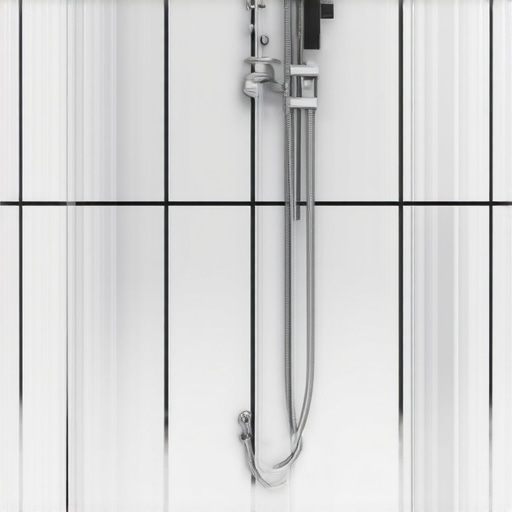
Most guys skip the leveling compound. They think the underlayment will hide the dip. It won’t. I spent three days grinding concrete on a job last month just so the floor wouldn’t click like a castanet. That is the same fundamental logic people use when they pick dark grout for a four by four shower stall. They think it looks edgy. They think it hides the soap scum. What they actually do is build a visual cage that shrinks the room by thirty percent before the first tile is even set. In a small space, every line you draw is a boundary. Dark grout draws a heavy, black line around every single tile. Instead of a unified surface, your eyes see a hundred small boxes. It is the visual equivalent of a prison cell. I have seen thousand dollar tile jobs look like a basement utility closet because the homeowner wanted that industrial look without understanding the physics of light and space.
The visual compression of high contrast
Dark grout creates a grid pattern that forces the human eye to process every individual tile as a separate object. In a large room, this adds texture and interest. In a small shower, it creates a claustrophobic effect known as visual noise. When the grout color contrasts sharply with the tile, the brain cannot perceive the wall as a continuous plane. The walls feel like they are closing in because the grid highlights the proximity of the corners. Light colors bounce photons. Dark colors absorb them. If you use charcoal grout with white subway tile in a windowless bathroom, you are essentially installing a light sponge that sucks the brightness out of the room. You end up needing twice the wattage in your lighting fixtures just to see your feet.
“A floor is only as good as the subfloor beneath it; deflection is the enemy of every joint.” – Master Flooring Axiom
The chemical reality of carbon black pigments
Dark grouts are heavily loaded with pigments, often carbon black or iron oxide, to achieve those deep midnight shades. These pigments are not just for show. They change the way the grout handles water and how it cures. In my twenty five years of scraping out failed joints, I have noticed that over-pigmented grouts often have a higher rate of efflorescence. That is the white, crusty salt that leaches out of cement. On light grout, you never see it. On dark grout, it looks like someone sprayed the walls with salt water. You spend the next five years scrubbing a shadow that will never go away. Furthermore, the high pigment load can sometimes interfere with the polymer chains in modified thin sets if you are not careful about your mixing ratios. It is a structural risk for a purely aesthetic choice that usually fails the vibe check.
| Grout Type | Pigment Load | Moisture Resistance | Visual Weight |
|---|---|---|---|
| Sanded Cement | High | Moderate | Heavy |
| Unsanded Cement | Medium | Low | Medium |
| Epoxy Grout | Very High | Excellent | Massive |
| Acrylic Premix | Low | High | Light |
Why your subfloor is lying to you
The subfloor is the foundation of every shower pan. If your subfloor has a dip of even an eighth of an inch over ten feet, your tile will eventually crack. This matters for grout choice because dark grout highlights every imperfection in your tile setting. If one tile is slightly higher than the neighbor, a dark grout line will cast a shadow that makes the lip look like a mountain range. I have seen guys try to hide bad tile work with dark grout, but it does the opposite. It provides a high contrast reference point that tells the world your installer was lazy. A color matched grout hides those tiny variances that occur when a house settles or when the joists under the bathroom start to deflect under the weight of a heavy cast iron tub.
The myth of the maintenance free dark joint
Homeowners choose dark grout because they think it stays clean. That is a lie. While dark grout might hide a bit of dirt, it highlights every speck of hard water scale and dried soap. In a small shower, the spray hits every wall. As the water evaporates, it leaves behind calcium and magnesium. These minerals are white. Against black or dark gray grout, they stand out like a neon sign. You end up scrubbing just as much, but now you are fighting a battle against white spots instead of brown ones. If you really want a low maintenance shower, you go with a mid-tone gray that matches the dust and the minerals in your local water supply. It is about working with chemistry, not fighting it.
“Grout joint width and color must be considered as a singular design element to ensure the longevity of the tile assembly.” – TCNA Handbook Standards
The physics of light refraction on wet surfaces
When tile gets wet, its refractive index changes. Light penetrates the surface differently. Dark grout becomes even darker when saturated with water, deepening the contrast and making the shower feel even smaller during use. This is particularly problematic in regions like the Pacific Northwest where the lack of natural sunlight makes interior bathrooms feel like bunkers. If you are in a high humidity environment, that grout is going to stay damp longer, meaning the cave effect is permanent. You are essentially living in a wet, dark box. I always tell clients to look at their tile samples under a spray bottle before they commit. The change in tone is usually enough to make them reconsider the charcoal dream.
- Check subfloor deflection using a digital level before starting the pan.
- Ensure the moisture barrier overlaps the flange by at least two inches.
- Acclimate all tile and grout materials to room temperature for forty eight hours.
- Use a grout sealer that is vapor permeable to allow the assembly to breathe.
- Mix grout with distilled water to prevent mineral staining from the tap.
The ghost in the expansion gap
Every shower needs an expansion gap where the walls meet the floor. Most guys just shove grout in there and call it a day. That is a rookie mistake. That joint needs to be 100 percent silicone caulk because the walls and the floor will move at different rates. If you have dark grout and you use a slightly different shade of dark caulk, the transition looks terrible. It creates a thick, gummy line at the base of your shower that collects hair and grime. In a small shower, that line is right at your eye level when you are scrubbing your toes. It makes the floor feel disconnected from the walls. A lighter, monochromatic approach blends that movement joint so it disappears. You want the architecture to speak, not the expansion gap.
Hardwood and laminate are not shower materials
I get asked all the time if people can run their laminate or hardwood into the bathroom to make the space feel bigger. The answer is a hard no. Even the best waterproof laminate is not designed for the standing water of a shower environment. The core will swell, the edges will peak, and you will be calling me in six months to rip it all out. If you want the look of wood, use porcelain planks with a color matched grout. This gives you the warmth of the wood grain without the structural failure of rotting cellulose. But again, keep the grout lines tight. If you use dark grout with wood look tile, you break the illusion of a continuous wood floor. Real wood floors do not have black lines between the boards unless they are a hundred years old and full of gaps. If you want a modern, expansive feel, your grout needs to be a ghost.
The 1/8 inch that ruins everything
Spacing is the final frontier. In a small shower, you should be aiming for the smallest grout joint the tile manufacturer allows. For most rectified tiles, that is one sixteenth of an inch. When you combine a tiny joint with a color that matches the tile, the walls appear to be made of a single, solid slab. This is the secret to making a small bathroom feel like a spa. It removes the grid. It removes the visual boundaries. It lets the light move across the surface without being interrupted by a dark line every three or six inches. I have spent decades perfecting the art of the invisible joint. It is harder to do. It requires a perfectly flat subfloor and a steady hand. But the result is a room that feels twice as big as it actually is.