
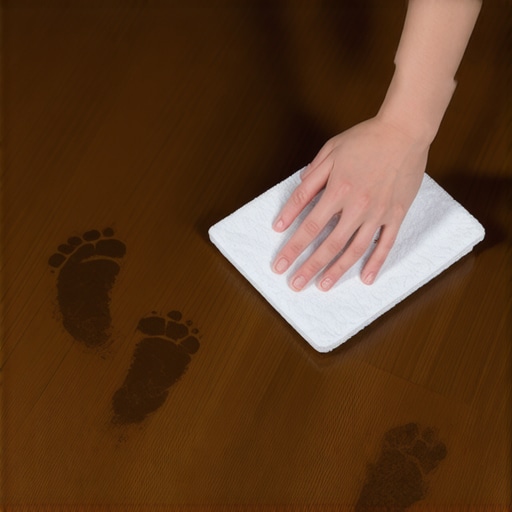
Why dark laminate shows every footprint and the simple buffing fix
I spent three days grinding concrete on a job last month just so the floor wouldn’t click like a castanet. Most guys skip the leveling compound. They think the underlayment will hide the dip. It won’t. I walked into that house smelling like WD-40 and oak dust, knowing the homeowner was about to complain about the dark finish. They always do. They buy the obsidian, the deep espresso, or the midnight oak laminate because it looks like a million bucks in the showroom. Then they get it home and realize they can’t even walk to the kitchen for a glass of water without leaving a trail like a muddy dog. The subfloor prep is where the war is won, but the finish is where the sanity is lost. If your subfloor has even a 1/8 inch dip, the boards flex. That flex acts like a bellows, puffing fine dust up through the click-lock joints and right onto that dark, unforgiving surface. It is a structural engineering failure masked as a cleaning problem.
The light physics of dark surfaces
Dark laminate floors show footprints because the dark pigment absorbs the majority of the visible light spectrum while the smooth melamine wear layer reflects oils. Skin oils, known as sebum, possess a distinct refractive index that creates an optical contrast against the deep, light-absorbing background of the planks. This is basically the same reason a black car looks filthy ten minutes after a wash. The melamine resin used in the manufacturing of laminate is a non-porous plastic. It does not absorb anything. When you step on it, the oils from your feet or the moisture from your socks sit right on top of the surface. On a lighter floor, like a natural oak or a light maple, the reflection of the wood grain and the light color of the wood fibers scatter the light. This scattering hides the oil. On a dark floor, there is no scattering. There is only the dark abyss of the pigment and the oily shine of your foot. It is a high-contrast environment where every micro-gram of skin oil is magnified by the surrounding darkness. To understand this, you have to look at the molecular level. Laminate is a sandwich of high-density fiberboard, a photographic layer, and a clear aluminum oxide or melamine wear layer. That wear layer is engineered for abrasion resistance, not oil rejection. It is literally designed to be hard, not clean.
The subfloor secret that ruins your finish
A subfloor that is not perfectly level causes the laminate planks to shift and depress underfoot which forces air and microscopic debris through the locking mechanisms. This movement generates static electricity on the surface of the floor which attracts dust and holds onto the oils from your skin. I see it every week. A guy installs a floor over a wavy plywood subfloor and wonders why the floor feels ‘crunchy’ or why it always looks dusty. Every time you step on a plank that has a void beneath it, the air in that void has to go somewhere. It gets squeezed out of the joints. That air is full of construction dust, pet dander, and skin cells. Because the laminate is a plastic product, it builds up a static charge as you walk across it. This charge acts like a magnet for that dust. When the dust hits the oils left behind by your feet, it creates a smudge that no vacuum can pull up. It is a cycle of filth that starts under the floor, not on top of it. You can mop until your arms fall off, but if that floor is moving, the dust will keep coming. You have to address the deflection. Deflection is the enemy of every joint, and it is the best friend of a dirty-looking floor.
“A floor is only as good as the subfloor beneath it; deflection is the enemy of every joint.” – Master Flooring Axiom
The molecular reality of microfiber buffing
The simple buffing fix involves using a high-density microfiber cloth and a pH-neutral cleaner to break the surface tension of the oils without leaving a residue. Dry buffing with a clean microfiber pad is the most effective way to remove the oily residue that causes visible footprints. Most homeowners make the mistake of using too much water or, heaven forbid, a wax-based polish. Wax is the devil’s condiment in the flooring world. It creates a sticky film that captures every footprint and turns it into a permanent mark. To fix this, you need to use a fine mist of a 70 percent water and 30 percent isopropyl alcohol solution. The alcohol acts as a surfactant, breaking down the lipids in the skin oils. Then, you use a dry, heavy-weight microfiber mop. The tiny hooks in the microfiber reach into the micro-textures of the melamine and pull the oils away from the surface. You are not just spreading the oil around; you are lifting it. This is why buffing is different from mopping. Mopping is wet; buffing is dry or nearly dry. If you leave moisture on the floor, it will evaporate and leave behind the minerals from your water, creating streaks that look just as bad as the footprints.
| AC Rating | Usage Category | Wear Layer Chemistry |
|---|---|---|
| AC1 | Light Residential | Standard Melamine |
| AC2 | Moderate Residential | Enhanced Melamine |
| AC3 | Heavy Residential | Aluminum Oxide Infused |
| AC4 | Light Commercial | High-Density Al2O3 |
| AC5 | Heavy Commercial | Industrial Resin Bond |
Why your skin oils love melamine resin
Melamine resin is a thermosetting plastic that provides the hardness of laminate but lacks the hydrophobic properties of modern ceramic coatings. This means that the surface of the floor is chemically prone to bonding with the organic compounds found in human sweat and sebum. When you walk barefoot, you are essentially printing your identity onto the floor. The oils transfer from your skin to the cool surface of the laminate via thermal transfer. Because the laminate is a dense, non-reactive material, those oils sit there in a semi-liquid state. When light hits those oils, it undergoes a process called specular reflection. Instead of the light hitting the floor and disappearing into the dark pigment, it hits the oil and bounces back to your eye. This is why the footprint looks like a shiny, greasy spot. It is literally a different type of light reflection than the rest of the floor. If you want to stop this, you have to wear socks or slippers. There is no chemical coating you can apply that will stop your skin from producing oils, and there is no laminate on the market that can magically absorb those oils without ruining the core of the board.
- Use a dry microfiber mop every single day to manage static and dust.
- Never use steam mops as they can delaminate the edges of the planks.
- Apply a 70/30 water to alcohol mix for spot cleaning stubborn oily areas.
- Ensure your humidity is between 35 and 55 percent to prevent plank shrinkage.
- Place walk-off mats at every entrance to catch grit before it scratches the melamine.
Hardwood floors and the dark pigment trap
Hardwood floors are often compared to laminate but they handle oils differently because of the grain texture and the type of topcoat applied at the factory or on-site. While dark stained hardwood also shows footprints, the natural variations in the wood cells help to hide imperfections better than the uniform surface of laminate. If you have a site-finished oak floor with a matte polyurethane, the oil might soak in slightly or be masked by the grain. Laminate has no grain. It has a picture of grain. The surface is as flat as a pane of glass at the microscopic level. This flatness is why the footprints are so prominent. When you compare this to other surfaces like showers or grout, you see a pattern. Grout is porous. It absorbs oils, which is why it turns dark and nasty over time. Showers deal with soap scum, which is just oil and minerals. Laminate is the opposite; it refuses to absorb anything, so it displays its sins on the surface for everyone to see. If you are choosing between dark hardwood and dark laminate, the hardwood will be slightly more forgiving, but the maintenance stays the same. You are a slave to the microfiber mop either way.
“Subfloor flatness must be within 3/16 inch in a 10-foot radius for all floating installations.” – NWFA Standards
The final word on dark surfaces
The reality of dark flooring is that it requires a level of discipline that most households aren’t ready for. It is a performance surface that demands a specific maintenance protocol. You cannot treat it like a beige carpet from the 1990s. You have to understand the chemistry of the cleaners you use and the physics of the light in your room. If you have large windows that let in low-angle sunlight, your dark laminate will always look dirty because that light is perfectly positioned to highlight the specular reflection of every smudge. The fix is not a magic chemical. The fix is a consistent, dry-buffing routine and an obsession with subfloor flatting. If you get the foundation right, the floor stays still. If the floor stays still, the dust stays down. If the dust stays down, your buffing lasts a lot longer. It is a game of inches and molecules, and if you play it right, that dark floor can actually look as good as it did in the magazine. Just keep your shoes on and your microfiber clean. That is the only way to win this fight. Follow the NWFA standards and stop looking for a shortcut in a bottle of floor wax.