
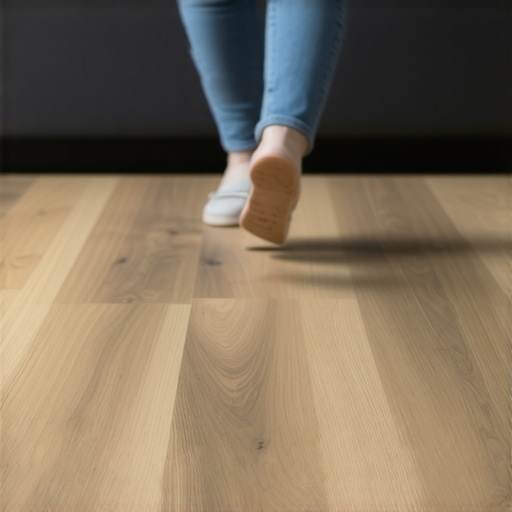
The physics of the click
Laminate flooring clicks when the subfloor is not flat, causing the boards to deflect vertically under weight. This movement forces the locking mechanism to rub against the neighboring plank. The sound occurs because the tongue and groove joints frictionally engage or disengage in a dry, resonant environment. Most guys skip the leveling compound. They think the underlayment will hide the dip. It won’t. I spent three days grinding concrete on a job last month just so the floor wouldn’t click like a castanet. I smell like oak dust and the sharp tang of floor wax most days, and I have seen too many homeowners cry over a floor that sounds like popcorn. A floor is a performance surface. It is a structural engineering feat that you walk on. When you hear that plastic snap, it is not just noise. It is the sound of your investment slowly grinding itself into sawdust. I have spent twenty five years on my knees with a moisture meter and a level, and I can tell you that a click is a symptom of a deeper sickness in the subfloor.
The 1/8 inch that ruins everything
Subfloor flatness is the single most important factor in preventing laminate floor noise. According to industry standards, a subfloor must be flat within 3/16 of an inch over a 10 foot radius or 1/8 of an inch over a 6 foot radius. If the floor exceeds these tolerances, the floating floor will bridge over the low spots. When you step on that bridge, the floor deflects. This movement is called vertical deflection. The locking tongue of a 12mm laminate plank is only about 3mm thick. If the floor dips 1/8 inch, that tongue is taking 100% of the shear force of a 200 pound human. It bends. It rubs. It clicks. Eventually, it snaps. I once walked into a house where they had laid expensive laminate over an old plywood subfloor that looked like the rolling hills of Kentucky. The homeowner thought the thick underlayment would cushion the blow. It did the opposite. The extra cushion allowed the joints to move even more, leading to total joint failure within six months.
“A floor is only as good as the subfloor beneath it; deflection is the enemy of every joint.” – Master Flooring Axiom
The ghost in the expansion gap
Expansion gaps are required around the entire perimeter of a laminate floor to allow for seasonal movement. If the floor is installed tight against a wall or a heavy fixed object like a kitchen island, the planks cannot move horizontally. This tension creates a vertical lift that causes clicking and buckling. Laminate is made of High Density Fiberboard, or HDF. This material is essentially wood fibers compressed with resins like urea formaldehyde. Even though it is engineered, it still behaves like wood. It expands when the humidity rises and shrinks when it falls. If you lock that floor in place, the energy has to go somewhere. It goes up. This creates a trampoline effect. Every time you walk, the floor snaps back down against the subfloor. That sharp sound is the air being pushed out from under the plank and the click of the joint being stressed. You need a minimum of 1/4 inch to 1/2 inch of space at every vertical obstruction. Do not forget the doorjambs. Undercut them properly or you will hear the ghost of the installer clicking every time you go to the bathroom.
Underlayment mistakes that kill your joints
The wrong underlayment can cause laminate floors to click by providing too much or too little support. While homeowners often choose the thickest foam thinking it will be softer, excessive cushion causes the locking mechanisms to over flex and rub. The ideal underlayment has a high compression strength to support the joints.
| Underlayment Type | Compression Strength | Moisture Protection | Best Use Case |
|---|---|---|---|
| Standard Foam | Low | Minimal | Budget guest rooms |
| IXPE Foam | High | Excellent | High traffic living areas |
| Rubber | Highest | Superior | Soundproofing apartments |
| Cork | Medium | Natural | Thermal insulation |
I have seen people double up on underlayment to try and level a floor. This is a disaster. You are essentially building a floor on a sponge. The joints will rub together with every step. The friction between the tongue and the groove creates a high pitched clicking sound. You want an underlayment with a high IIC rating for sound, but it must be dense. Cross linked polyethylene foam, known as IXPE, is a gold standard. It provides a vapor barrier and a firm foundation. It does not compress like cheap white foam.
The molecular reality of moisture and friction
Humidity levels in the home must remain between 35 percent and 55 percent to maintain the structural integrity of the laminate core. When the air is too dry, the HDF core shrinks, causing the locking joints to loosen. This creates a gap where the tongue can rattle inside the groove. In a dry environment like Phoenix, your floor will shrink until the baseboards show a gap. In a humid place like Houston, the floor will swell. This constant movement wears down the wax coating that many manufacturers put on the joints to keep them quiet. Once that wax is gone, you have raw HDF rubbing against raw HDF. It is like two pieces of sandpaper rubbing together. To fix this, some people use a specialized floor lubricant. You can find dry Teflon or silicone based sprays that you can work into the joints. This reduces the coefficient of friction. However, this is a band aid. If the subfloor is not flat, no amount of spray will keep it quiet forever.
“Subfloor flatness is not a suggestion; it is the structural foundation of product longevity.” – NWFA Installation Standards
How to silence the floor without ripping it up
To silence a clicking floor without a full reinstall, you can use a combination of floor lubricants, weight distribution, and spot repairs. Injecting a specialized floor adhesive into the hollow spot under the plank can also stabilize the movement and eliminate the noise. Here is a checklist for the desperate homeowner:
- Check the perimeter expansion gaps by removing the baseboard.
- Use a floor lubricant specifically designed for click lock joints.
- Ensure the humidity in the room is stabilized between 35 and 55 percent.
- Inspect for heavy furniture like kitchen islands that might be pinning the floor.
- Identify hollow spots by tapping the floor and consider injecting a floor patch.
If you find a low spot that is causing the click, you can sometimes drill a tiny hole and inject a low expansion foam or a specialized floor adhesive. This fills the void and stops the deflection. It is a surgical procedure. You have to be careful not to create a hump. I have done this on dozens of jobs where the client did not want to pay for a full tear out. It works, but it requires a steady hand and a lot of patience.
Professional repair protocols and long term stability
Fixing a clicking laminate floor properly requires removing the planks back to the source of the problem and leveling the subfloor with a high quality Portland cement based compound. This ensures a permanent fix by removing the cause of the vertical deflection. If you are starting a new project, do not trust the subfloor. Even in new construction, the joists can crown or the slab can have birdbaths. Use a long straightedge. Grind the high spots. Fill the low spots. Let the laminate acclimate in the room for at least 48 hours. This allows the moisture content of the HDF to reach equilibrium with the environment. If you skip this, the floor will move after it is installed, and the clicking will start within a week. I have seen it a thousand times. The installer rushes, the floor clicks, and the homeowner is left with a mess. Do it right the first time. Flatten the subfloor, use the right underlayment, and leave the gaps. That is the only way to have a silent floor that lasts twenty years. It is about the chemistry of the bond and the physics of the load. Anything else is just wishful thinking.