
I once walked into a house where a $15,000 wide-plank walnut floor was cupping so bad it looked like a potato chip because the installer didn’t check the crawlspace humidity. It is a sickening feeling to see high-end lumber fail because someone ignored the physics of moisture. My hands usually smell like oak dust and WD-40, and my knees have the permanent calluses of a man who has spent three decades refusing to accept a subfloor that is anything less than perfectly level. People think a floor is just a surface to walk on. They are wrong. It is a dynamic, living structural assembly that reacts to every change in the atmosphere. When a heavy chair or a dropped cast-iron skillet leaves a dent in your beautiful hardwood, most homeowners panic. They think the wood is broken. It is not broken. It is merely compressed. The cellular structure of the wood, those microscopic tubes that once carried water through the tree, has been flattened. If the finish is still intact and the fibers are not severed, you can often coax those cells back to their original shape using nothing more than an ice cube, a cotton cloth, and a household iron. This is not magic. It is a calculated application of thermodynamics and hygroscopic expansion. We are going to look at the exact way to manipulate the lignin and cellulose within your planks to erase the evidence of impact damage without reaching for the sander.
The cellular mechanics of a compressed wood plank
Hardwood floor dents represent localized compression of the wood cellulose and lignin structures rather than a loss of material. When a heavy object strikes the surface, the hollow cells known as tracheids and vessel elements collapse under the pressure. Because wood is a hygroscopic material, it retains the ability to absorb moisture and swell, which is the foundational principle behind the ice cube recovery method. To understand why this works, you have to look at the anatomy of the timber. A piece of White Oak or Hard Maple is not a solid, inert block. It is a dense network of fibers held together by lignin, which acts as a natural glue. When you drop something heavy, you are essentially squashing these hollow fibers like a handful of plastic straws. If the impact did not snap the fibers or tear the polyurethane finish, those straws are still there, just flattened. By introducing water and heat, we can create localized steam. This steam penetrates the wood grain, softening the lignin and allowing the internal pressure of the expanding water molecules to push the cell walls back into their upright position. It is a structural reset that relies on the wood’s inherent memory. If you use a moisture meter, you will see that the spot becomes saturated, but the goal is to dry it back down to the surrounding equilibrium moisture content once the dent is lifted.
“A floor is only as good as the subfloor beneath it, deflection is the enemy of every joint.” – Master Flooring Axiom
The precise steps for executing the ice cube steam method
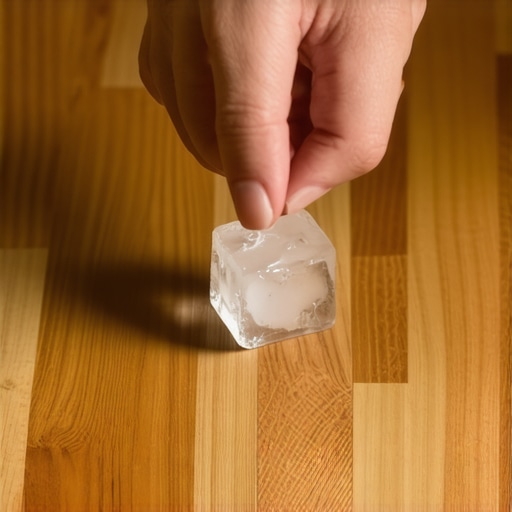
The ice cube trick requires placing a single cube of ice directly on the dent and allowing it to melt slowly before applying heat with an iron. This slow release of moisture ensures that the water penetrates deep into the compressed grain rather than just sitting on the surface of the finish. First, clean the area with a microfiber cloth to ensure no grit is present. Place the ice cube in the center of the depression. As it melts, the water will find the microscopic cracks in the finish or permeate through the grain if it is a site-finished floor. Once the ice is gone, place a damp, thin cotton cloth over the spot. Set your iron to the highest steam setting. Gently press the iron onto the cloth over the dented area, making small circular motions. Do not leave the iron in one spot for more than a few seconds. The heat converts the liquid water trapped in the wood fibers into steam. This steam expands rapidly, creating internal pressure that forces the wood cells to pop back up. You should check your progress every thirty seconds. You will often see the dent vanish before your eyes. Once the surface is level, remove the heat and let the area air dry naturally. Do not use a hair dryer, as rapid desiccation can cause the wood to shrink too quickly and potentially crack the finish. This method works best on domestic hardwoods like Oak, Cherry, and Walnut, which have a porous enough structure to accept the steam.
Limitations of moisture recovery on modern laminate and vinyl
Laminate flooring and luxury vinyl plank LVP cannot be repaired using the ice cube trick because their composition is non-porous and synthetic. Unlike solid hardwood, laminate is made of high-density fiberboard HDF topped with a melamine resin wear layer that is essentially plastic. If you try to steam a dent out of laminate, you will simply cause the edges to swell and the layers to delaminate, ruining the plank entirely. Vinyl is even more resistant to this approach as it is made of PVC and stone dust. It has no cellular memory to trigger. If you dent a vinyl floor, the material has likely been permanently deformed or the core has been crushed. This is why I always tell my clients to keep a few extra boxes of planks in the attic. For those dealing with tile and grout, the story is similar. A cracked tile is a structural failure, often caused by deflection in the subfloor or a lack of proper thin-set coverage. You cannot steam a crack out of ceramic or stone. In showers, any impact that damages the tile might also compromise the waterproofing membrane behind it. If you have a dent in a hardwood floor, you are in luck. If you have a dent in your laminate, you are looking at a board replacement. It is important to know the species and the construction of your floor before you bring a hot iron anywhere near it.
| Wood Species | Janka Hardness Rating | Steam Recovery Potential | Acclimation Time Required |
|---|---|---|---|
| White Oak | 1360 | High | 7 to 14 Days |
| Black Walnut | 1010 | Very High | 10 to 14 Days |
| Hard Maple | 1450 | Moderate | 10 to 21 Days |
| Brazilian Cherry | 2350 | Low | 21 to 30 Days |
| Laminate | N/A | None | 48 Hours |
The ghost in the expansion gap
Expansion gaps at the perimeter of a room are vital because they allow the entire floor to move as humidity levels change throughout the seasons. If you fill these gaps with baseboards that are nailed too tightly or if you forget to leave the required space, the floor will buckle or crown when the wood expands in the summer. When you are performing a repair like the ice cube trick, you are technically introducing a localized swell. On a microscopic level, that plank is getting wider and longer for a brief moment. If the floor is already tight against the walls, that extra moisture could be the tipping point that causes a joint to pop elsewhere. Always ensure your floor has room to breathe. I have seen guys install 3/4 inch solid oak tight against a stone fireplace. Within six months, the floor had lifted two inches off the subfloor in the middle of the room. It looked like a speed bump. Wood is a powerful force. When those cells expand with moisture, they can exert enough pressure to move walls or snap heavy furniture legs. The ice cube trick is safe because it is localized, but it serves as a reminder of how sensitive wood is to its environment. You must respect the expansion gap like it is a holy boundary. It is the only thing keeping your floor from destroying itself during a humid July.
“Wood moves. It is the first lesson every apprentice ignores and every master floor layer obsesses over.” – Master Flooring Axiom
Why your subfloor is lying to you
Subfloors often appear flat to the naked eye but contain subtle dips and peaks that create hollow sounds and structural stress. Even if you successfully lift a dent with steam, the underlying cause of floor damage is often a lack of support from the plywood or concrete beneath. I spent three days grinding concrete on a job last month just so the floor wouldn’t click like a castanet. If the subfloor has a dip, the hardwood plank will flex every time someone walks over it. This constant movement can cause the finish to crack around the area where you just fixed a dent. Before you blame the wood for being soft, check the levelness of the house. Most guys skip the leveling compound. They think the underlayment will hide the dip. It won’t. A 1/8 inch deviation over six feet is enough to ruin the feel of a high-end installation. When you are kneeling on the floor with your iron and your ice cube, take a second to knock on the wood. If it sounds hollow, you have a subfloor issue that no amount of steam will fix. The integrity of the surface is an illusion provided by the substrate. If the substrate fails, the hardwood is just a very expensive bridge over a void. Always address the foundation before you worry about the aesthetics of the grain.
The 1/8 inch that ruins everything
Precision in flooring is measured in fractions of an inch because the tolerances of tongue and groove joints are incredibly tight. When you use the ice cube trick, you are aiming for a level surface that matches the surrounding planks within a hair’s breadth. If you over-saturate the wood, you can cause a phenomenon called crowning, where the center of the plank sits higher than the edges. This is just as bad as the dent you started with. You need a steady hand and a patient mind. Check the depth of the dent with a straight edge. If it is deeper than 1/8 of an inch, the fibers might be severed, and no amount of steam will bring them back. In those cases, you are looking at a wood filler or a full plank replacement. But for the typical dings from dropped keys or high heels, the steam method is the gold standard. It preserves the original patina and the factory finish, which is something you can never perfectly replicate with a patch kit. Use the following checklist to ensure you are ready for the repair.
- Verify the floor is solid hardwood or engineered wood with a thick wear layer
- Clean the dented area of all wax and oil buildup
- Prepare a distilled water ice cube to avoid mineral staining
- Use a clean cotton cloth with no dye that could bleed into the wood
- Set the iron to steam but never touch the bare wood with the metal plate
- Allow 24 hours of dry time before applying any touch up finish
The chemistry of wood is fascinating. You have these long chains of cellulose molecules held together by hydrogen bonds. When the ice melts and the heat is applied, you are temporarily breaking and reforming those hydrogen bonds. It is molecular engineering in your living room. The wood becomes plasticized, pliable, and responsive. As the temperature drops and the moisture evaporates, the bonds reform in the new, upright position. This is why the repair is permanent. You aren’t just masking the dent, you are rebuilding the internal structure of the timber. Just remember that wood is a natural product. It has flaws and character. A small dent here and there is part of the story of a home, but if you want that showroom finish, the ice cube is your best friend in the toolbox. Avoid the temptation to use heavy chemicals or aggressive sanding. Start with the simplest solution and let the physics of the wood work for you. It will buckle if you mistreat it, but it will shine if you respect its nature. Article Schema JSON-LD: {“@context”: “https://schema.org”, “@type”: “Article”, “headline”: “The Ice Cube Trick for Lifting Dents Out of Hardwood Floors”, “author”: {“@type”: “Person”, “name”: “Master Floor Specialist”}, “datePublished”: “2023-10-27”, “description”: “Learn the professional method for removing dents from hardwood floors using thermodynamics and the ice cube trick.”}