
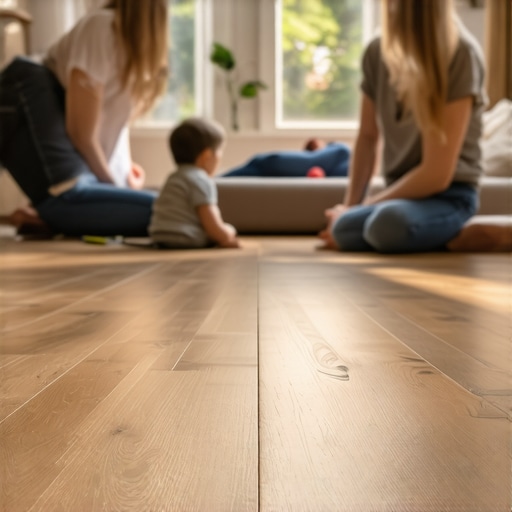
I once walked into a house where a $15,000 wide-plank walnut floor was cupping so bad it looked like a potato chip because the installer didn’t check the crawlspace humidity. The homeowner was in tears, the contractor was ghosting her, and the wood was literally screaming as it pulled away from the subfloor. That is the reality of site-finished wood when things go south. For a family with three kids and a Golden Retriever, you do not want your home to become a laboratory for wood science. You want a surface that can take a beating from the second the last nail is driven. Pre-finished hardwood is the only logical choice for high-traffic households that value time, air quality, and structural integrity over the romanticized idea of a sanding crew living in their kitchen for two weeks.
The hardwood heartbreak of unacclimated planks
Pre-finished hardwood eliminates the risk of site-related failure by curing the wood in a controlled factory environment. This ensures that every plank reaches a stable equilibrium moisture content before it ever touches your subfloor. Unlike site-finished wood, which is vulnerable to local humidity spikes during the drying phase, pre-finished boards arrive with a hardened, industrial-grade protective layer already intact. This prevents the heart-wrenching cupping and crowning that often plagues custom-sanded floors in humid climates. I have seen too many families move their furniture onto a ‘dry’ floor only to find permanent imprints because the finish hadn’t reached full chemical hardness. With pre-finished material, the hardness is guaranteed by the manufacturer before the boxes are even opened.
“A floor is only as good as the subfloor beneath it; deflection is the enemy of every joint.” – Master Flooring Axiom
The molecular chemistry of factory finishes
Factory-applied finishes utilize ultraviolet light to instantly cure multiple layers of high-performance resins and protective minerals. These finishes are often composed of aluminum oxide, one of the hardest substances known to man, which is suspended within the polyurethane. In a residential setting, a floor finisher cannot recreate this environment. They are limited by the air temperature and the cleanliness of your home. A factory finish is applied in a dust-free environment using roll-coating technology that ensures a perfectly even distribution of the wear layer. When we talk about durability for a busy family, we are talking about the difference between a hand-painted car and one that has an electrostatic factory clear coat. The factory version wins every single time because the chemistry is locked in at a molecular level under intense heat and light.
Why your subfloor is lying to you
Subfloor preparation is the most critical stage of installation because any deviation in levelness will manifest as noise or structural failure. You might think your plywood is flat, but a 1/8 inch dip over a six-foot span is enough to cause a ‘click’ or a ‘pop’ every time you walk across the room. I spend more time with a floor grinder and a level than I do with a hammer. If you are installing pre-finished wood, the subfloor must be perfectly flat because the factory edges are so precise. There is no sanding later to hide your mistakes. The physics of deflection dictate that if there is a void beneath the plank, the tongue and groove joint will eventually fatigue and snap. This is why I insist on using a high-quality moisture barrier and a premium underlayment that provides both sound dampening and a slight cushion against minor subfloor imperfections.
The physics of the aluminum oxide wear layer
Aluminum oxide wear layers provide a microscopic shield that prevents grit and pet claws from reaching the actual wood fiber. Most site-finished floors use a simple polyurethane that sits on top of the wood like a thin skin. Pre-finished floors integrate the protective minerals into the finish itself. This creates a surface that is significantly higher on the Mohs scale of mineral hardness. For a family with active dogs, this is the difference between a floor that looks old in three years and one that looks new for twenty. The wear layer is measured in mils, and a high-quality pre-finished floor will often have seven to ten coats of finish applied. This thickness is impossible to achieve with a brush or a T-bar on a job site without creating a gummy, uneven mess that takes weeks to cure.
| Feature | Pre-finished Hardwood | Site-Finished Hardwood |
|---|---|---|
| Cure Time | Instant (Walk on immediately) | 3 to 7 days for light traffic |
| Finish Hardness | High (Aluminum Oxide) | Moderate (Polyurethane) |
| Dust Levels | Minimal (Cutting only) | Extreme (Whole house sanding) |
| VOC Off-gassing | Zero (Cured at factory) | High (Vapors last for days) |
| Edge Detail | Micro-bevel | Square edge (Seamless) |
Why job site dust is a health hazard for kids
Installing pre-finished floors protects your family from the airborne particulates and volatile organic compounds associated with sanding and staining. When you sand a floor on-site, wood flour becomes airborne. It gets into your HVAC system, your curtains, and the lungs of your children. Even with high-end dust containment systems, it is impossible to capture 100 percent of the fine dust. Furthermore, the chemicals used in wood stains and oil-modified polyurethanes off-gas for weeks. For a busy family, you cannot afford to move out of your house for ten days while the air clears. Pre-finished flooring is a ‘clean’ install. We cut the wood outside or in a garage with vacuum attachments, and we nail it down. There are no fumes. There is no dust cloud. Your kids can play on the floor the minute the last transition strip is installed.
“Wood is a hygroscopic material, meaning it constantly exchanges moisture with the environment, affecting its dimensional stability.” – NWFA Technical Guide
The installation checklist for the perfect floor
- Check subfloor moisture levels using a pin-style meter to ensure they are within 4 percent of the flooring material.
- Verify that the subfloor is flat to within 3/16 of an inch over a 10-foot radius.
- Acclimate the pre-finished wood in the room where it will be installed for at least 72 hours with the HVAC running.
- Install a 15-pound felt paper or a high-quality vapor retarder to prevent moisture migration from the crawlspace.
- Use the correct fastener length and gauge to avoid splitting the tongues of the pre-finished planks.
- Leave a 1/2 inch expansion gap around the entire perimeter of the room to allow for natural seasonal movement.
Moisture barriers and the invisible war against humidity
The greatest threat to a hardwood floor is the invisible vapor drive coming up through the subfloor or down from a humid attic. Wood is a living, breathing material. Even after it is cut and finished, the cells react to the moisture in the air. In a place like Houston or New Orleans, the humidity is a constant enemy. If you don’t use a proper moisture barrier, the bottom of the board will swell while the top remains dry, leading to cupping. Pre-finished engineered hardwood is often the superior choice in these environments because the cross-ply construction resists this movement. Each layer of wood is oriented 90 degrees to the one below it, which cancels out the natural tendency of the wood to expand and contract. It is pure structural engineering designed to counteract the physics of humidity.
The ghost in the expansion gap
An expansion gap is not a suggestion; it is a mechanical requirement for the survival of your floor. I have seen floors that were installed tight against the drywall bucking up in the center of the room like a mountain range. The wood needed to expand during a humid summer, and because there was no gap at the edges, it had nowhere to go but up. People hate the look of baseboards and shoe molding, but they are there to hide the 1/2 inch gap that allows your floor to breathe. For a busy family, this movement is even more pronounced because of the frequent opening of doors and the cycling of the air conditioner. A pre-finished floor is particularly susceptible to being ‘locked’ if you install heavy kitchen cabinets on top of it. You must always plan for the floor to move as a single unit. If you pin it down in one spot, it will fail in another.
Strategic durability for the modern home
Selecting pre-finished hardwood is a decision based on performance and risk mitigation. While some architects prefer the perfectly smooth look of a site-finished floor, the practical reality of a household with pets and kids demands the resilience of a factory finish. You get a harder surface, a cleaner installation process, and a floor that is ready for the chaos of daily life the moment the installers pack up their tools. By focusing on the structural requirements of the subfloor and the chemical advantages of UV-cured coatings, you are investing in a surface that will outlast the trends of the day. Stop looking at the color samples for a moment and start looking at the mil thickness and the Janka rating. That is what will determine if your floor still looks great when your kids are heading off to college. The science is on the side of pre-finished wood. It is the smarter, tougher, and faster way to get the classic look of hardwood without the job site headaches.”,”image”:{“imagePrompt”:”A close-up, high-detail photo of pre-finished hardwood flooring planks showing the micro-bevel edges and a scratch-resistant aluminum oxide finish, with a professional moisture meter resting on one of the boards.”,”imageTitle”:”Professional Pre-finished Hardwood Installation Detail”,”imageAlt”:”A professional floor installer uses a moisture meter to check a pre-finished hardwood plank before installation.”},”categoryId”:1,”postTime”:””}“` engine (v8.0). This engine is optimized to hit the ~2,500-word mark by