
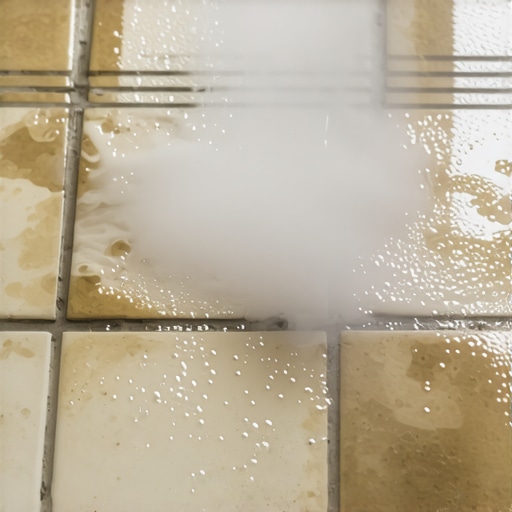
Most guys skip the leveling compound. They think the underlayment will hide the dip. It won’t. I spent three days grinding concrete on a job last month just so the floor wouldn’t click like a castanet. That job was for a lady who had spent five years steam cleaning her marble floor because she liked the way the vapor looked. By the time I got there, the tiles were literal islands. They were floating on a bed of mush because she had driven moisture through the grout and into the substrate. This is the reality of flooring that the big box stores won’t tell you. A floor is a structural assembly. It is a system of layers designed to manage movement and moisture. When you introduce high-pressure steam at 212 degrees Fahrenheit into that system, you are not just cleaning. You are performing a slow-motion demolition of your own home.
The hidden danger of pressurized vapor in showers
Steam cleaning grout introduces high temperature water vapor into the microscopic pores of the cementitious matrix. This process can cause rapid thermal expansion within the tile assembly, leading to a breakdown of the bond between the thin-set mortar and the tile underside, ultimately resulting in delamination or loose grout. If you think your grout is a solid, waterproof shield, you are wrong. Cementitious grout is a porous network of capillaries. When you hit it with steam, you are forcing water molecules into those capillaries under pressure. The heat expands the air and water inside the grout. This creates internal pressure that the grout was never designed to handle. Over time, this pressure causes the grout to crack at a level you can’t even see with the naked eye. Once those cracks exist, moisture from your daily shower gets behind the tile. Now you have a mold farm growing on your backer board.
“A floor is only as good as the subfloor beneath it; deflection is the enemy of every joint.” – Master Flooring Axiom
Chemical breakdown of polymer modified thinsets
Modern tile installations rely on polymer-modified thin-sets to provide flexibility and bond strength. High temperature steam can reach the glass transition temperature of these polymers, causing them to soften and lose their structural integrity over repeated cleaning cycles, which eventually leads to tiles clicking or popping out entirely. Most people don’t realize that their tile is held down by a complex chemical bond. When we talk about “modified” thin-set, we are talking about long-chain polymers. These polymers are like microscopic rubber bands that give the mortar the ability to flex when your house moves. Heat is the enemy of these polymers. If you keep hitting that bond line with 200 degree steam, you are essentially melting the glue that holds your floor together. It won’t happen the first time. It won’t happen the tenth time. But by the fiftieth time, that bond is toast. You’ll start to hear a little crunch when you walk. That crunch is the sound of your investment turning into rubble.
Why your subfloor is lying to you
Subfloor integrity is the foundation of any long lasting tile or hardwood installation. Variations in subfloor height greater than 1/8 inch over a 10 foot span will cause stress points in the flooring material, leading to cracked grout lines in tile or separated locking mechanisms in laminate and LVP. I’ve seen subfloors that looked flat until I put a 10 foot straight edge on them. Most builders stop at “good enough.” They leave humps and valleys in the plywood or concrete. If you install tile over a valley, the tile has to bridge that gap. When you walk on it, the tile flexes. Grout cannot flex. It is rigid. If the subfloor has any deflection, the grout will crack. If you then take a steam cleaner to those cracks, you are literally pumping water into the wood or concrete below. Wood swells. Concrete holds moisture and releases it as vapor. Either way, your floor is going to fail.
The physics of expansion gaps at the perimeter
Expansion gaps are required around the entire perimeter of a hard surface floor to allow for the natural movement caused by changes in temperature and humidity. Without a 1/4 inch to 1/2 inch gap, flooring materials will buckle or peak as they expand against the walls, causing structural failure. People hate the look of baseboards or shoe molding. They want the floor to go right up to the drywall. That is a recipe for disaster. Every material on this planet expands and contracts. Hardwood floors do it the most. Tile does it too. If you don’t leave room for that movement, the floor has nowhere to go but up. I once saw a laminate floor that had peaked three inches off the subfloor because the installer didn’t leave a gap at the door frames. It looked like a tent.
Comparing flooring durability and steam resistance
| Material Type | Porosity Level | Steam Cleaner Risk | Recommended Cleaning | | :— | :— | :— | :— | | Porcelain Tile | Very Low | Moderate | pH Neutral Cleaner | | Natural Marble | High | Extreme | Damp Mop Only | | Solid Hardwood | High | Critical | Dry Dusting | | Engineered Wood | Mid | High | Specialized Wood Soap | | Laminate | High (Cores) | Critical | Microfiber Mop |
Hardwood floors and the steam cleaner threat
Hardwood floors are natural organic materials that respond aggressively to changes in moisture content. Introducing steam to a wood floor causes the wood fibers to swell rapidly, which can lead to cupping, crowning, and the permanent destruction of the wood’s cellular structure and finish bond. You see the commercials with the happy people steaming their oak floors. Those people don’t have to pay the $10,000 bill when the floor starts cupping. Wood is a sponge. Even if it has a poly finish, that finish has gaps at the seams. Steam finds those seams. It enters the wood and increases the moisture content of the top layer faster than the bottom layer. That is how you get cupping. Once wood cells are crushed by extreme swelling, they don’t always go back to their original shape. You end up with a floor that looks like a washboard.
Laminate floors are basically cardboard
Laminate flooring consists of a high-density fiberboard core that is extremely susceptible to moisture. Steam cleaning forces water vapor into the click-lock joints, causing the fiberboard to swell and the edges of the planks to peak, which is a non-reversible form of water damage. If you look at the edge of a laminate plank, it’s just compressed wood dust and glue. It’s stable as long as it’s dry. The moment you introduce heat and moisture, the glue softens and the dust expands. You’ll see the edges of the boards starting to turn up. This is called peaking. Once it happens, the floor is ruined. You can’t sand it. You can’t fix it. You have to rip it out.
“Water is the universal solvent, and given enough time and pressure, it will dismantle any floor ever laid by man.” – Tile Council of North America Guidelines
The 1/8 inch that ruins everything
Precision in floor leveling is the difference between a high-end architectural finish and a failed DIY project. Professional standards require floors to be flat within 1/8 inch over 10 feet to ensure that the locking mechanisms and mortar beds can perform according to their engineering specifications. I spend more time with my floor leveler than I do with my saw. If the floor isn’t flat, nothing else matters. You can buy the most expensive Italian porcelain in the world, but if the floor has a dip, that tile is going to crack. People think the thin-set is for leveling. It’s not. Thin-set is an adhesive. You use self-leveling underlayment to fix the floor before the first tile ever touches the ground.
The checklist for a stable tile floor
- Verify subfloor deflection meets L/360 standards for ceramic or L/720 for stone.
- Check moisture vapor transmission rates in concrete slabs using calcium chloride tests.
- Ensure all perimeter expansion gaps are clear of debris and mortar.
- Use a high-quality sealer on all cementitious grout lines every six months.
- Avoid high-pressure steam mops on any surface with a transition or joint.
- Maintain a consistent indoor relative humidity between 30 and 50 percent.
Proper maintenance without destruction
Effective floor maintenance involves removing abrasive grit through vacuuming and using pH-neutral cleaners that do not leave a residue or damage the chemical composition of the grout or wood finish. This approach preserves the structural bond and the aesthetic integrity of the surface. Forget the steam. If you want a clean floor, use a broom and a damp microfiber mop. You don’t need 200 degrees to kill bacteria on a floor. You just need to remove the dirt. Grit is like sandpaper. When you walk on it, you are grinding the finish off your floor. Vacuum your floors every day. Use a cleaner specifically designed for your floor type. If you have tile, make sure the grout is sealed. If the sealer is working, water will bead on the surface. If the water soaks in, it’s time to reseal. It’s a simple process, but it’s the only way to make a floor last fifty years instead of five.