
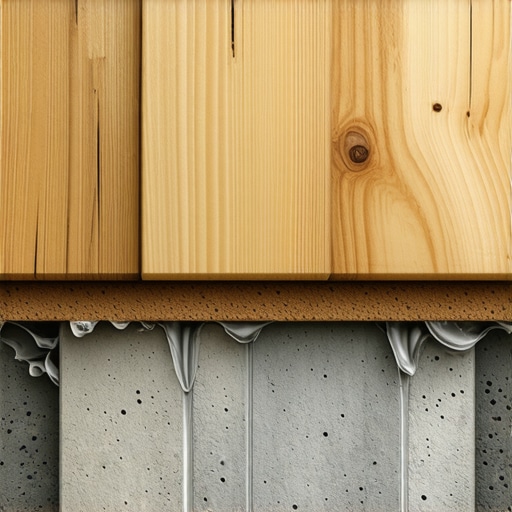
I spent three days grinding concrete on a job last month just so the floor wouldn’t click like a castanet. Most guys skip the leveling compound. They think the underlayment will hide the dip. It won’t. I have seen countless homeowners and amateur installers look at a perfectly dry looking concrete slab and assume it is safe. They throw down a cheap foam pad, click the planks together, and walk away. Three months later, they are calling me because the floor feels like a trampoline and the seams are peaking. That is the reality of subfloor moisture. It is an invisible force that treats your expensive laminate like a snack. My knees are shot and my hands smell like WD-40 and oak dust because I do this the right way. If you want a floor that lasts, you stop looking at the color and start looking at the chemistry of the slab.
The invisible water rising from the slab
Subfloor moisture migrates upward through concrete via vapor drive, eventually saturating the underside of laminate planks. This moisture causes the high-density fiberboard core to expand, leading to bubbles, peaking, and structural failure. Even if the surface looks dry, hydrostatic pressure keeps the moisture moving constantly. You have to understand that concrete is a sponge. It is not a solid, impenetrable mass. It is a network of microscopic capillaries. When the ground underneath your house gets wet, that water wants to move from the high-pressure area of the soil to the low-pressure area of your climate-controlled living room. This is the physics of vapor transmission. If you put a non-porous layer of laminate over it without a proper barrier, you are essentially creating a greenhouse. The water vapor hits the bottom of the plank and has nowhere to go. It sits there. It soaks into the wood fibers. It breaks the chemical bonds of the resins holding that HDF together. You get bubbles because the material is literally growing from the inside out. It is a slow motion explosion of the floor joints.
“A floor is only as good as the subfloor beneath it; deflection is the enemy of every joint.” – Master Flooring Axiom
The ghost in the expansion gap
Expansion gaps at the perimeter of a room are required to allow the floor to breathe as humidity fluctuates throughout the seasons. Without these gaps, the laminate planks have no room to grow and will buckle or bubble upward at the weakest point. A quarter-inch gap is the industry minimum. I have seen people jam their laminate right up against the drywall. They think it looks cleaner. What they are actually doing is building a ticking time bomb. Laminate is made of wood byproducts. Wood reacts to moisture. When the relative humidity in your house jumps from 30 percent in the winter to 60 percent in the summer, those planks are going to expand. If they hit a wall, they cannot go sideways. They have to go up. That is where you get those weird humps in the middle of the hallway. It is basic mechanical engineering. You need to leave at least a quarter inch, though I prefer a half inch if the baseboards are thick enough to cover it. You are not just laying a floor; you are managing a living system that wants to move. If you lock it down, it will break your heart.
Why your subfloor is lying to you
Surface dryness is a deceptive metric that ignores the internal moisture content of a concrete or wood subfloor. A slab can feel dry to the touch while still holding enough water to ruin a laminate installation within weeks. Professional moisture testing is the only way to verify the substrate. I always carry a moisture meter. I do not care if the house is fifty years old or fifty days old. You need to know the numbers. For concrete, you should be looking at the Relative Humidity levels inside the slab using in-situ probes. This is the ASTM F2170 standard. If that slab is over 75 percent RH, you are asking for trouble. For wood subfloors, you want to be within 2 to 4 percent of the moisture content of your laminate planks. If the subfloor is at 12 percent and your flooring is at 6 percent, that moisture is going to equalize by moving into your new floor. This causes the planks to cup. The edges will rise up, and you will see those characteristic bubbles along the seams. It is not a defect in the product. It is a defect in the preparation. You cannot outrun the laws of thermodynamics.
| Metric | Concrete Slab Requirement | Plywood Subfloor Requirement |
|---|---|---|
| Moisture Content (MC) | < 4% (Tramex) | < 12% Total |
| Relative Humidity (RH) | < 75% (ASTM F2170) | N/A |
| Flatness Tolerance | 1/8 inch over 10 feet | 3/16 inch over 10 feet |
| Acclimation Time | 72 Hours Minimum | 48 to 72 Hours |
The 1/8 inch that ruins everything
Subfloor flatness is just as important as moisture control because low spots allow the floor to flex, which pumps air and moisture through the joints. A floor that is not flat within 1/8 inch over a 10-foot radius will eventually suffer from mechanical joint failure. When the floor is uneven, every time you step on it, the plank deflects. This deflection acts like a bellows. It sucks in the humid air from the subfloor and pushes it through the locking mechanism. This is why you see bubbling specifically at the edges. The constant mechanical stress of walking on an uneven floor weakens the melamine wear layer. Once that seal is broken, any moisture in the air or on the floor gets into the core. I spend more time with a straightedge and a bag of self-leveling compound than I do actually laying planks. If the foundation is trash, the finish will be trash. You can buy the most expensive laminate in the world, but if your subfloor has a dip, it will feel like a cheap hotel floor within a year. Leveling is the most fundamental part of the job that everyone wants to skip because it is messy and takes time.
- Test the subfloor with a pin-less moisture meter before starting.
- Ensure the concrete slab has cured for at least 28 days if it is new construction.
- Install a 6-mil polyethylene vapor barrier over all concrete substrates.
- Check the flatness of the floor using a 10-foot straightedge.
- Acclimate the laminate planks in the room for at least 48 hours before opening the boxes.
- Use a high-quality underlayment that provides both sound dampening and moisture resistance.
The chemistry of the laminate core
The core of most laminate flooring is High-Density Fiberboard, which is composed of compressed wood fibers and resin. While the top layer is durable, the raw HDF core is highly hydrophilic and will swell rapidly when exposed to liquid water or high vapor pressure. Think of the HDF core as a compressed sponge. The manufacturing process uses heat and pressure to bind these fibers together, but they still want to return to their natural state. When water molecules penetrate the core, they lodge between the wood fibers. This causes the fibers to expand. Because the top wear layer is rigid, the only way the material can expand is by bulging. This is what you see as a bubble. It is the internal structure of the plank failing. Many modern floors claim to be waterproof, but this usually just means the joints are tight or the top is coated. If water gets underneath, the game is over. No amount of wax or topical sealant can stop vapor drive from the bottom. This is why I tell people to stop obsessing over the finish and start worrying about the vapor barrier. A 6-mil poly sheet costs twenty bucks and saves a five thousand dollar floor.
“Substrate preparation is the silent partner of a successful installation; ignore it at your own peril.” – TCNA Flooring Standard
The cushion myth and locking failure
While most people want the thickest underlayment, too much cushion actually causes the locking mechanisms on LVP and laminate to snap under pressure. Excessive vertical movement leads to seam separation which allows moisture to penetrate the core easily. I see this all the time. People buy a laminate that already has a pad attached, and then they add another thick foam pad underneath it. They think they are being smart by making the floor softer. They are actually killing the floor. These locking systems are engineered for a specific amount of deflection. If the floor is too bouncy, the tongue and groove will rub against each other every time you walk. This friction wears down the locking profile. Eventually, the joint snaps. Once the joint is gone, the floor is no longer water resistant. Any moisture in the subfloor or a spilled drink will go straight into the HDF core. You want a firm, high-density underlayment, not a soft pillow. The goal is support, not squish. If you want a soft floor, buy a rug. If you want a floor that stays flat, use a high-compression underlayment that limits vertical travel.