
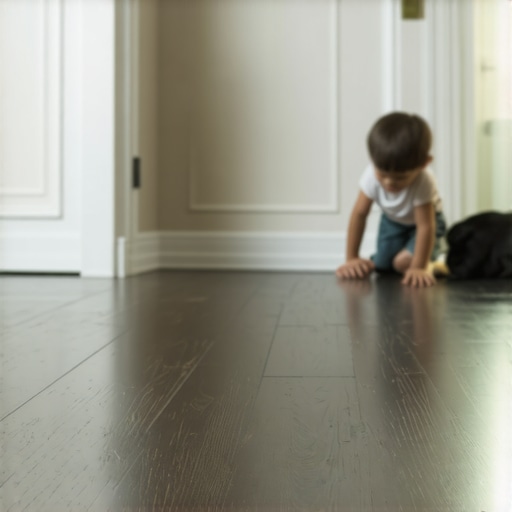
The dark wood trap for families
I once walked into a house where a $15,000 wide-plank walnut floor was cupping so bad it looked like a potato chip because the installer didn’t check the crawlspace humidity. The homeowner was in tears. Not only was the floor physically failing, but every single scratch from their Golden Retriever looked like a neon sign against that deep, dark finish. I could smell the oak dust on my shirt and the WD-40 on my hands as I knelt down to show them the moisture meter reading. It was a disaster that could have been avoided with a little common sense and a better understanding of how light interacts with dark pigments. Dark floors are a vanity project for people without a pulse or a pet. For the rest of us, they are a relentless maintenance treadmill. You think you are buying elegance. What you are actually buying is a full-time job as a janitor. I have spent twenty five years on my knees looking at wood cells through a jeweler’s loupe, and I am telling you, dark wood is the enemy of the active household. It is not just about the color. It is about the physics of light, the chemistry of polyurethane, and the inevitable reality of life with small humans and animals.
Why every scratch screams on a dark surface
Dark hardwood floors reveal scratches because the natural wood color underneath the pigmented stain is significantly lighter, creating a high contrast visual. When a dog claw or metal toy breaks the finish layer, the resulting white line stands out against the espresso or ebony background immediately. This is not just a cosmetic issue. It is a fundamental problem with how light hits the surface. When you have a natural oak floor, a scratch is just a texture change. On a dark floor, a scratch is a color change. The molecular structure of the finish itself often turns white when it is crushed or abraded. This is known as the white-out effect. In a room with high natural light, these marks become the focal point of the entire space. You can try to hide them with touch-up pens, but you are just chasing a ghost. The moment the sun hits that floor at a forty five degree angle, every single transgression is revealed.
“A floor is only as good as the subfloor beneath it; deflection is the enemy of every joint.” – Master Flooring Axiom
The science of light reflection and dust
Dust and pet dander are naturally light colored particles that show up prominently on dark flooring surfaces because of refractive contrast. A dark floor acts like a mirror for debris, making even a single day of dust look like a week of neglect. This is the part they don’t tell you in the showroom. In the showroom, the lighting is controlled and the floors are polished every twenty minutes. In your house, the dust settles constantly. Every skin cell, every bit of lint, and every speck of dirt is highlighted. It is the same reason a black car looks dirty five minutes after it leaves the car wash. If you live in a place with high humidity like Houston, that dust can even stick to the surface, making it harder to sweep. You will find yourself reaching for the microfiber mop three times a day. It is exhausting. I have seen homeowners go from loving their dark floors to hating them in less than a month because of the constant cleaning requirements.
How pet dander turns your floor into a crime scene
Pet hair and dander create an obvious visual layer on dark hardwood because most pet fur is lighter than the floor stain. The oils from pet paws also leave visible smudges on dark satin or semi-gloss finishes, requiring frequent cleaning to maintain a uniform appearance. I have watched dogs walk across a dark floor and leave a trail of paw prints that look like they were made with grease. This is because the natural oils in their pads interact with the surface tension of the finish. If you have a cat, their dander will settle in the grain and look like white salt. It is not just about the hair. It is about the microscopic bits of skin and the trail of moisture they leave behind. If your pet has an accident, the tannins in certain woods like white oak can react with the ammonia in the urine, causing a black stain that is even harder to hide on a dark floor. You are fighting a losing battle against biology. The Janka hardness of the wood doesn’t even matter here. You could have the hardest wood in the world, and it will still look terrible if it is covered in paw prints and fur.
Hardness and Visibility Comparison
| Wood Species | Janka Hardness Rating | Scratch Visibility | Maintenance Level |
|---|---|---|---|
| White Oak | 1360 | Low | Moderate |
| Brazilian Cherry | 2350 | Medium | High |
| Ebony Stained Maple | 1450 | Extreme | Very High |
| Natural Hickory | 1820 | Very Low | Low |
Maintenance nightmares you cannot ignore
Cleaning dark hardwood requires specialized pH-neutral cleaners and frequent microfiber dusting to avoid streaking and hazy buildup. Unlike lighter floors, dark wood shows water spots and residue from floor wax or improper soaps almost instantly. You cannot just grab a bucket of mop water and go to town. If you use too much water, you risk the wood swelling. If you use the wrong soap, you leave a film. I tell my clients to avoid those big-box store spray mops that promise a shiny finish. That shine is just a layer of acrylic that will eventually peel or turn cloudy. Once that happens, you are looking at a full sand and refinish. For a dark floor, that means moving all your furniture out and living in a hotel for a week while the dust settles. It is a massive headache. You have to be a stickler for the rules.
“Wood is a hygroscopic material; it will always try to reach equilibrium with its environment, regardless of the stain color.” – NWFA Technical Guidelines
Subfloor stability and the dark floor myth
Subfloor preparation is more critical for dark floors because minor deflections can cause seam peaking, which is highly visible on darker surfaces. If your subfloor is not level within one eighth of an inch over ten feet, the shadows cast by uneven planks will be magnified by the dark stain. Most guys skip the leveling compound. They think the underlayment will hide the dip. It won’t. I spent three days grinding concrete on a job last month just so the floor wouldn’t click like a castanet. If you have a dark floor on an uneven subfloor, every time a plank flexes, you might see the light-colored tongue and groove start to peek through. This is called ‘white lining’ and it is the bane of my existence. You need a rock-solid foundation. If you are putting dark wood over a bouncy plywood subfloor, you are asking for trouble. The movement will eventually break the finish at the joints, and then you have a series of white cracks running through your beautiful dark expanse.
Better alternatives for high traffic homes
Lighter wood tones and natural finishes are superior for families because they mask scratches and hide dust through low contrast. Options like wire-brushed oak or distressed hickory provide texture that camouflages wear and tear from kids and pets. If you absolutely must have a dark look, look into a high-quality laminate. Modern laminates have a wear layer that is much tougher than a site-finished hardwood. But even then, the dark color will show the dust. My advice is to go with a mid-tone ‘gunstock’ or a natural ‘clear’ finish. It hides a multitude of sins. You can go a week without sweeping and nobody will notice. With a dark floor, you can’t go six hours. If you are worried about the ‘dated’ look of light wood, look at the European White Oak trends. They are light, airy, and they make a room feel huge. Plus, they don’t show the dog’s hair.
The Essential Maintenance Checklist
- Dust mop daily with a clean microfiber head.
- Ensure indoor humidity stays between 35 and 55 percent.
- Use felt pads on every single piece of furniture.
- Trim pet nails every two weeks without fail.
- Avoid all steam mops as they delaminate the finish.
- Use area rugs in high-traffic transition zones.
The truth about Janka ratings and finish hardness
Janka ratings measure the force required to embed a steel ball into the wood, but they do not account for finish scratch resistance. A hard wood species like Hickory can still show scratches if the dark polyurethane coating is soft or brittle. People get hung up on the Janka scale. They think if they buy a hard wood, it won’t scratch. That is a lie. The wood doesn’t scratch. The finish scratches. And when that finish is dark, the scratch is visible. I have seen Brazilian Cherry, which is hard as a rock, look like a mess because the homeowner had two labs. The wood didn’t dent, but the finish was shredded. If you are going dark, you need a commercial-grade finish with aluminum oxide additives, but even that has its limits. The best finish in the world can’t overcome the laws of optics. When you gouge a dark surface, it reflects light differently. That is the end of the story. Stop looking at the hardness of the wood and start looking at the reality of your lifestyle. If you have kids who drop Legos and dogs who zoom through the hallway, dark hardwood is a mistake you will regret every time you pick up a broom.