
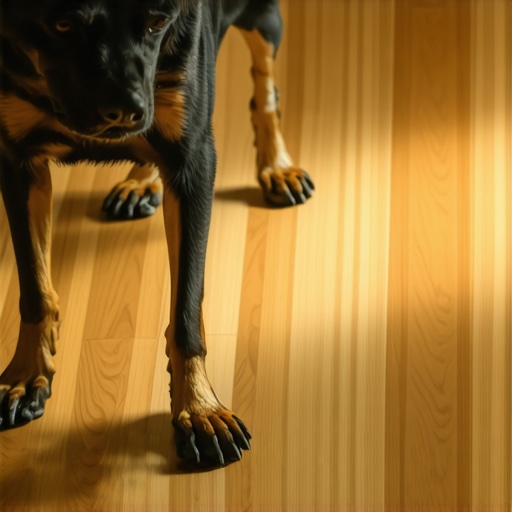
The hidden cost of dark hardwood floors for dog owners
I once walked into a house where a $15,000 wide-plank walnut floor was cupping so bad it looked like a potato chip because the installer didn’t check the crawlspace humidity. It was a tragedy of professional negligence. But what happened next was even more heartbreaking. Once we stabilized the environment and the floor settled, the homeowner brought in two massive Great Danes. Within a week, that dark, sophisticated walnut looked like it had been through a wood chipper. The deep, rich stain that looked so beautiful in the showroom became a high-contrast canvas for every single scratch, hair, and speck of dander. If you are a dog owner, choosing a dark floor is not just a design choice, it is a commitment to a perpetual maintenance cycle that most people are not prepared to handle. You are fighting against the physics of light and the chemistry of topcoats.
The optical trap of deep ebony stains
Dark hardwood floors create a high-contrast background that highlights light-colored debris including dog hair, skin cells, and microscopic scratches in the polyurethane. These finishes absorb light rather than reflecting it, making the white refractive index of a scratch stand out with extreme clarity against the dark wood grain. This phenomenon is the primary reason why professional installers steer pet owners away from dark palettes. When a dog’s claw, which is composed of keratin, strikes a hardwood floor, it does not always penetrate the wood itself. Often, it merely deforms the protective topcoat. On a light natural oak floor, that deformation is invisible. On a dark stained floor, the light hits that tiny valley in the finish and reflects a bright white line. It looks like the floor is ruined when, in reality, you are just seeing the physics of light reflection at work. You are essentially living on a giant chalkboard where every movement is recorded in white lines. Every time your dog jumps off the sofa or runs to the door, they are signing their name into your investment. Most homeowners do not realize that the darker the stain, the more visible the wear. It is a mathematical certainty in the world of flooring physics.
Why dog claws act like microscopic chisels
Dog claws exert concentrated pressure measured in hundreds of pounds per square inch during sudden movements or traction events. This mechanical force exceeds the sheer strength of many residential hardwood finishes, leading to permanent indentations in the wood fibers and fractures in the protective wear layer of the floor. When a large dog accelerates, their back legs exert a tremendous amount of force on a very small surface area. If you look at a dog’s paw, only the tips of the claws provide the traction needed for a sprint. This is a point-load nightmare for any flooring material. Even the hardest wood species on the Janka scale, like Brazilian Cherry or Hickory, cannot fully resist the localized pressure of a 90-pound Labrador. The wood cells beneath the finish are compressed, and the finish itself must flex with that compression. If the finish is too brittle, it cracks. If it is too soft, it scratches. Dark stains exacerbate this because the pigment is often pushed out of the way or highlighted by the damage. [IMAGE_PLACEHOLDER] I have seen homeowners spend thousands on exotic Wenge only to realize their pets have effectively sanded the floor in high-traffic zones within six months.
“A floor is only as good as the subfloor beneath it; deflection is the enemy of every joint.” – Master Flooring Axiom
The structural failure of dark finishes
Dark stains require more pigment which can sometimes interfere with the chemical bond between the wood grain and the polyurethane topcoat if not applied correctly. Heavy pigmentation can sit on the surface of the wood cells, creating a layer that is more prone to chipping and flaking under the mechanical stress of pet traffic. This is a chemistry problem that many retail-focused designers ignore. When we site-finish a floor, the stain must penetrate the wood. If we go very dark, we are saturating the wood fibers with oil or water-based pigments. This can sometimes prevent the first coat of finish from grabbing the wood as effectively as it would on a natural board. When your dog slides across the floor, they are applying lateral force. If the bond between the finish and the wood is compromised by an over-abundance of stain pigment, you get delamination. This looks like small white flakes coming off the floor. It is a structural failure at the molecular level. This is why I always recommend site-finished floors over pre-finished if you must go dark, because we can control the dry times and the chemical compatibility better in the field, though even then, the laws of physics still apply to the scratches.
The Janka scale and the lie of hardness
The Janka Hardness Scale measures the force required to embed a steel ball into wood, but it does not account for the scratch resistance of the finish or the visibility of damage on stained surfaces. A hard wood species with a dark stain will still show more pet damage than a soft wood with a natural finish. People often come to me saying they want Hickory because it is the hardest domestic wood. They think that hardness equals invincibility. It does not. Hardness only tells you how much the wood resists denting. It tells you nothing about how the surface will look after a year of dog claws. In fact, very hard woods are often more difficult to stain evenly, leading to blotchiness that makes scratches even more apparent. If you put a dark ebony stain on a Hickory floor, you are getting a very hard surface that still shows every single white scratch. You have essentially created a very durable billboard for your dog’s activity.
| Wood Species | Janka Rating | Pet Suitability | Visibility of Scratches |
|---|---|---|---|
| White Oak | 1360 | High | Low (Natural) |
| Hickory | 1820 | High | Moderate |
| Black Walnut | 1010 | Low | Very High |
| Maple | 1450 | Moderate | High (Stained) |
The subfloor and moisture factor
Moisture levels in the subfloor and ambient humidity directly affect the stability of hardwood planks, which can worsen the appearance of scratches if the boards begin to cup or crown. Darker floors show the shadows created by uneven board edges more prominently than lighter floors do. In my 25 years of doing this, I have noticed that dark floors are incredibly unforgiving of subfloor imperfections. If your subfloor has a dip of 1/8 inch over 10 feet, a light oak floor will hide it. A dark, semi-gloss floor will reflect the light in such a way that the dip looks like a canyon. Now add a dog to that mix. As the dog walks over a slightly uneven area, the boards flex. That flex causes the boards to rub against each other, often squeaking or causing the finish at the edges to crack. On a dark floor, those white cracks at the seams look like a spiderweb. We spent three days grinding concrete on a job last month just so the floor wouldn’t click like a castanet. If we hadn’t done that, the dark finish would have failed at every joint within a year. You cannot separate the aesthetics of the top from the engineering of the bottom. They are one single system.
“Wood is a hygroscopic material that will always seek equilibrium with its environment; ignore the moisture at your own peril.” – NWFA Technical Guidelines
The 1/8 inch that ruins everything
Expansion gaps at the perimeter of a room are vital for allowing hardwood to breathe as humidity changes throughout the seasons. Dark floors make the gaps between the floor and the baseboards more visible if the wood shrinks during dry winter months. This is another reason dark floors are a headache. Wood is alive. It moves. In the winter, when the heater is running, the wood loses moisture and shrinks. Small gaps appear between the planks. On a light-colored floor, the subfloor or the tongue of the board underneath is a similar color, so you don’t notice it. On a dark floor, the gap looks like a black hole. If you have a dog, those gaps become magnets for hair and dirt. You end up with a dark floor that has light-colored dog hair trapped in every single expansion gap. It is a visual nightmare. I tell my clients that if they can’t live with a 1/32 inch gap, they shouldn’t buy hardwood. If they have a dog and want dark hardwood, they should probably just buy a vacuum and prepare to use it three times a day.
Better alternatives for high-traffic homes
Homeowners who desire the look of dark wood but have large dogs should consider luxury vinyl plank with a 20-mil wear layer or porcelain wood-look tile. These materials offer superior scratch resistance and are not susceptible to the moisture-related issues that plague dark-stained natural wood. If you are dead set on the dark aesthetic, do yourself a favor and look at the modern LVP options. But be careful. While most people want the thickest underlayment, too much cushion actually causes the locking mechanisms on LVP to snap under pressure. You want a firm, stable base. LVP is essentially a photograph of wood protected by a clear layer of PVC and often aluminum oxide. It is much harder to scratch than a liquid polyurethane finish. If you must have real wood, go with a wire-brushed finish. This texture is created by pulling out the soft springwood with a wire wheel, leaving only the hard grain. When a dog scratches a wire-brushed floor, the scratch hides in the existing texture of the wood. It is the only way to keep your sanity as a dog owner with hardwood.
- Choose light to medium natural tones like White Oak or Natural Maple.
- Opt for a matte or satin finish to reduce light reflection on scratches.
- Select wood species with a busy grain pattern to camouflage wear.
- Ensure the subfloor is level to within 1/8 inch over 10 feet.
- Maintain indoor humidity between 30 and 50 percent year-round.
- Keep dog claws trimmed and use rugs in high-velocity transit zones.
The ghost in the expansion gap
Environmental control is the most overlooked aspect of floor longevity in homes with pets and dark finishes. Fluctuating temperatures can cause the finish to become brittle over time, making it easier for dog claws to chip the surface. Many people in the Northeast or the South experience massive swings in humidity. In a place like Houston, the swampy humidity means solid wood is a death wish; you need engineered cores. If you put a dark stain on a solid oak floor in a humid climate, the wood will expand and the dark finish will stretch. When the AC kicks in and dries the air, the wood shrinks but the finish has been stressed. This cycle creates microscopic fractures. When a dog runs across that stressed finish, it fails much faster than it would in a climate-controlled environment. You have to treat your home like a humidor if you want a dark floor to stay looking new. Most people are not that disciplined. They want to open the windows in the spring. If you do that, your dark floor will tell the story of every weather change and every dog sprint for the rest of its life.