
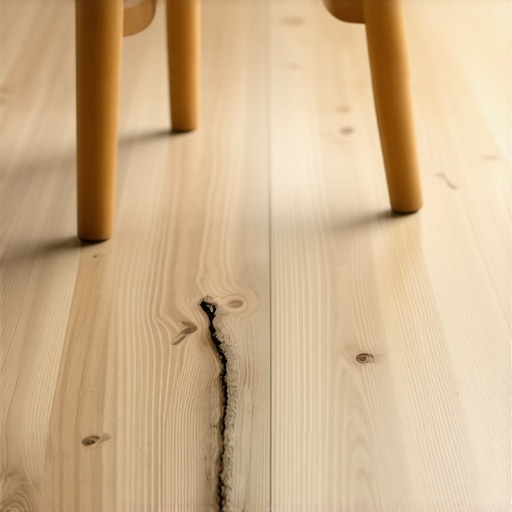
I once walked into a house where a $15,000 wide-plank walnut floor was cupping so bad it looked like a potato chip because the installer didn’t check the crawlspace humidity, but that was nothing compared to the homeowner who dragged a solid oak dining table across the room. I still smell the oak dust and the WD-40 from my tools as I remember the sound of that finish screaming. You spend a fortune on a floor that looks like solid wood, and then you treat it like a sidewalk. It makes my blood boil. Flooring is an engineered system, a performance surface that relies on the structural integrity of its layers and the chemical bond of its finish. When you slide a heavy dresser or a sofa across that surface, you are not just making a mark. You are initiating a mechanical failure that compromises the entire plank. I have spent twenty-five years on my knees with a moisture meter and a level, and I can tell you that the difference between a floor that lasts decades and one that ruins your week is usually found in how you move your furniture.
The mechanics of a surface scar
Dragging furniture on engineered hardwood causes permanent damage because the concentrated weight creates localized pressure that exceeds the hardness of the protective finish and the wood veneer. This action generates friction heat that can soften the urethane and allow grit to embed deeply into the wood fibers themselves. To understand why this happens, you have to look at the physics of the contact point. When a heavy object sits on a floor, its weight is distributed across the square inch of the leg. When you push that object, all that mass is focused on a leading edge. This creates a massive increase in pounds per square inch (PSI). Most engineered floors use a UV-cured urethane finish infused with aluminum oxide. This finish is incredibly hard, but it is also brittle. It is designed to resist vertical impact and general foot traffic, not the lateral shearing force of a dragging table leg. The friction generates enough heat at the point of contact to actually cause the finish to lose its elasticity. Once the finish is breached, you are scratching the actual wood. Since the wear layer on many engineered floors is only 2 to 4 millimeters thick, a deep scratch can reach the plywood core in a heartbeat. This is not like solid hardwood where you can just sand it down indefinitely. You have a finite amount of real wood to work with. If you gouge it, you have compromised the structural layer that gives the floor its aesthetic value.
Why the wear layer is thinner than you think
The wear layer of an engineered hardwood floor is the top slice of real wood that sits above the structural core layers. Most mid-grade products have a wear layer ranging from 2mm to 4mm in thickness, meaning a single deep gouge from furniture can penetrate the entire wood surface. I see this all the time. A homeowner buys a floor labeled as hardwood and assumes it has the same depth as a 3/4 inch solid oak plank. It does not. The core of your floor is likely cross-laminated birch or poplar. These softer woods are there for stability, not for looks. When you drag a heavy appliance, you are risking a tear that exposes that core. This is especially true in areas like kitchens where you might be tempted to slide a refrigerator to clean behind it. Unlike tile or grout in showers, which can handle a bit more abrasive contact, wood is a cellular material. It has pores and grains that can be crushed. Once those wood cells are crushed by the pressure of a dragging leg, they cannot be un-crushed. You are left with a permanent depression in the wood that will catch light and look like a scar forever. I always tell my clients to think of their floor like the skin of a high-end car. You would not drag a metal crate across the hood of a Porsche, so do not do it to your hickory planks.
The lie of the janka hardness scale
The Janka hardness scale measures the force required to embed a steel ball into wood, but it does not account for the scratch resistance of the chemical finish or the stability of the engineered core. A high Janka rating for the wood species does not protect your floor from furniture drags. People look at the Janka scale and see that Hickory is rated at 1820 while White Oak is at 1360. They think this makes their Hickory floor bulletproof. That is a dangerous assumption. The Janka test is about indentation, not scratching. While a Hickory floor might resist the dent from a dropped hammer better than Oak, the aluminum oxide finish on both floors is often the same thickness. If you drag a chair with a missing felt pad, the finish will scratch regardless of how hard the wood underneath is. Furthermore, the core of the engineered plank is often softer than the top veneer. If the pressure is high enough, the veneer can actually crack because the sub-layer beneath it gave way. It is a structural engineering problem. You have a hard shell over a semi-rigid core. When you apply lateral force, you are testing the shear strength of the bond between the wood and the adhesive. I have seen the top layer of a walnut floor actually delaminate and peel away because someone tried to slide a heavy bookcase without lifting it. The glue can only hold so much when you are using the floor as a lever.
| Wood Species | Janka Hardness Rating | Typical Wear Layer | Sensitivity to Scratches |
|---|---|---|---|
| Walnut | 1010 | 3mm | High |
| White Oak | 1360 | 4mm | Moderate |
| Hickory | 1820 | 3mm | Low (to dents) |
| Maple | 1450 | 2mm | Moderate |
Friction heat and finish failure
Friction heat generated by sliding heavy objects across a floor can cause the polyurethane finish to reach its glass transition temperature and soften. This softening allows microscopic debris to become permanently embedded in the surface of the engineered hardwood, resulting in a dull or hazy appearance. This is the chemistry that people ignore. UV-cured finishes are made of complex polymers like polyurethane diacrylate. These chains of molecules are cross-linked to provide a hard, clear surface. However, when you drag a heavy sofa, the friction at the point of contact can easily exceed 150 degrees Fahrenheit in a split second. This heat makes the polymer chains more mobile. If there is even a tiny amount of dust or grit on the floor, the heavy object pushes that grit into the softened finish. When the object passes and the finish cools down, that dirt is now part of your floor. This is why you see those long, dull streaks that won’t wash away. It is not just a scratch, it is a localized chemical and physical alteration of the finish. It is much harder to fix than a simple scratch. You can’t just rub a little oil on it. You have to mechanically remove the contaminated finish and hope you don’t burn through to the wood. This is why I always keep my shop vacuum running on a job site. Even a tiny bit of sawdust under a moving object acts like sandpaper.
“A floor is only as good as the subfloor beneath it; deflection is the enemy of every joint.” – Master Flooring Axiom
How subfloor dips amplify furniture damage
Uneven subfloors create localized high spots where the weight of furniture is concentrated during a drag, significantly increasing the likelihood of deep scratches. If a subfloor is not leveled to within 3/16 of an inch over 10 feet, the floor will flex and catch on moving objects. Most guys skip the leveling compound. They think the underlayment will hide the dip. It won’t. I spent three days grinding concrete on a job last month just so the floor wouldn’t click like a castanet. When you drag furniture over a floor that has a void underneath it, the plank bows downward. This causes the edges of the neighboring planks to kick up slightly. As you slide the furniture, the leg hits that raised edge like a speed bump. This is how you get those nasty chips at the seams. Engineered hardwood is designed to be a flat, continuous surface. Any deviation in the subfloor turns your floor into a series of obstacles. If you are installing over a concrete slab, you need to check for moisture and flatness. A wet slab will eventually cause the wood to expand, making it even more susceptible to damage when you move things around. Even laminate floors, which are often tougher than hardwood, will fail at the joints if the subfloor is not perfect. The grout in your bathroom tile would crack under the same conditions, and your hardwood is no different.
The correct way to move heavy objects
To safely move furniture on engineered hardwood, you must use high-density felt pads, air-sleds, or thick moving blankets to eliminate direct contact between the furniture and the floor. Lifting the object entirely is the only way to guarantee that no surface damage occurs during the process. I have a strict checklist for every job I finish. If I see a homeowner start to push a table, I stop them immediately. It doesn’t matter if it’s a small chair or a grand piano. The rules are the same.
- Inspect the bottom of every furniture leg for embedded grit or missing protectors.
- Apply heavy-duty felt pads that are slightly smaller than the leg so they don’t collect dust.
- Use a piece of 1/8 inch hardboard or Masonite as a temporary runway for very heavy appliances.
- Clean the floor thoroughly with a micro-fiber mop before moving anything to remove abrasive particles.
- Never use rubber or plastic casters as they can chemically react with the finish and leave marks.
If you follow these steps, you are protecting the structural integrity of your investment. You wouldn’t skip the waterproofing in your showers or the grout sealing in your kitchen, so don’t skip the protection for your hardwood floors. The cost of a few felt pads is nothing compared to the cost of a professional repair. Most people think they can just use a touch-up pen to fix a scratch. Those pens are for small nicks, not for three-foot-long gouges. If the scratch is deep enough to reach the core, the only real fix is to pull up the planks and replace them. That means taking off the baseboards, pulling up the transitions, and hoping you have enough matching material from the original lot. It is a nightmare you want to avoid. Take the extra five minutes to lift the furniture. Your floor and your wallet will thank you. Wood is a living, breathing material that has been repurposed into your home. Respect the physics of the installation and it will last you a lifetime.
“Wood flooring is a natural product that will expand and contract with changes in atmospheric conditions; proper acclimation is not optional.” – National Wood Flooring Association Standard