
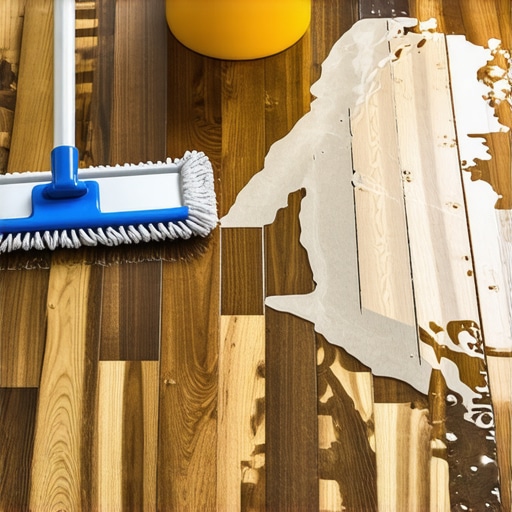
I remember a job in a suburban kitchen back in 2008. The homeowner was proud of her brand new laminate, but she treated it like her old linoleum. Every Saturday, she would drag out the heavy yellow mop bucket and slosh water across the floor. Within three months, every single joint was peaked like a mountain range. The moisture did not just sit on top. It found the seams and nuked the High-Density Fiberboard core. I had to rip out three hundred square feet of garbage because of a five dollar bucket. That was the day I realized people do not understand the physics of wood composites. They see a plastic surface and assume it is invincible. It is not. It is a sponge wrapped in a thin layer of melamine.
The water is the enemy of the core
Laminate flooring consists of a decorative layer fused to a high-density fiberboard HDF core that absorbs water with extreme efficiency through its unprotected edges. While the top wear layer is often resin-impregnated and resistant to spills, the click-lock joints are the Achilles heel. When you use a mop and bucket, liquid water enters these microscopic gaps and travels deep into the cellulose fibers of the core material. This triggers a chemical and physical reaction where the wood fibers expand at a rate that the surrounding resin cannot contain. The result is edge swelling, which is an irreversible structural failure of the floor board.
The chemistry of the swelling edge
The chemical bond between the melamine resin and the wood fiber core breaks down when subjected to prolonged hydrostatic pressure from standing water. You have to understand that HDF is essentially sawdust and glue. When water enters, it creates osmotic pressure. The fibers want to return to their natural, uncompressed state. This is why you see the edges of your laminate boards lifting or peaking. Once those fibers have expanded, they do not shrink back to their original size when they dry. The board is permanently deformed. If you use a mop and bucket, you are effectively feeding the sponge. Even if you think you wrung out the mop, you are leaving behind enough moisture to saturate the seams. This is a slow death for a floor that should have lasted twenty years.
“A floor is only as good as the subfloor beneath it; deflection is the enemy of every joint.” – Master Flooring Axiom
The physics of the capillary action
Capillary action pulls water into the tight joints of laminate flooring where evaporation cannot occur quickly enough to prevent damage. Because the gap between boards is so small, surface tension actually helps pull the water down into the seam. This is the same principle that allows trees to pull water from their roots to their leaves. On a floor, it means that even a small amount of dampness can be sucked into the core. Once the water is under the wear layer, it is trapped. It cannot evaporate through the plastic top. It sits there, rotting the fiberboard from the inside out. This is why manufacturers insist on dry mopping or using specialized cleaners that evaporate instantly upon contact.
The underlayment sponge effect
Standard foam underlayment acts as a secondary reservoir for moisture that seeps through the laminate joints, keeping the bottom of the boards wet for days. Most people think the underlayment is just for sound. It is actually part of the moisture management system, but it can work against you. If you flood the floor with a mop, the water that bypasses the core will pool on the underlayment. This creates a humid microclimate directly beneath your floor. This leads to mold, mildew, and a persistent musty smell that you can never quite get rid of. I have seen subfloors covered in black mold simply because someone liked the smell of Pine-Sol and a soaking wet mop. It is a structural disaster waiting to happen.
Why your subfloor is lying to you
A subfloor may appear dry on the surface while holding significant moisture that interacts with the laminate core when external humidity levels fluctuate. You cannot just look at a concrete slab and know it is ready. You need a calcium chloride test or a pinless moisture meter. If you add the moisture of a mop and bucket to a subfloor that is already at the limit of its moisture vapor emission rate, you are pushing the system over the edge. The balance is delicate. Laminate needs a stable environment. When you introduce liquid water, you are disrupting the equilibrium of the entire room. This leads to the floor shifting, clicking, and eventually failing at the locking mechanisms.
| Material Type | Moisture Tolerance | Core Composition | Primary Weakness |
|---|---|---|---|
| Laminate | Very Low | HDF / Wood Fiber | Edge Swelling |
| Hardwood Floors | Moderate | Solid Wood / Plywood | Cupping and Warping |
| LVP (Vinyl) | High | PVC / Stone Plastic | Heat Expansion |
| Ceramic Tile | High | Fired Clay | Cracked Grout |
The 1/8 inch that ruins everything
Maintaining a precise expansion gap of at least 1/8 to 1/4 inch at all vertical obstructions is required for laminate to survive seasonal changes. When you wet the floor with a mop, the boards expand. If they have no room to grow because you or your installer skipped the expansion gap, the floor will buckle. I have seen floors lift three inches off the subfloor like a tent. This happens because the force of the expanding wood fibers is immense. It can pop baseboards right off the wall. This is why keeping the floor dry is not just about the surface appearance, it is about maintaining the structural geometry of the installation. A dry floor is a stable floor.
Maintenance strategies that actually work
Effective laminate maintenance relies on pH-neutral spray cleaners and microfiber pads that trap dust without introducing liquid water to the joints. You do not need a bucket. You need a spray bottle and a dream. The goal is to use the least amount of liquid possible. If the floor takes more than sixty seconds to dry, you used too much. You should also be aware of the impact of steam mops. Steam is even worse than a bucket of water. It forces high-temperature water vapor into the joints under pressure, which is essentially a fast-track to floor replacement. Stick to a dry broom and a lightly dampened microfiber cloth for stubborn spots.
- Use a soft-bristle broom or vacuum on the hard floor setting.
- Apply cleaner to the microfiber pad, never directly to the floor.
- Clean up spills immediately with a dry paper towel.
- Avoid waxes and polishes that leave a residue in the seams.
- Maintain indoor humidity between 30 and 50 percent.
The ghost in the expansion gap
Hidden moisture trapped in the perimeter expansion gaps can cause long-term rot in the wall plates and the edges of the laminate flooring. When you slop water around with a mop, it inevitably ends up at the edges of the room. It gets under the baseboards. This is where the raw, cut edges of the laminate are exposed. They do not have the protection of the factory-sealed click lock. They are just open wood fibers. Once water hits these edges, the floor starts to grow from the outside in. You will notice the baseboards starting to tilt or the quarter-round molding popping off. This is a sign that the floor is expanding and pushing against the walls because it is saturated with water.
“Waterproof is a marketing term, not a physical law; every material has a breaking point when submerged.” – Master Flooring Axiom
The truth about waterproof laminate
Modern waterproof laminate often features a wax-coated joint system, but this only provides a temporary window of protection rather than total immunity. Do not believe the labels that say you can leave a spill for 24 hours. That is a laboratory result, not a real-world guarantee. In your home, there are variations in the subfloor and the installation quality that can leave gaps in that protection. If the click-lock joint is slightly stressed or if the subfloor has a 1/8 inch dip, that waterproof seal is broken. Using a mop and bucket on these floors is still a massive risk. It is like wearing a raincoat but leaving it unzipped in a thunderstorm. You are going to get wet eventually.
When the damage is permanent
Permanent damage to laminate flooring manifests as delamination of the top layer or a crunching sound caused by the breakdown of the HDF core. If you walk across your floor and it sounds like you are stepping on dry leaves, your core is gone. The water has dissolved the resins holding the wood fibers together. There is no fix for this. You cannot sand laminate. You cannot refinish it. Once the wear layer begins to peel away from the core, the floor is a total loss. This is the ultimate price of the mop and bucket. You save ten minutes on cleaning and lose five thousand dollars in property value. It is the worst trade you can make in home maintenance.
The grout and tile comparison
While tile and grout can handle the moisture of a mop and bucket, laminate lacks the vitrified surface and cementitious bond required for wet cleaning. People often transition from a tiled bathroom or kitchen into a laminate living area and use the same cleaning tool for both. This is a mistake. Tile is fired at thousands of degrees. It is stone. Grout is a mineral product. Laminate is a biological product. You have to treat it like the wood it is. If you treat your laminate like tile, you will be calling me for a quote to replace it within two years. Use the right tool for the right surface. Keep the bucket in the garage. Use a microfiber system for your laminate and keep your investment safe. Your subfloor will thank you. Your wallet will too.