
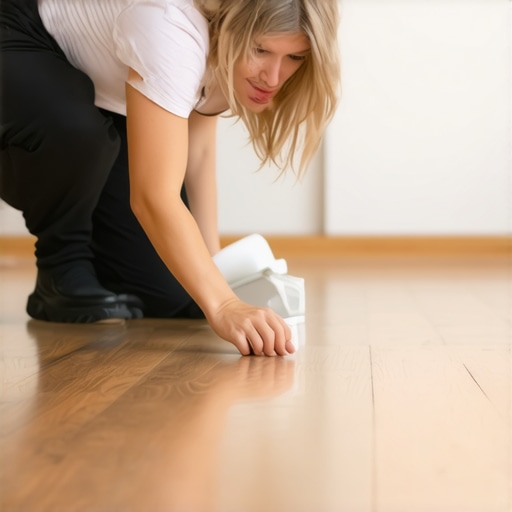
The factory finish is a ceramic shield
Pre-finished hardwood floors utilize a factory-applied aluminum oxide finish that creates a microscopic ceramic shield, making them fundamentally different from site-finished floors. This finish is UV-cured under intense industrial lights, resulting in a surface that is significantly harder than any finish applied in a residential setting. Adding wax to this surface is a chemical mistake. I once walked into a house where a $15,000 wide-plank walnut floor was cupping so bad it looked like a potato chip because the installer didn’t check the crawlspace humidity. The homeowner tried to fix the dullness with wax. It made the tragedy permanent. They thought they were helping the wood. In reality, they were sealing in the moisture and creating a chemical bond that would require a full sand and finish to correct. That walnut was beautiful, but the ignorance of the maintenance killed it. You cannot treat modern engineering with old-world solvents. The chemistry does not allow for it. When you apply wax to a pre-finished board, you are placing a soft, permeable layer over a hard, non-porous one. The wax cannot penetrate the aluminum oxide. It sits on top. It floats. It catches every piece of dust, every dog hair, and every skin cell that falls. Within weeks, the floor looks like a muddy pond instead of a high-end architectural feature. The friction of walking then grinds that debris into the wax, creating a sandpaper effect that actually dulls the very finish you were trying to protect. It is a cycle of destruction that starts with a single bottle of floor shine.
Why wax creates a sticky magnet for grime
Applying wax to a modern urethane or aluminum oxide floor creates a sticky residue that attracts airborne particulates and household pollutants. Unlike site-finished floors of the 1950s, modern boards are not designed to absorb oils. The wax has nowhere to go. It remains in a semi-liquid state, even after it feels dry to the touch. This creates a high-surface-tension environment where dirt becomes embedded. Most homeowners notice the floor loses its luster within a month. They respond by adding more wax. This is the death spiral of flooring maintenance. You are layering filth between layers of soft paraffin. The structural integrity of the plank is not compromised yet, but the aesthetic value is effectively zero. You will see footprints. You will see smudges that no vacuum can pull up. To understand why this happens, we have to look at the molecular level. The factory finish is designed to be low-friction. Wax is high-friction. By changing the surface physics, you are making the floor harder to clean. You are fighting the engineering. It is like putting cheap tape over a Teflon pan. It will not stick well, and it will ruin the performance. I have spent decades on my knees with a moisture meter and a level. I have seen the way these layers interact. It is never a happy ending. The wax eventually turns yellow as it oxidizes, and your expensive white oak starts to look like an old nicotine-stained ceiling. It is a visual disaster that costs thousands to fix.
“A floor is only as good as the subfloor beneath it; deflection is the enemy of every joint.” – Master Flooring Axiom
The tragedy of the walnut cupping incident
Wood cupping occurs when the moisture content at the bottom of the plank is significantly higher than the moisture content at the top. This physical imbalance causes the wood fibers to expand unevenly, forcing the edges of the board upward. In the walnut case I mentioned, the crawlspace was a swamp. The vapor retarder was non-existent. When the homeowner added wax, they sealed the top of the boards. This prevented the wood from breathing. Usually, wood can exchange moisture with the air in the room. By waxing, they created a one-way valve. The moisture came up from the subfloor, hit the wax barrier, and stayed there. The cells of the walnut saturated and swelled. The Janka hardness of walnut is about 1010, which is soft for a hardwood. This makes it more susceptible to structural movement than something like Brazilian Cherry. The wax acted as a sealant for the disaster. I had to tell them the floor was a total loss. You cannot sand out a cup that severe without thinning the wear layer to the point of failure. If they had left the floor alone and just used a dehumidifier, we might have saved it. But the wax was the final nail in the coffin. It is the same with grout in showers or laminate in kitchens. People think more product equals more protection. It is often the opposite. The best protection is a controlled environment and the correct chemical cleaner. Nothing else works.
Understanding the Janka scale and structural integrity
The Janka Hardness Scale measures the force required to embed a 0.444-inch steel ball halfway into a piece of wood. This metric is essential for understanding how a floor will stand up to impact, but it says nothing about how it reacts to chemicals. A high Janka rating like 2350 for Brazilian Cherry does not mean you can wax it. In fact, denser woods are even worse candidates for waxing because their cell structure is so tight. There is absolutely no room for the wax to find a mechanical grip. The chemical bond of modified thin-set is strong, but the bond of wax to aluminum oxide is non-existent. It is a physical overlay, not a chemical union. When you choose a floor, you are choosing a system. The subfloor, the underlayment, the wood, and the finish all work together. If you introduce an alien element like wax, you disrupt the system. I have seen guys skip the leveling compound and try to hide dips with thicker underlayment. It never works. The floor clicks like a castanet. Wax is the maintenance version of that mistake. It is an attempt to hide a problem that only creates a larger, more expensive problem. You must respect the material. Wood is a living thing, even after it is cut and finished. It moves. It reacts. Wax prevents it from reacting in a healthy way.
| Wood Species | Janka Rating | Finish Type | Expansion Risk |
|---|---|---|---|
| Brazilian Cherry | 2350 | Aluminum Oxide | Low |
| Hickory | 1820 | UV Urethane | Medium |
| White Oak | 1360 | Aluminum Oxide | Medium |
| Black Walnut | 1010 | Oil Finish | High |
| Red Oak | 1290 | Polyurethane | Medium |
The chemical war between wax and urethane
Urethane and wax are chemically incompatible because the non-polar molecules in wax cannot form a stable bond with the polar surface of a cured urethane finish. This is why wax eventually peels or flakes. It is also why you can never recoat a waxed floor. If you want to add a new layer of finish in ten years to refresh the look, you cannot do it if there is even a trace of wax in the grain. The new finish will crawl. It will bubble and peel off. I have seen contractors walk away from jobs because they smelled the telltale scent of lemon wax. It is a liability nightmare. To fix it, you have to use aggressive chemical strippers that can damage the wood if they sit too long. You are essentially poisoning your floor to save it. Most people do not realize that modern finishes are engineered to last 25 years without any help. They are not like the old wax floors of your grandmother’s house. Those were raw wood that needed a lipid barrier. Your modern floor is encased in a plasticized shield. Adding wax to it is like trying to polish a diamond with butter. It does nothing but hide the beauty. The technical term for this is inter-coat adhesion failure. It is the number one reason for floor finish complaints in the industry. It is preventable by simply using the manufacturer’s recommended cleaner and nothing else.
“A floor is only as good as the subfloor beneath it; deflection is the enemy of every joint.” – Master Flooring Axiom
Step by step guide to floor preservation
Proper maintenance of pre-finished hardwood requires a minimalist approach that focuses on grit removal and moisture control. You do not need expensive machines. You do not need shiny bottles from the grocery store aisle. You need a consistent routine that respects the factory finish. If you follow these steps, your floor will look new for decades. If you ignore them, you will be calling someone like me to tear it out. Here is the process that professionals use to keep high-end installs in gallery condition.
- Vacuum daily using a soft brush attachment to remove abrasive sand and grit.
- Use a microfiber mop dampened with a pH-neutral cleaner specifically for wood.
- Maintain indoor humidity between 30 and 50 percent to prevent gapping and cupping.
- Place breathable rugs at all exterior entrances to catch moisture and salt.
- Never use steam mops as the high-pressure heat can force water into the joints.
- Trim pet nails regularly to prevent scratching the aluminum oxide layer.
- Wipe up spills immediately to prevent the liquid from penetrating the tongue and groove.
Humidity and the subterranean moisture battle
The climate of your region dictates the behavior of your hardwood more than the brand of wood you buy. In the swampy humidity of Houston, solid wood is a death wish. You need engineered cores that can handle the massive swings in moisture. If you live in a place like that and you wax your floor, you are trapping the Texas humidity inside the wood cells. The result is a floor that buckles and heaves. In dry climates like Phoenix, the wood will shrink. If you have wax in the cracks, it will harden and then crumble as the wood moves, leaving a white, crusty residue that looks like salt. It is disgusting. You must understand that wood is hygroscopic. It is a sponge. It wants to be as wet as the air around it. The factory finish is designed to slow this process down so the wood can adjust slowly. Wax interferes with this natural regulation. I have seen $20,000 floors ruined because someone didn’t understand the dew point in their own living room. It is about the physics of the environment. Your floor is the largest piece of furniture in your house. Treat it like a precision instrument. Keep the wax in the garage for your car. Keep it off the white oak. If you want shine, buy a floor with a higher gloss rating from the factory. Do not try to manufacture it with a bottle of goop. It will only lead to heartbreak and a very expensive bill from a guy like me. Your subfloor is the foundation, but your maintenance is the life span. Choose wisely.