
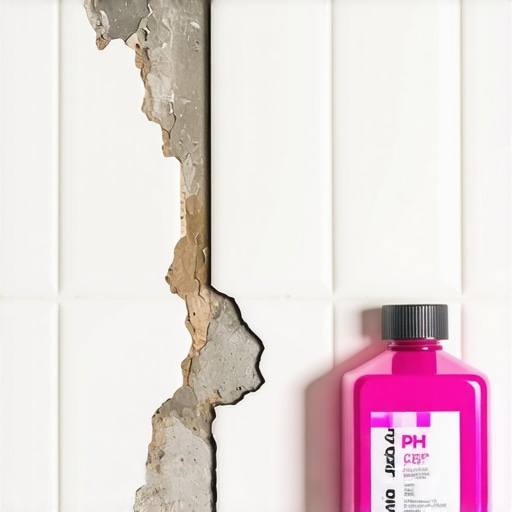
Most guys skip the leveling compound. They think the underlayment will hide the dip. It won’t. I spent three days grinding concrete on a job last month just so the floor wouldn’t click like a castanet. This is the reality of the trade that most big-box stores won’t tell you. A floor is a structural assembly, a layered machine where every component must work in harmony. When I walk onto a job site and see crumbling grout in a shower or cracked laminate joints in a kitchen, I do not see a surface problem. I see a failure of physics and chemistry. Grout is not just a filler, it is a rigid cementitious matrix that is under constant assault from gravity, moisture, and the very chemicals you use to keep it clean. If your grout is turning to sand, you are likely losing a war against acidity and subfloor deflection that started the day the thin-set was mixed. Fixing it requires more than a patch kit. It requires understanding the molecular bond between the tile edge and the cement. [IMAGE_PLACEHOLDER]
The hidden physics of grout failure
Grout crumbles primarily due to subfloor deflection, improper water-to-powder mixing ratios, and the use of acidic cleaners that dissolve the cementitious binder. When a subfloor moves more than the industry standard of L/360, the rigid grout joints cannot handle the stress and fracture. This process is accelerated if the grout was mixed with too much water, leaving behind microscopic voids once the excess moisture evaporates. Most homeowners ignore the structural requirements of the Tile Council of North America and wonder why their high-end tile looks like a ruin after two years. You cannot expect a rigid stone product to sit on a trampoline and stay intact.
“A floor is only as good as the subfloor beneath it; deflection is the enemy of every joint.” – Master Flooring Axiom
Every time you step on a tile that has a tiny bit of air beneath it, you are applying thousands of pounds of pressure per square inch to the grout lines. This mechanical stress causes micro-fractures. In wet environments like showers, these fractures become highways for water. Once water enters the grout, it begins a cycle of saturation and drying that further weakens the bond. If you live in a region with high humidity, like the Gulf Coast, this cycle happens even faster as the ambient moisture prevents the thin-set from ever fully reaching its maximum compressive strength. The result is a grout line that looks fine on Tuesday but rubs off on your finger by Saturday.
The chemistry of the acid attack
Acidic cleaners with a low pH directly attack the calcium carbonate in grout, effectively dissolving the chemical bonds that hold the sand and pigment together. Grout is an alkaline material, usually sitting at a pH of 10 or higher. When you use common household cleaners like vinegar or lemon-based sprays, you are introducing a substance with a pH of 2 or 3. This causes a chemical reaction that leaches the lime out of the cement, leaving behind nothing but loose sand. This is why grout often looks white or chalky before it starts to fall out. You are seeing the mineral deposits of a dying floor. Most people think they are being eco-friendly by using vinegar, but they are actually performing a controlled demolition of their shower floor. To prevent this, you must use a dedicated pH-neutral cleaner. These cleaners are formulated to emulsify oils and lift dirt without interacting with the mineral structure of the grout. The goal is to maintain a neutral state where the grout remains hydrophobic after being sealed. If you strip the sealer with acid, you expose the porous cement to every drop of dirty water and soap scum that hits the floor. This leads to deep staining that no amount of scrubbing can fix, because the stain is now part of the stone.
Why shower floors are the hardest to maintain
Shower grout fails more often because it is subject to constant hydrostatic pressure, soap scum buildup, and frequent temperature fluctuations that cause tile expansion. The transition from a cold bathroom to a 105-degree shower causes the tiles to expand at a different rate than the grout. If there is no movement joint at the perimeter, the grout in the center of the floor will eventually pop. This is why the TCNA mandates 100 percent silicone caulk in all change-of-plane joints. If you have grout in the corners of your shower, it will crack. It is a mathematical certainty. In a shower, the grout is also the first line of defense for the waterproofing membrane beneath. If the grout becomes porous through acid damage, water seeps through and sits on the liner. This creates a dark, damp environment where mold thrives. You might think your grout is just dirty, but often what you are seeing is mold growing from the bottom up, feeding on the organic matter trapped in the crumbling cement matrix. To fix this, you need to remove the compromised grout and replace it with a high-performance epoxy or a pre-mixed urethane grout that is naturally resistant to chemical attacks and water absorption.
| Grout Type | Water Absorption | Compressive Strength | Best Use Case |
|---|---|---|---|
| Sanded Portland | High | 3,000 PSI | Wide joints over 1/8 inch |
| Unsanded Portland | High | 2,500 PSI | Narrow joints under 1/8 inch |
| High-Performance Cement | Medium | 5,000 PSI | Commercial floors and showers |
| Epoxy Grout | Zero | 8,000 PSI | Industrial kitchens and steam showers |
The 1/8 inch that ruins everything
Expansion gaps are the most overlooked part of any flooring installation, and their absence leads to buckling, grout failure, and snapped locking mechanisms in laminate. Every floor needs room to breathe. Whether it is a 3/4 inch solid oak floor or a floating laminate plank, the material will expand and contract based on the relative humidity of the room. If you run your tile or laminate tight against the drywall, the floor has nowhere to go when the humidity spikes. The pressure has to be released somewhere, and that usually happens at the weakest point, the grout joint or the click-lock tongue.
“Properly cured Portland cement grout requires a neutral environment to maintain its structural integrity over time.” – TCNA Handbook Logic
This is especially true for hardwood floors. If you install a wide-plank white oak in a house without a functioning HVAC system to control the climate, those planks will cup and crown. The pressure can literally rip the fasteners out of the subfloor. I have seen grout lines in large-format tile installations explode because the installer didn’t leave a 1/4 inch gap under the baseboards. It sounds like a gunshot when it happens. Professionalism in flooring is about managing these invisible forces. It is about understanding that the house is a living thing that moves, and the floor must move with it.
How a pH balancer restores the matrix
A pH balancer works by neutralizing the acidic residues left behind by cleaners and hard water, stabilizing the grout’s chemical environment. By applying a neutralizing agent, you stop the ongoing erosion of the calcium bonds. This is the secret to making a grout job last for thirty years instead of three. Once the pH is stabilized, you must apply a high-quality penetrative sealer. This sealer does not sit on top like a wax; it soaks into the pores and creates a barrier at the molecular level. It prevents water and oil from entering the grout while still allowing the assembly to breathe. This is a delicate balance. If you use a film-forming sealer on a damp slab, the moisture will get trapped and turn the sealer cloudy, a phenomenon known as blushing. You have to wait until the moisture content of the grout is below 5 percent before you even think about sealing. Use a pinless moisture meter to be sure. Most guys just slap sealer on the next day and wonder why it peels. Patience is the hallmark of a master installer. If you treat your floor like a scientific experiment, it will reward you with a lifetime of service.
- Always use a pH-neutral cleaner for daily maintenance of tile and grout.
- Verify subfloor stiffness meets L/360 requirements before laying a single tile.
- Maintain a consistent indoor relative humidity between 30 and 50 percent.
- Never skip the perimeter expansion gap under the baseboards.
- Replace grout in corners and change-of-plane joints with 100% silicone.
- Re-seal your grout joints every 12 to 24 months depending on traffic.