
Most guys skip the leveling compound. They think the underlayment will hide the dip. It won’t. I spent three days grinding concrete on a job last month just so the floor wouldn’t click like a castanet. That is the reality of the flooring business. You can buy the most expensive wide-plank material in the world, but if your subfloor has a 3/16 inch dip over a 10 foot radius, you are building a drum, not a floor. When you walk across a floating floor and hear that rhythmic clicking, it is the sound of friction between the tongue and the groove. It is the sound of a locking mechanism under duress. It is the sound of an installer who didn’t own a long enough level. I have seen homeowners lose their minds over this sound. They expect the silent solidity of site-finished hardwood floors but they bought a floating system that was slapped over a wavy substrate. The fix is often structural, but sometimes, when the click is a minor friction issue, we turn to the chemistry of dry lubricants.
The phantom sound in your floorboards
Laminate flooring clicks because the locking joints are rubbing against each other due to subfloor unevenness or lack of expansion space. This friction occurs at the microscopic level when the High-Density Fiberboard (HDF) core flexes under your weight. If the floor is not perfectly flat, the tongue moves within the groove, creating a sharp snapping or ticking sound that resonates through the hollow space beneath the planks.
Why your subfloor is lying to you
The subfloor is the foundation of every installation. Most people look at a plywood deck or a concrete slab and assume it is flat because they cannot see the undulations with the naked eye. I have walked onto jobs where the builder swore the slab was ready for flooring. I pull out my 10 foot straight-edge and find a valley deep enough to hold a gallon of water. That valley is a death sentence for laminate. When you bridge a dip with a floating plank, you create a trampoline. Every time you step on that plank, the locking mechanism is forced to bend. These joints are engineered to stay static. When they move, the friction creates the click. This is why grinding or filling the subfloor is the most neglected part of the trade. You have to be a surgeon with the grinder. You need to identify every high spot and bring it down to within 1/8 inch over a 10 foot span. Anything less is just a gamble with the customer’s ears. Unlike tile where you can compensate with a bit more thin-set in the grout lines, laminate has no forgiveness. It is a rigid system that demands a rigid, flat base.
“A floor is only as good as the subfloor beneath it; deflection is the enemy of every joint.” – Master Flooring Axiom
The chemistry of friction and clicking joints
Laminate is essentially a sandwich of melamine, photographic paper, and HDF. The HDF core is the muscle. It is dense, but it is still made of wood fibers and resins. These fibers are abrasive. When two pieces of HDF rub together under the pressure of a 200 pound human, they grip and release in rapid succession. This is the physics of stick-slip friction. In some cases, the clicking is not caused by a dip in the floor but by the wax or lack thereof on the locking profile. Manufacturers like Uniclic or Valinge design these joints to be tight. If the humidity in the room drops, the HDF shrinks slightly, changing the tolerances of the lock. Now, instead of a snug fit, you have a tiny gap where the tongue can chatter. This is especially common in climates with heavy winter heating where the air becomes bone dry. The material pulls back, the gaps open up, and the clicking starts. It is a structural engineering challenge that most people treat as a simple DIY project.
How the talcum powder fix actually works
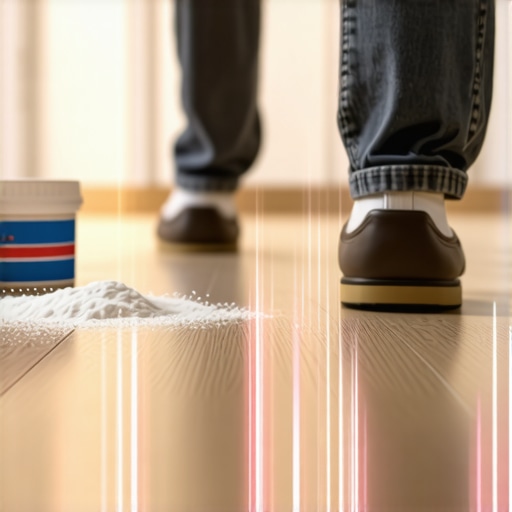
The talcum powder trick is not a miracle cure for a floor that is bouncing three inches off the ground, but for minor friction clicks, it is a legitimate tool in the bag. Talc is a metamorphic mineral. It is the softest known mineral on Earth. When you sweep talcum powder into the joints of a clicking floor, you are introducing a dry lubricant into the friction zone. The microscopic plates of the talc slide over one another with almost zero resistance. By working the powder into the groove, you coat the HDF fibers. The next time you step on the plank and the joint flexes, the tongue slides against the groove instead of gripping it. It is the same principle as using graphite in a door lock. You are reducing the coefficient of friction to the point where the sound is no longer audible. You must use a soft brush to work the powder deep into the joint. Do not just dump it on top. You have to walk over the area to open the joints slightly, allowing the powder to migrate down where the actual contact is happening. It is a messy, temporary fix for a permanent structural problem, but it saves many people from tearing up their entire living room.
The hidden danger of expansion gaps
I have seen more floors ruined by a lack of expansion gaps than by water damage. Homeowners and amateur installers think they should run the laminate tight against the baseboards or the transitions near showers. This is a massive mistake. A floating floor is a living thing. It expands and contracts with the seasons. If you lock that floor against a wall or a heavy kitchen island, the pressure has nowhere to go. The floor will peak or cup. This pressure puts immense stress on the locking mechanisms. When you walk on a floor that is under lateral pressure, every joint is primed to click. It is like a guitar string under tension. You need at least a 1/4 inch gap around the entire perimeter. I have seen guys who even forget to leave space around the pipes for the radiators. That one points of contact can cause the whole floor to buckle and click three rooms away. The floor needs to breathe. It needs to move as a single unit without hitting any vertical obstructions. This is why we use T-moldings in doorways. It breaks the floor into smaller, manageable sections that are less likely to build up enough tension to cause noise.
| Flooring Type | Janka Hardness | Moisture Tolerance | Noise Potential |
|---|---|---|---|
| Solid White Oak | 1360 | Low | Low (Nail Down) |
| Engineered Maple | 1450 | Medium | Low to Medium |
| Premium Laminate | N/A (AC4) | Medium | High (Floating) |
| Luxury Vinyl Plank | N/A | High | Medium |
Checklist for a silent floor installation
- Verify subfloor flatness within 1/8 inch over 10 feet.
- Acclimate the planks in the room for at least 48 hours.
- Use a high-quality underlayment with a high density rating.
- Maintain an expansion gap of at least 1/4 inch at all vertical walls.
- Check the moisture content of the subfloor with a professional meter.
- Avoid running the floor under heavy stationary cabinets or islands.
When the powder fails to stop the noise
If you have tried the talcum powder and the floor still sounds like a bag of potato chips, you have a structural deflection issue. No amount of lubricant will fix a joint that is being pulled apart by a subfloor dip. At that point, you are looking at a repair. You might have to pull up the planks in that specific area and use a self-leveling compound to fill the low spot. I hate giving people that news, but a floor is a precision instrument. If the foundation is wrong, the finish will never be right. Sometimes the clicking is caused by the underlayment itself. If the underlayment is too thick or too soft, it allows the floor to bounce too much. People think a thicker pad means a softer walk, but it actually causes the locking mechanisms to snap. You want a dense, high-compression underlayment. It should feel firm, not like a sponge. The industry is full of cheap foam that collapses after six months, leaving the floor floating in mid-air. That is when the clicking turns into a structural failure. You have to respect the physics of the material. Laminate is a great product when installed to NWFA standards, but it is unforgiving of laziness.
“Deflection is the enemy of every joint. If the subfloor moves, the floor fails.” – Master Flooring Axiom
Moisture and the transition to wet areas
We see a lot of issues where laminate meets the tile in bathrooms or near showers. The humidity from the shower can cause the edges of the laminate to swell if the grout lines or transitions aren’t sealed properly. When the edge of an HDF plank absorbs moisture, it expands. This expansion creates a thickness mismatch between the planks. Now, when you walk across the transition, one plank is slightly higher than the other. This creates a lip-trip and, you guessed it, more clicking. The joint is being sheared instead of compressed. In these areas, you must use a high-quality silicone sealant in the expansion gap. This prevents the moisture from the shower or the cleaning of the grout from seeping into the core of the laminate. I always tell my clients that if they want a floor that lasts, they need to treat it like a machine. It needs maintenance, it needs the right environment, and it needs a perfect setup. Hardwood floors are a bit more forgiving because they are nailed down, but a floating laminate floor is at the mercy of the air and the ground. Keep the humidity between 30 and 50 percent, keep the subfloor flat, and you won’t need a bottle of talcum powder to enjoy your home.