
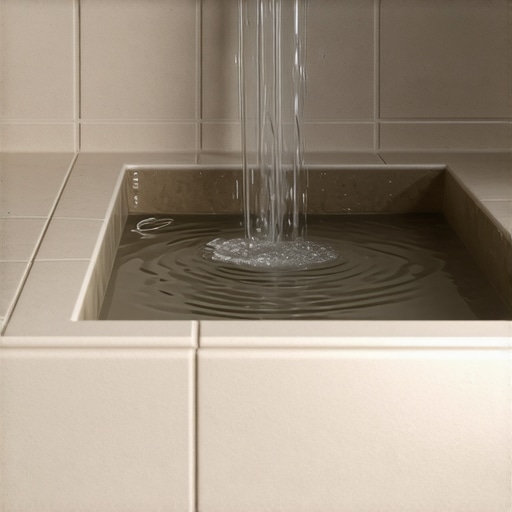
A shower niche is not a decoration. It is a hydraulic management system integrated into a vertical wall assembly. When you see standing water or a persistent ring of slime at the base of your niche, you are looking at a failure of structural physics and a fundamental misunderstanding of the TCNA guidelines. Most installers treat a niche like a picture frame. They cut a hole, slap in some backer board, and hope the tile hides the lack of slope. It never does. Water follows the path of least resistance, and if that path leads to a flat corner with zero gravity assist, you have a petri dish in your wall.
The 1/8 inch slope that saves your grout
A shower niche must have a positive slope of at least 1/8 inch toward the shower floor to ensure gravity pulls water off the horizontal surface. Without this pitch, surface tension keeps water trapped against the grout lines, leading to mold growth and eventual bond failure. Most guys skip the leveling compound. They think the underlayment will hide the dip. It won’t. I spent three days grinding concrete on a job last month just so the floor wouldn’t click like a castanet, and shower niches require that same level of obsessive prep. If the shelf is level, it is actually wrong. In the world of tile, level means stagnant. You need a slight, intentional tilt that the eye cannot see but a marble would roll off of instantly. When water sits on a horizontal tile surface, it begins to penetrate the grout through capillary action. Over months, this moisture saturates the thinset behind the tile. If your waterproofing membrane has the slightest pinhole, that standing water will rot your studs before you even see a leak in the ceiling below.
“A floor is only as good as the subfloor beneath it; deflection is the enemy of every joint.” – Master Flooring Axiom
The molecular reality of water is that it likes to stick to itself. This is called cohesion. On a flat niche shelf, the water molecules bond together and stay put. You need to break that bond using gravity. I have seen thousand dollar marble niches ruined because the installer used a spirit level to make it perfectly horizontal. That is a rookie mistake. You need to be a stickler for the pitch. If you are working in a high humidity environment like Houston or Miami, this becomes even more vital because the air won’t help you with evaporation. The water just sits there, feeding the microbes in your grout pores. Unlike a floating laminate floor that can handle a bit of movement, a shower niche is a rigid system. Any mistake in the base layer will telegraph through the tile and result in a puddle that never goes away.
The structural engineering of a recessed shelf
Standing water in a niche is usually the result of a framing error where the bottom horizontal 2×4 is not planed to account for the thickness of the tile and the necessary pitch. When you build the box between the studs, you have to overcompensate for the final finish material. If you install the framing perfectly square, the thickness of your thinset at the back of the niche will often push the front of the tile up. This creates a back-pitch. A back-pitched niche is a bucket. It collects water and funnels it into the wall cavity. You have to anticipate the stack-up of materials including the waterproofing membrane, the mortar bed, and the tile itself. If you are using a thick natural stone, your calculations must be precise. I have walked onto jobs where the homeowner was complaining about a smell, only to find the niche was tilted back by three degrees. That is enough to hold a quarter inch of water indefinitely. You cannot fix this with extra grout. Grout is not a structural filler. It is a porous material that will eventually crack if it is used to build up a slope.
| Material Type | Recommended Pitch | Acclimation Needs |
|---|---|---|
| Ceramic Tile | 1/8 inch per foot | None |
| Natural Stone | 1/4 inch per foot | 24 hours in dry room |
| Glass Mosaic | 1/8 inch per foot | Temperature stabilization |
| Porcelain Slab | 3/16 inch per foot | None |
Hardwood floors and laminate require expansion gaps, but shower niches require absolute seal integrity. You are essentially building a submarine. If the niche is holding water, it means the surface tension is winning. You need to consider the mil thickness of your waterproofing. If you apply a liquid membrane like RedGard too thick in the corners, it can create a rounded buildup that prevents the tile from sitting flat. This buildup often forces the tile into a slight upward angle at the front edge. It looks flat to the naked eye, but the physics of fluid dynamics do not care what it looks like. If that front edge is 1/64th of an inch higher than the back, the water stays in the niche. This is why I prefer using pre-sloped foam niches from manufacturers like Schluter. They are engineered with the pitch built in, removing the human error of a tired carpenter with a dull saw.
How water tension defeats a flat surface
Water tension is the primary force that keeps moisture trapped on a niche shelf when the pitch is less than 2 percent. At a molecular level, the hydrogen bonds in the water are stronger than the pull of gravity on a flat plane. You must overcome this with a physical incline. Think about how a windshield behaves. If it is flat, the rain stays. If it is angled, the rain clears. Your niche is no different. Many homeowners want that perfectly clean look with no visible angles, but you have to explain the chemistry of the situation. If they want the niche to last thirty years, it has to drain. I once saw a solid walnut floor in a master suite get ruined because the shower niche leaked so slowly through the wall that the subfloor stayed wet for two years without the owners knowing. By the time they called me, the hardwood was cupping like a potato chip. All because of a flat niche shelf three rooms away.
- Check framing for plumb before installing backer board.
- Apply waterproofing membrane in two coats to ensure 30 mil thickness.
- Pre-cut the bottom tile to ensure it has a slight overhang for a drip edge.
- Use epoxy grout in the niche to prevent water absorption.
- Test the pitch with a marble before the thinset cures.
The hidden disaster of improper framing
If the wall studs are twisted or out of alignment, the niche box will never sit correctly regardless of how much thinset you use to try and level the tile. Wood is a living material. It moves, it bows, and it shrinks. In a bathroom, the heat and humidity cause framing to dance. If you do not sister your studs or use metal shims to create a perfectly flat plane, the niche will eventually warp. This is the information gain most contractors won’t tell you. They want to get in and out in a day. But a master knows that the prep takes twice as long as the tile. If you are building a niche, you should be using a six foot level on the surrounding wall to ensure there is no deflection. Deflection is the enemy. If the wall moves, the niche joints will crack, and the water sitting on that flat shelf will find the crack. It is a slow motion train wreck.
“Waterproof does not mean water-shedding; the slope is the only true protection against saturation.” – Tile Council of North America Logic
Using a large format tile in a niche can actually make the standing water problem worse. Larger tiles have fewer grout lines to act as drainage channels. While grout should not be relied upon for drainage, the texture of a small mosaic often helps break the surface tension of the water, allowing it to move. If you use a single piece of 12 by 24 porcelain for the bottom of the niche, it must be pitched perfectly. Any slight deviation will be highlighted by the large, flat surface area. I always recommend using a solid stone sill for the bottom of the niche. It allows you to create a slight bullnose edge that lets water drip directly off the front instead of curling back under the tile via the capillary effect. It is these small details that separate a master from a handyman. It is about understanding the chemistry of the bond and the physics of the fluid.