
The microscopic betrayal of the grout line
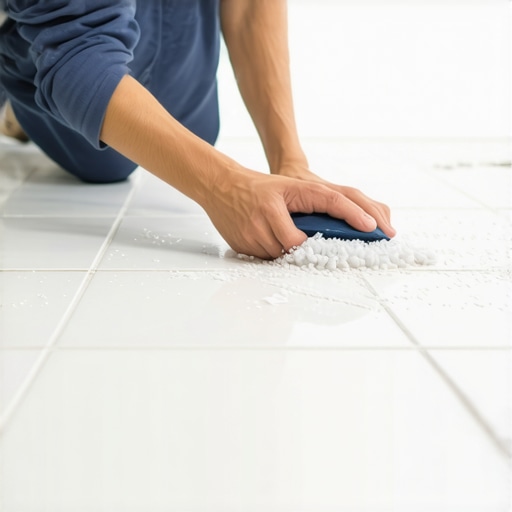
Professional grout cleaning requires pH-neutral cleaners to preserve the structural integrity of the cementitious matrix and the stability of embedded pigments. Acidic solutions dissolve calcium carbonate, which acts as the primary binder in traditional grout, leading to erosion, pitting, and permanent color loss over time.
I spent three days grinding concrete on a job last month just so the floor would not click like a castanet. Most guys skip the leveling compound. They think the underlayment will hide the dip. It won’t. This same lack of respect for the materials is what leads people to ruin their tile work with acidic cleaners. I once saw a bathroom where the homeowner used a high-concentration vinegar solution every week. Within a year, the grout was soft enough to scrape out with a fingernail. The floor was technically clean, but the structural bond was gone. Grout is not just a filler. It is a performance component that locks tiles into a monolithic surface. When you introduce acid, you are starting a chemical reaction that cannot be reversed. You are eating the floor from the inside out.
Why your subfloor is lying to you
A stable grout joint begins with a rigid subfloor that meets the L/360 deflection standard for ceramic tile or L/720 for natural stone. If the substrate moves, the grout will crack regardless of the cleaning agent used, but acidic cleaners accelerate this failure by weakening the grout bond.
The chemistry of grout is fascinating if you actually care about how buildings stay together. Most grout is Portland cement based. This material relies on a crystalline structure that forms during the hydration process. When you apply an acid with a pH below 7.0, you are triggering an ion exchange that replaces calcium with hydrogen. This destroys the crystals. The result is a chalky residue that pulls away from the tile edge. This creates a micro-gap where water can penetrate. In showers, this is the beginning of the end. Once water gets behind the tile and hits the thin-set, you are looking at a full tear-out in five years. I have pulled up laminate floors in adjacent rooms that were buckling because moisture from a compromised shower floor traveled through the subfloor via capillary action. Hardwood floors nearby will cup and crown as they suck up that moisture like a straw.
“A floor is only as good as the subfloor beneath it; deflection is the enemy of every joint.” – Master Flooring Axiom
The chemistry of pigment and surface tension
Pigments used in modern grout are often iron oxide based and are sensitive to chemical oxidation from harsh cleaners. Maintaining a neutral environment is the only way to ensure that the color you picked in the showroom is the color that stays on your floor.
The physical reality of a grout line is that it is a series of interconnected pores. If you do not seal these pores, they act like a sponge. When you use a colored grout, you are looking at finely ground particles trapped in that cement matrix. Acidic cleaners do not just clean the dirt. They reach into those pores and strip the pigment. This is why grout often looks blotchy after a deep clean. It is not that the dirt stayed. It is that the color left. If you are dealing with hardwood floors in the same house, you know that finish matters. You would not use paint thinner to clean your oak planks. Why would you use acid on your grout? The molecular bond of the sealant is also compromised by acids. Most sealers are fluoropolymers or siliconates. They are designed to repel water and oils. Acid breaks down these long-chain molecules, leaving your grout naked and vulnerable to the next spill.
| Grout Type | Chemical Resistance | Porosity Level | Best Cleaning Agent |
|---|---|---|---|
| Sanded Cement | Low | High | pH Neutral Soap |
| Unsanded Cement | Low | Very High | Neutral Cleaner |
| High Performance | Medium | Low | Oxygenated Bleach |
| Epoxy Grout | Very High | Non-porous | Alkaline Degreaser |
The 1/8 inch that ruins everything
Precision in grout joint width is essential for managing the thermal expansion and contraction of the tile assembly. Smaller joints are more susceptible to damage from abrasive cleaning tools that can chip the tile edge while trying to reach deep seated grime.
I have seen people try to scrub their way out of a bad installation. They use wire brushes and heavy acids. All they do is scratch the glaze on their tile. If you have laminate or hardwood floors elsewhere, you understand the importance of the wear layer. Tile has a wear layer too. It is the glaze. Once you scratch it with a harsh brush or etch it with acid, it will catch dirt twice as fast. You are creating a cycle of destruction. The mechanic in me says to do it right the first time. Use a soft nylon brush and a cleaner specifically formulated for stone and tile. If the grout is too far gone, do not reach for the vinegar. Re-grout it. It is the only way to get back to a baseline of structural integrity. I have spent decades on my knees with a moisture meter. I can tell you that a dry subfloor is a happy subfloor. A clean floor is a happy floor. But a chemically burned floor is just a countdown to a bill you do not want to pay.
“The integrity of the assembly depends upon the chemical stability of the interface between the tile and the grout.” – TCNA Handbook Insight
- Test your cleaner in an inconspicuous corner before doing the whole room.
- Apply the cleaner and let it sit for ten minutes to allow the surfactants to work.
- Agitate gently with a soft brush to lift debris from the pores.
- Rinse with clean water to ensure no residue remains to attract more dirt.
- Re-seal the grout every year to maintain the hydrophobic barrier.
The ghost in the expansion gap
Expansion gaps at the perimeter of a room are vital for preventing tile tenting and grout cracking. These gaps should be filled with color-matched 100 percent silicone caulk rather than hard grout to allow for structural movement.
When you transition from a tile shower to hardwood floors in a hallway, that transition is a high-stress zone. The wood expands and contracts with humidity. The tile is relatively stable but the subfloor moves. If you have used acid cleaners that have leaked into the expansion gap, you might be corroding the subfloor fasteners. I have seen rusted staples and screws under tile because of cleaning habits. It is a system. Every part affects the other. Laminate is particularly sensitive to the liquids you use on your grout. If you are mopping your tile with a bucket full of acidic water and that water sloshes onto the laminate, the salt and acid can get into the click-lock joints. It will swell the HDF core. It will ruin the floor. Professional maintenance is about understanding the boundary layers between materials. You are an architect of your home’s longevity. Treat the grout with respect and the rest of the floor will follow suit. Stop looking for shortcuts in the pantry. Use the right chemistry for the job.
“, “image”: {“imagePrompt”: “A high-resolution, technical cross-section of a tile floor showing the subfloor, thin-set, tile, and the porous structure of cementitious grout, with a pH scale icon indicating neutral 7.0.”, “imageTitle”: “Technical Anatomy of a Grout Joint”, “imageAlt”: “Cross-section view of tile installation showing layers from subfloor to grout.”}, “categoryId”: 0, “postTime”: “”}