
The Rubber Mallet Secret for Tightening Loose Laminate Planks
I spent three days grinding concrete on a job last month just so the floor wouldn’t click like a castanet. Most guys skip the leveling compound and they think the underlayment will hide the dip. It won’t. I have seen fifteen thousand dollar wide plank floors cup like potato chips because the installer didn’t check the crawlspace humidity. When you see a gap in your laminate, you are looking at a failure of friction and subfloor integrity. I have spent twenty five years with sawdust under my nails and a moisture meter in my pocket and I can tell you that a floor is a performance surface, not a decoration. Most homeowners assume their floor is ruined when they see a dark gap between planks. It is not. You just need a specific mechanical trick and a bit of physics to reset the locking mechanism without tearing out your baseboards. This is the secret of the high tack tape and the rubber mallet.
The physics of the floating floor failure
Laminate floor gaps occur when the friction between the plank and the underlayment is overcome by structural movement or subfloor unevenness. To fix this, you must understand that the click lock system relies on lateral tension and a perfectly flat substrate. When a subfloor has a dip, the plank deflects downward when stepped on, which slowly unzips the tongue from the groove over hundreds of footfalls. This is not a product defect. It is a failure of the installer to meet the three sixteenths of an inch over ten feet flatness standard required by the National Wood Flooring Association. When the plank moves, the mechanical lock is stressed until it slides apart. You cannot simply kick it back into place because you will damage the wear layer. You need to create a temporary anchor point on the surface of the plank to pull it back into its home without hitting the fragile edges. This requires a scrap piece of wood and high strength double sided tape.
The subfloor secret that no one tells you
A subfloor that is not flat will eventually cause every floating floor to separate or snap at the joints. I have seen people try to fix this by squishing wood glue into the gap. That is a mistake. Glue turns a floating floor into a fixed floor, and when the humidity changes, the floor will crack because it cannot expand. The real secret is that the subfloor is the foundation of the house. If you have a dip larger than one eighth of an inch, the plank is constantly air cushioned. Every time you walk on it, you are flexing the HDF core. High Density Fiberboard is essentially compressed wood fibers and resin. It has a high compressive strength but poor shear resistance. Once you flex it enough, the locking profile starts to wear down. The rubber mallet trick is a temporary fix for a structural problem, but if you do it right, it can last for years by reseating the joint before the tongue snaps off entirely.
“A floor is only as good as the subfloor beneath it; deflection is the enemy of every joint.” – Master Flooring Axiom
The double sided tape and mallet method
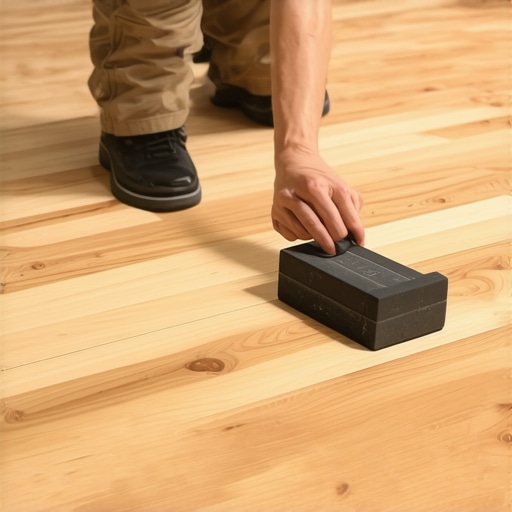
The mallet secret involves using a block of wood taped to the laminate surface to provide a striking point for lateral force. You do not hit the floor. You hit a block that is stuck to the floor. First, find a block of wood about six inches long. Apply high quality double sided carpet tape to the bottom of it. Press this block firmly onto the plank that has moved, about two inches away from the gap. Now, take your rubber mallet and strike the side of the block in the direction of the gap. The kinetic energy transfers through the block and the tape into the plank, sliding it back into the locking mechanism of the neighboring piece. This is the only way to move a plank that is in the middle of a room without disassembling the entire floor. You must be careful not to use tape so strong that it pulls the finish off the laminate, though most modern aluminum oxide coatings can handle the tension. Once the gap is closed, you can pull the block off and clean any residue with a bit of mineral spirits on a rag.
Comparing the resilience of different flooring systems
Not all floors respond to the mallet trick the same way. Hardwood floors that are nail down or glue down do not gap in the same manner as floating laminate. In a shower, grout is rigid and will crack if the subfloor moves, whereas laminate is flexible but finite in its movement. Below is a comparison of how different materials handle structural shifts.
| Floor Type | Core Material | Attachment Method | Gap Risk | Repair Difficulty |
|---|---|---|---|---|
| Laminate | HDF / MDF | Floating Click | High | Low with Mallet |
| Solid Hardwood | Oak / Maple | Nail Down | Medium | High |
| Engineered Wood | Plywood Core | Glue / Nail | Low | Medium |
| LVT / LVP | PVC / Stone | Click / Glue | Medium | Medium |

Why your floor is walking away from you
Planks move because they are not constrained by the perimeter or because the expansion gap is blocked. A floating floor needs a quarter inch gap around the entire room. If you run the floor tight against a wall or a heavy kitchen island, the floor cannot move as one unit. Instead, it buckles in the middle or pulls apart at the weakest joint. I have seen homeowners put a thousand pound granite island on top of a floating floor and then wonder why the planks are separating ten feet away. You have effectively anchored one side of the floor while the other side is free to shrink. This creates a tug of war that the mechanical locks will always lose. When you use the mallet trick, you are basically winning one battle in a war against physics. If the floor keeps gapping in the same spot, you need to check if the floor is pinched somewhere under a baseboard or a transition strip.
The ghost in the expansion gap
Every floor has a ghost that lives in the perimeter gap and when that ghost is squeezed the floor will scream. By scream, I mean it will pop and creak. People think they can hide the gap with a tiny bit of caulk. Never do that. Caulk hardens. When the floor tries to expand in the summer heat, it hits that caulk and the force is transferred back into the joints. If you are in a high humidity area, the planks can swell by several millimeters across the width of a room. That is enough force to snap the tongue of a laminate plank like a toothpick. You need to ensure your baseboards are not nailed into the flooring itself. The baseboard must be nailed to the wall so the floor can slide freely underneath it. If your floor is gapping, go to the nearest wall and pull the shoe molding. You might find that the floor is jammed against the drywall, which is preventing it from settling back into place after you walk on it.
Humidity and the cellular structure of wood fibers
Laminate is mostly wood and wood is hygroscopic, meaning it drinks water from the air. Even though the surface is plastic, the core is wood fiber. If your house drops below thirty percent humidity in the winter, the planks will shrink. If it goes above fifty percent, they will grow. This constant cycle of expansion and contraction is what eventually vibrates the planks apart. This is why acclimation is the most ignored step in flooring. You cannot take a pallet of laminate from a cold warehouse and install it in a warm house the same day. It needs seventy two hours to reach equilibrium. If you skip this, the floor will do its moving while it is already locked together, leading to the very gaps you are trying to fix with your mallet. I always tell people to keep their home at a steady temperature and humidity. Your floor likes the same weather you do.
Underlayment and the compression trap
While most people want the thickest underlayment for comfort, too much cushion actually causes the locking mechanisms on laminate to snap under pressure. This is a contrarian point that sales people at big box stores will never tell you. They want to sell you the expensive six millimeter foam. But a thick foam is like walking on a mattress. When you step on a joint, the foam compresses and the tongue and groove are forced to bend. Most laminate is only eight to twelve millimeters thick. The tongue is only about two millimeters thick. It cannot handle that much vertical movement. You want a high density, thin underlayment that provides moisture protection and sound dampening without allowing the floor to bounce. If your floor bounces when you walk, the mallet trick is only a temporary fix because the joint will eventually fail from metal fatigue in the wood fibers.
“Deflection is the silent killer of the floating floor; if it moves vertically, it will eventually move horizontally.” – National Wood Flooring Association Standard
A checklist for a permanent gap fix
- Verify that the subfloor is flat within 3/16 inch over a 10 foot span.
- Check the perimeter for at least 1/4 inch of expansion space.
- Ensure no heavy furniture like kitchen islands are pinning the floor down.
- Use a hygrometer to keep indoor humidity between 35 and 55 percent.
- Apply the rubber mallet and wood block trick to reset separated joints.
- Apply a tiny drop of PVA wood glue to the tongue if the joint keeps sliding open.
- Avoid using excessive water when cleaning as it swells the HDF core.
The final word on mechanical floor integrity
The rubber mallet secret is a testament to the fact that flooring is about management of force and friction. You are not just laying down boards. You are engineering a surface that must withstand thousands of pounds of pressure over its lifetime. If you treat the floor with respect and understand the physics of why it is moving, you can maintain a beautiful surface for decades. Do not blame the product when the installation or the environment is at fault. Get your mallet, get your tape, and get to work. Your floor is not broken. It is just out of alignment. Once you pull those planks back together and fix the source of the movement, the floor will be as solid as the day it was clicked into place. Just remember that sawdust is the only acceptable dirt in a house and a level is your best friend. Keep your subfloors flat and your expansion gaps wide and you will never have to worry about gaps again.