
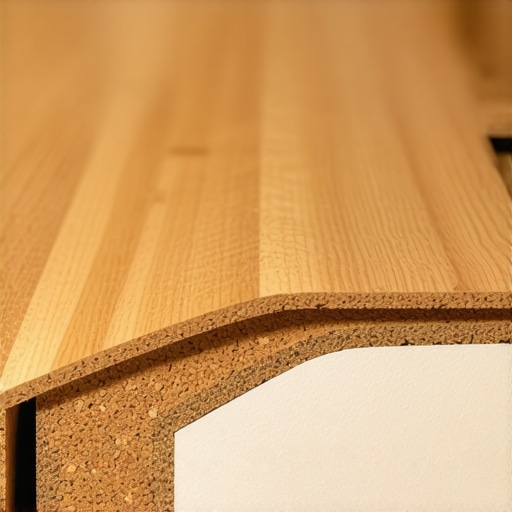
Why Cork Underlayment is the Secret to Quiet Laminate Floors
Most guys skip the leveling compound. They think the underlayment will hide the dip. It won’t. I spent three days grinding concrete on a job last month just so the floor wouldn’t click like a castanet. The homeowner thought I was overcharging for the prep work. Then we laid the cork. Silence. Total, heavy silence. That is what you pay for when you move away from the cheap blue foam rolls. I have spent twenty five years with sawdust under my nails and a moisture meter in my pocket. I have seen floors buckle and snap because people treat them like a rug. A floor is a structural assembly. If you ignore the physics of what happens between the laminate and the subfloor, you are just waiting for a failure. Cork underlayment is the only material that respects the mechanical requirements of a floating floor while solving the acoustic nightmare of laminate. It is not just about the noise. It is about the density and the way it supports the locking mechanisms that are the weakest link in any laminate installation.
The hollow drum effect in modern homes
The hollow drum effect occurs when the air gap between a floating floor and the subfloor acts as a resonance chamber for impact noise. This is the primary reason laminate floors feel cheap or noisy. When you walk across a floor without high density underlayment, the energy of your heel strike vibrates through the plank and bounces off the subfloor. This creates a high frequency click. Cork stops this by acting as a decoupling agent. It is a material composed of millions of microscopic air filled cells. These cells compress and recover without losing their structural integrity. Unlike cheap foam, which contains large air bubbles that pop and flatten over time, cork remains resilient. This means the sound dampening you have on day one will still be there in year twenty. I have pulled up floors from the nineties where the foam underlayment was nothing but a thin layer of dust. The cork on the other hand still looked and felt like it did the day it was installed.
Why synthetic foam fails under pressure
Synthetic foam underlayment often lacks the compressive strength required to protect the thin tongue and groove locking systems of modern laminate. Most people think a thicker, softer underlayment is better. They want that squishy feeling under their feet. That is a massive mistake. When an underlayment is too soft, it allows the laminate planks to deflect too much when you walk on them. This vertical movement puts immense stress on the plastic or fiberboard locking joints. Eventually, those joints will snap. Once the joint is broken, the planks start to separate and the floor is ruined. Cork is the contrarian solution. It is firm. It provides a solid base that limits vertical deflection while still offering enough cushion to absorb sound. This balance of firmness and acoustic absorption is why professionals choose cork for high traffic areas and multi story buildings.
“A floor is only as good as the subfloor beneath it; deflection is the enemy of every joint.” – Master Flooring Axiom
The cellular biology of sustainable acoustic barriers
The secret to the performance of cork lies in its unique suberin content and its closed cell structure. Cork is harvested from the bark of the Quercus suber tree. Each cubic centimeter of cork contains approximately forty million cells. These cells are filled with an air like gas. This makes cork extremely light but also remarkably compressible. Because the cells are closed, they do not absorb water easily. This is a common misconception in the flooring world. People think cork is like a sponge. It is not. It is more like a dense cluster of microscopic balloons. When you apply pressure, the air inside the cells compresses. When the pressure is released, the air expands. This is why cork underlayment is the best choice for heavy furniture. It does not take a permanent set like polyethylene foam does.
Measuring the real world impact of IIC ratings
Impact Insulation Class or IIC is the standard measurement used to determine how well a floor assembly blocks impact noise from traveling to the room below. If you live in a condo or an apartment, your HOA likely has a minimum IIC requirement. Standard laminate over a concrete slab might have an IIC rating in the low thirties. That is like living inside a drum. Adding a high quality six millimeter cork underlayment can jump that rating into the sixties. This is a logarithmic scale, so the difference is not just double, it is a massive reduction in perceived noise. You also have to look at the Sound Transmission Class or STC, which measures airborne noise like voices or television. Cork performs exceptionally well in both categories because its density blocks the low frequencies while its cellular structure absorbs the high frequencies.
| Underlayment Type | Typical Thickness | IIC Rating | Compressive Strength |
|---|---|---|---|
| Standard Blue Foam | 2mm – 3mm | 50 – 52 | Low |
| High Density EVA | 3mm | 58 – 60 | Medium |
| Natural Cork | 3mm | 60 – 62 | High |
| Natural Cork | 6mm | 65 – 68 | Very High |
The 1/8 inch rule for subfloor preparation
Subfloor flatness is more important than subfloor levelness when installing laminate over cork. You can have a floor that is sloped, but it must be flat. The industry standard is a deviation of no more than one eighth of an inch over a ten foot radius. If you have a hump or a dip, the cork will follow it. While cork is better at bridging minor imperfections than foam, it cannot miracles. I always tell my clients that if I don’t spend a day with a straight edge and a bag of self leveling compound, the floor will fail. You have to grind down the high spots in the concrete. You have to fill the low spots in the plywood. If you skip this, the laminate will bridge the gap. Every time you step on that spot, the floor will flex. That flex creates a squeak. That squeak will drive you crazy. Cork helps dampen that sound, but it won’t fix a bad subfloor. Do the prep work or don’t bother laying the floor.
- Check subfloor moisture with a calcium chloride test.
- Grind down all ridges and high spots in the concrete.
- Vacuum the subfloor three times to remove all grit.
- Lay the cork sheets in a staggered brick pattern.
- Tape all seams with a high quality vapor tape.
- Maintain a quarter inch expansion gap at all perimeters.
Moisture management in high humidity environments
Cork is naturally resistant to mold and mildew due to the presence of suberin, but it still requires a dedicated vapor barrier over concrete. This is another area where DIY installers get confused. They think because cork is natural, it can breathe and therefore doesn’t need a poly film. In a basement or on a slab, moisture vapor is constantly rising. If that vapor gets trapped between the cork and the laminate, it will cause the laminate core to swell. Even waterproof laminate can have issues if the moisture is trapped underneath for years. You must lay a six mil polyethylene vapor barrier down first, then the cork, then the laminate. This sandwich protects the organic material of the cork and the wood fiber of the laminate. In high humidity regions like the Gulf Coast, this step is non negotiable. The moisture in the air will find its way into your subfloor. You have to build a wall against it.
“Wood based flooring products must be acclimated to the environment in which they will be installed to reach their equilibrium moisture content.” – NWFA Technical Guidelines
Practical steps for a silent installation
The final results of your floor depend on the precision of your perimeter gaps and the quality of your transitions. If you push the laminate tight against the baseboards, the floor has nowhere to expand. It will pressure lock. Once it pressure locks, it will lift off the underlayment. Now you have an air gap. Now you have noise. You need that quarter inch or half inch gap at every wall. You also need to avoid the heavy kitchen island mistake. Never install a floating floor and then bolt a heavy island on top of it. You are essentially pinning the floor to the subfloor. This prevents the planks from sliding over the cork as they expand and contract with the seasons. If the floor cannot move, it will buck or the joints will pull apart. Treat the floor as a single moving unit that sits on a bed of cork. If you give it the room it needs, it will stay quiet and stable for decades. The final verdict is simple. If you want a floor that feels like a permanent part of the house and not a temporary plastic cover, spend the extra money on cork. Your ears and your joints will thank you.