
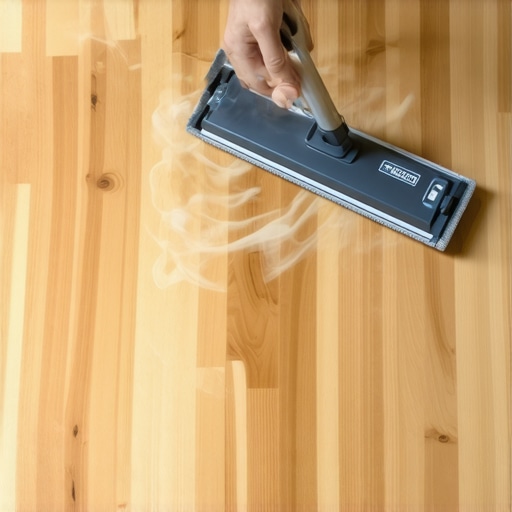
The smell of floor wax and the dry sting of oak dust define my life. I have spent twenty-five years staring at subfloors through the lens of a moisture meter and a six-foot straight edge. Most homeowners think a floor is a decoration. I know it is a structural engineering system. I spent three days grinding concrete on a job last month just so the floor would not click like a castanet. That is the reality of professional installation. Most guys skip the leveling compound. They think the underlayment will hide the dip. It won’t. When you bring a steam mop into your home, you are bringing a high-pressure vapor weapon to a molecular knife fight. This machine is designed to force microscopic water molecules into places they were never meant to go. On a glued laminate floor, this is a death sentence. The adhesive bonds that hold your planks together are susceptible to thermal degradation and moisture infiltration. Once that bond breaks, the floor is junk. There is no fixing a blown laminate joint.
The hidden chemistry of steam and glue
Steam mops use pressurized vapor to clean surfaces but this vapor is physically smaller than liquid water droplets. This allows the heat to penetrate the seams of your laminate floor and attack the Polyvinyl Acetate or specialized flooring adhesive used in the joints. When you pull the trigger on a steam mop, you are injecting 212-degree water vapor directly into the cross-linked polymer chains of the glue. This causes the adhesive to soften and lose its grip. Laminate flooring is a composite product. It consists of a wear layer, a decorative layer, a High-Density Fiberboard core, and a backing layer. The glue is the only thing protecting the core at the seams. Once the steam compromises that glue, the HDF core acts like a sponge. It absorbs the moisture and expands. This expansion is permanent. Unlike solid hardwood floors that might cup and then settle back down, laminate is a one-way street of destruction. The wood fibers in the HDF core are shredded and compressed during manufacturing. When they swell, they lose their structural integrity forever.
“A floor is only as good as the subfloor beneath it; deflection is the enemy of every joint.” – Master Flooring Axiom
The physical failure of the tongue and groove
Every laminate plank relies on a mechanical or glued connection to maintain a flat surface across the entire room. When steam hits the tongue and groove joint, it creates a localized greenhouse effect. The heat expands the air trapped in the gap. The vapor coats the raw edges of the HDF. If you have a glued laminate floor, you might think the glue creates a waterproof seal. You are wrong. No glue used in standard flooring is rated for constant exposure to pressurized steam. The steam eventually find a microscopic void. It enters the core. The core swells. The edges of the planks begin to lift. This is called peaking. Once peaking occurs, the wear layer at the edge of the plank becomes the highest point of the floor. Your feet, your vacuum, and your furniture will catch on these raised edges. Within months, the decorative layer will start to chip away, exposing the brown fiberboard underneath. This is why I tell my customers that a steam mop is the most expensive cleaning tool they will ever buy. It turns a ten-year floor into a two-year floor in a matter of weeks.
Why your subfloor is lying to you
Subfloors often hide moisture issues that steam mops exacerbate through thermal transfer. If your concrete slab has a high moisture vapor emission rate, the steam mop adds fuel to the fire. The heat from the mop can actually draw moisture up from the subfloor, trapping it between the underlayment and the bottom of the laminate. This creates a sandwich of rot. I have seen floors where the bottom of the plank was covered in black mold while the top looked pristine. This happens because people trust the marketing on the box. Big-box retailers love the word waterproof. It is a lie. There is no such thing as a waterproof laminate floor when it comes to steam. The surface might be waterproof, but the system is not. The joints are the weak point. The perimeter is the weak point. If you have grout or tile in an adjacent room, you might be tempted to use the steam mop there and let it wander onto the laminate. Do not do it. The moisture will migrate under the transition strips and destroy the edge of the laminate room before you even realize there is a problem.
| Material Property | HDF Core Laminate | Engineered Wood | Solid White Oak |
|---|---|---|---|
| Moisture Absorption Rate | High | Medium | Moderate |
| Heat Resistance (Steam) | Very Low | Low | Low |
| Joint Integrity | Mechanical/Glue | Tongue/Groove | Nailed/Glued |
| Repairability | Zero | Minimal | High |
The ghost in the expansion gap
Proper flooring installation requires a 1/4 inch to 3/8 inch expansion gap around the entire perimeter of the room. This gap is there because floors are living, breathing entities. They move based on the humidity in your home. When you use a steam mop, you are artificially inflating the humidity of the floor planks. They expand rapidly. If they hit the wall because you did not leave a big enough gap, the floor will buckle. I have seen entire floors lift off the subfloor like a tent because the owner was obsessed with steam cleaning. They wanted that sterile, hospital-clean feeling. What they got was a $10,000 replacement bill. The expansion gap is not a suggestion. It is a requirement. If you fill that gap with steam, you are asking for the floor to fail at its weakest point. The physics of wood fiber do not care about your cleaning habits. If the fiber gets wet and hot, it grows. If it has nowhere to go, it goes up.
The structural lie of the waterproof claim
Marketing departments have done more damage to floors than termites ever could. They label laminate as waterproof to compete with Luxury Vinyl Plank. But laminate is made of wood. Vinyl is made of plastic. You can steam a plastic floor, though I still would not recommend it for the sake of the adhesive, but you cannot steam a wood-based floor. The core of a laminate plank is basically sawdust held together with hope and resin. When that resin meets 212-degree vapor, the hope evaporates. The resin softens. The sawdust returns to its natural state. You need to understand the mil-thickness of your wear layer too. Even a high AC4 or AC5 rated floor cannot protect the core from steam entering through the side of the plank. The wear layer is on top. The side of the plank is vulnerable. Every time you pass that steam head over a seam, you are gambling with the structural integrity of the installation.
“Deflection is the silent killer of floors, but moisture is the loud one that takes no prisoners.” – Master Flooring Axiom
Better ways to maintain your investment
Maintaining a glued laminate floor requires a dry-to-damp approach rather than a wet-to-steamed approach. You want to use a pH-neutral cleaner specifically designed for laminate. You want to use a microfiber mop that is barely damp to the touch. If you can squeeze a single drop of water out of the mop, it is too wet. This is the professional standard. We do not use buckets of water. We do not use steam. We use friction and the right chemistry to lift dirt without disturbing the subfloor or the adhesive bonds. If you have showers nearby, make sure the transitions are sealed with 100 percent silicone. Do not let water sit on the surface. Laminate is a fantastic product for durability and scratch resistance, but it is allergic to moisture in large quantities. Treat it with respect and it will last thirty years. Abuse it with a steam mop and you will be calling me for a tear-out quote before the year is over.
- Use a microfiber dust mop daily to remove abrasive grit.
- Mist a pH-neutral cleaner onto the mop head, never directly onto the floor.
- Maintain indoor humidity between 35 and 55 percent.
- Never use wax or polish on a laminate surface.
- Place walk-off mats at every exterior entrance.
- Check your dishwasher and refrigerator for slow leaks monthly.
Regional moisture impacts and climate logic
The environment where you live dictates how your floor reacts to cleaning and ambient conditions. If you are in the swampy humidity of Houston, your floor is already fighting a battle against the air. Adding steam to that environment is like throwing gasoline on a fire. The floor is already at its expansion limit. In the dry heat of Phoenix, the floor might have shrunk, opening up the seams even more. These open seams are like open wounds. They allow steam to enter the core even faster than they would in a more temperate climate. In the Pacific Northwest, the subfloors are often damp to begin with. You have to be an expert in moisture barriers there. Adding steam from the top while moisture is trying to come up from the bottom will rot the core of your laminate in record time. I always tell people to look at their local weather before they decide how to clean their floors. The climate is your partner or your enemy. Do not make it your enemy by adding unnecessary moisture. [image placeholder] One contrarian data point that most people miss is the thickness of the underlayment. While most people want the thickest underlayment for comfort, too much cushion actually causes the locking mechanisms on laminate to snap under pressure. This happens because the floor deflects too much when you walk on it. Now, imagine that mechanical stress combined with steam-softened HDF. It is a recipe for total floor failure. Stick to a high-density, thin underlayment and stay away from the steam trigger. Your wallet will thank you. Your subfloor will thank you. And I won’t have to come out to your house to tell you that your beautiful new floor is a total loss.