
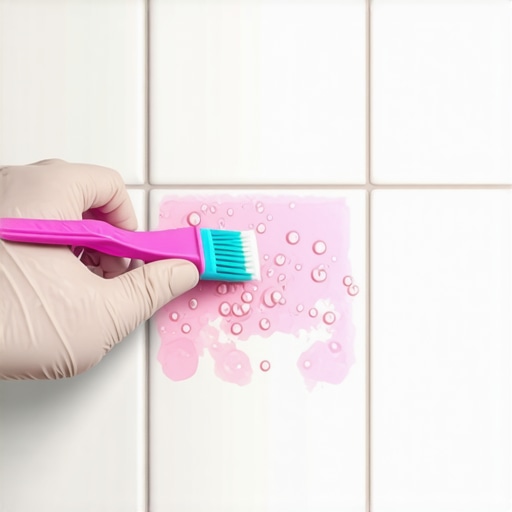
The pink film in the shower stall
The pink sludge appearing in the corners of your shower is not actually mold. It is a biological alarm. Most homeowners see that rosy hue and reach for the bleach, thinking they are fighting a fungus. They are wrong. This is an airborne bacterium called Serratia marcescens. It thrives in moist environments where it can feed on fatty phosphorus and fatty acid deposits. These deposits come from your soap and your shampoo. It is a persistent invader that colonizes the grout lines because the grout is porous. Grout is essentially a hard sponge. If it was not sealed properly or if the sealer has worn away through years of scrubbing with harsh chemicals, the bacteria find a home in the microscopic voids of the cementitious matrix. I have seen bathrooms where this pink film has migrated from the shower floor all the way into the subfloor through cracked transition strips. It is a mess. It is a sign of a moisture management failure. It tells me the humidity in the room is consistently above 60 percent. It tells me the ventilation is inadequate. It tells me the floor is holding onto water long after the shower is turned off. You are not just looking at a stain. You are looking at a living colony of bacteria that thrives on neglect and high humidity.
The biological reality of Serratia marcescens
Serratia marcescens is a Gram-negative, rod-shaped bacterium that produces a red pigment called prodigiosin when it grows at room temperature. This bacterium does not just appear. It is everywhere. It is in the dust. It is in the air. It waits for the perfect conditions to thrive. Those conditions are found in your shower grout. The bacteria require a carbon source and a moisture source. When you bathe, you provide the carbon in the form of body oils and soap residues. The water provides the rest. This bacterium is particularly hardy because it can survive in nutrient-poor environments for extended periods. It forms a biofilm. This biofilm is a protective layer that makes the bacteria resistant to standard cleaning agents. This is why you can scrub it away on Monday and see it return by Friday. The biofilm acts like a root system. If you do not kill the source and change the environment, the pink will return. This is a structural challenge as much as it is a cleaning one. If the grout is not dense enough or if it has been compromised by acid-based cleaners, it becomes a breeding ground. I always tell clients that if they see pink, they need to check their exhaust fan. They also need to check the integrity of their grout joints. A compromised joint allows water to sit in the subfloor. That is where the real damage starts. Once moisture gets under the tile, you are looking at rot. You are looking at a complete teardown.
The subfloor secret that ruins installations
Most guys skip the leveling compound. They think the underlayment will hide the dip. It won’t. I spent three days grinding concrete on a job last month just so the floor wouldn’t click like a castanet. That job was supposed to be a simple laminate install. Instead, I found a quarter-inch dip over a four-foot span. If I had laid the floor over that, the locking mechanisms would have snapped within six months. This same principle applies to your shower. If the subfloor or the mud pan was not sloped correctly, water sits. Water does not move toward the drain. It sits in the low spots. It saturates the grout. This constant saturation is what invites the Serratia marcescens to move in and set up shop. The chemistry of the floor is dictated by the physics of the subfloor. If the subfloor is not level and flat, every finish material you put on top of it will eventually fail. I have seen $20,000 marble showers ruined because the installer did not understand the importance of a pre-slope. They built the liner on a flat subfloor. The water sits on the liner, creates a swamp under the tile, and the pink bacteria bloom through the grout lines like a slow-motion explosion. You can scrub until your hands bleed, but if there is standing water under the tile, the pink will never leave. You have to fix the drainage. You have to fix the subfloor. There are no shortcuts in flooring. Not if you want it to last.
“A floor is only as good as the subfloor beneath it; deflection is the enemy of every joint.” – Master Flooring Axiom
The chemistry of grout and moisture migration
Grout is a mixture of cement, sand, and pigments. When water hits it, the water moves through the pores via capillary action. In a shower environment, this is expected. However, if the grout is not sealed, the water carries the bacteria deep into the structure. We measure the porosity of these materials because it dictates the lifespan of the installation. For a floor to survive, it must be able to dry out. If you have installed hardwood floors or laminate in an adjacent room, the moisture levels in the bathroom become even more critical. High humidity in the bathroom will migrate through the walls and under the door. It will find its way into the expansion gaps of your hardwood. Wood is a hygroscopic material. It absorbs water from the air. When the humidity in the bathroom stays high because of poor ventilation and bacterial blooms, the hardwood in the hallway will start to cup. The edges of the planks will lift. This is because the bottom of the board is drier than the top, or vice versa. The tension causes the wood to warp. You might think the pink in your shower is just a cosmetic annoyance. In reality, it is a symptom of an environment that is slowly destroying your entire flooring system. You need to manage the vapor pressure. You need to understand the dew point. If the air in the bathroom is saturated, the water on the floor has nowhere to go. It stays in the grout. The bacteria grow. The subfloor rots. It is a chain reaction that starts with a single drop of water and a dirty soap dish.
Molecular bonding and the failure of cheap sealers
Not all sealers are created equal. Most homeowners buy the cheap spray-on stuff at the big-box store. That is a mistake. Those sealers are often water-based and do not provide a true penetrating barrier. They sit on the surface and wear off within weeks. To truly stop pink bacteria, you need a high-quality solvent-based impregnating sealer. This sealer works at a molecular level. It penetrates the pores of the grout and lines them with a hydrophobic coating. This does not plug the pores. It allows the grout to breathe, meaning vapor can escape, but liquid water cannot enter. This is the gold standard. If the grout is sealed properly, the Serratia marcescens cannot find a foothold. It cannot get deep into the cement. It stays on the surface where it can be easily wiped away with a mild detergent. I see so many people ruin their floors by using bleach. Bleach is an oxidizer. It kills the bacteria on contact, but it also eats away at the sealer and the grout itself. It makes the grout more porous over time. It creates more surface area for the bacteria to hide in. It is a vicious cycle. You scrub with bleach, you destroy the grout, and the bacteria come back stronger. You need to stop using harsh acids and bases. You need to use pH-neutral cleaners and keep the surface dry. That is the only way to win the war against the pink.
| Material Type | Porosity Level | Acclimation Time | Moisture Resistance |
|---|---|---|---|
| Solid Hardwood | High | 7 to 14 Days | Low |
| Engineered Wood | Medium | 3 to 5 Days | Moderate |
| Laminate | Low | 2 Days | Moderate |
| Ceramic Tile | Very Low | None | High |
| Cement Grout | High | N/A | Low (Unsealed) |
The ghost in the expansion gap
Every floor needs room to move. When we install laminate or hardwood, we leave a gap at the perimeter. This is the expansion gap. If you do not leave this gap, the floor will buckle when the humidity rises. In a bathroom, this gap is often hidden under the baseboards or the transition strip. If the pink bacteria are present, it means moisture is high. That moisture is moving into that expansion gap. I have pulled up baseboards in bathrooms and found colonies of bacteria and mold growing in the hidden gaps. The water travels from the shower floor, under the tile, and into the wall cavity. This is where structural rot begins. The sill plate of your wall will soak up that water like a wick. I have seen 2×4 studs that I could crumble with my bare hands because a shower was leaking and the grout was neglected. You have to think about the floor as a system. The tile, the grout, the sealer, the subfloor, and the transition strips all work together. If one part fails, the whole system is compromised. The pink film is just the visible tip of the iceberg. Underneath, there is a world of moisture and biological activity that is trying to return your house to the earth. You have to be more aggressive than the bacteria. You have to be a stickler for the details. You have to ensure that every joint is tight and every surface is sealed.
- Deep clean grout with a stiff brush and an oxygen-based cleaner.
- Dry the shower completely after every use with a squeegee.
- Increase ventilation by running the exhaust fan for 30 minutes post-shower.
- Apply a high-quality solvent-based impregnating sealer to all grout lines.
- Check the perimeter of the room for signs of moisture migration.
- Replace any cracked or missing grout immediately.
The 1/8 inch that ruins everything
Precision is the difference between a floor that lasts forty years and one that fails in four. When I am setting tile, I am looking at the thin-set coverage. If you do not have 95 percent coverage in a wet area, you have voids. Those voids are pockets where water can collect. When water collects, it becomes stagnant. Stagnant water is a buffet for bacteria. I use a notched trowel and I back-butter every single tile. It is more work. It makes my back ache and my knees throb. But it ensures that there is no room for water to hide. Most DIY installers and