
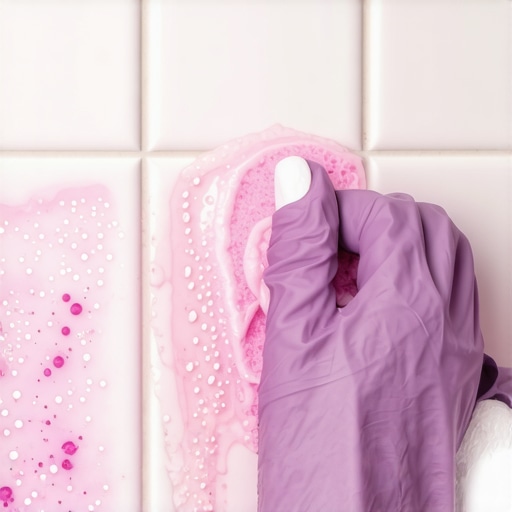
The biological invader in your bathroom
I spent three days grinding concrete on a job last month just so the floor wouldn’t click like a castanet. People think flooring is just about the surface, but it is always about what is happening underneath. When you see that unsettling pink hue creeping across your shower grout, you are not looking at a simple stain. You are looking at a living, breathing colony of bacteria that has found the perfect structural environment to thrive. I have walked into thousands of bathrooms where the homeowner blames the water quality or the soap. The reality is much more technical. It is about moisture, airborne phosphorus, and the porous nature of cementitious grout. If you treat this like a cosmetic smudge, you will lose the battle. You have to treat it like a biological breach of your home’s waterproofing system. Most guys skip the leveling compound and most homeowners skip the grout sealer. Both mistakes lead to the same result which is a structural failure that allows microorganisms to take root in the very foundation of your shower stall.
Serratia marcescens and the science of pink slime
Serratia marcescens bacteria are the primary cause of pink shower grout and thrive in moist environments by feeding on phosphorus and fatty substances found in soaps and shampoos. This airborne pathogen colonizes porous grout lines, creating a biofilm that resists standard wiping and requires targeted disinfection to eradicate effectively.
This bacterium is a fascinating piece of biological engineering. It produces a red pigment called prodigiosin, which, when diluted by the water in your shower, appears as that classic salmon or bubblegum pink. It is not a mold. It is a Gram-negative, rod-shaped bacterium. This distinction matters because the chemistry required to kill a bacterium is different from what you would use on a fungal growth. The Serratia marcescens is opportunistic. It waits for the humidity levels in your bathroom to spike. It settles on the damp surface of your grout. Because standard sanded or unsanded grout is essentially a hard sponge, the bacteria migrate into the microscopic voids of the cement. Once they are inside those pores, they are shielded from casual surface cleaning. They begin to secrete a slimy extracellular matrix. This matrix acts as a shield, making the colony incredibly resilient to the occasional splash of soapy water. You are dealing with a microscopic fortress built into your flooring joints.
How standing water feeds the beast
Standing water and high humidity provide the essential hydration for bacterial colonies to expand across shower surfaces and flooring transitions. Reducing the surface tension of water through proper drainage and ventilation is the most effective way to inhibit the metabolic activity of Serratia marcescens in residential bathrooms.
Think about the physics of a shower floor. If the plumber or the tile setter did not achieve a perfect 1/4 inch per foot slope toward the drain, you have birdbaths. These are tiny depressions where water sits. Even a millimeter of standing water is an ocean for a bacterial colony. As the water evaporates, it leaves behind a concentrated film of skin cells, fats, and minerals. This is the buffet that Serratia marcescens needs. If you have hardwood floors or laminate in the adjacent hallway, the humidity escaping from the shower is also your enemy. While the bacteria might stay in the shower, the moisture creates a vapor pressure that can affect the dimensional stability of wood products nearby. The bathroom is a pressurized chamber of humidity. If your fan is not moving at least 50 cubic feet per minute, you are essentially running a laboratory for pink slime. The bacteria will continue to bloom as long as the relative humidity stays above 55 percent. It is a mechanical failure of ventilation as much as it is a cleaning issue.
“A floor is only as good as the subfloor beneath it; deflection is the enemy of every joint.” – Master Flooring Axiom
The structural failure of porous grout
Porous grout acts as a capillary network that pulls contaminated water deep into the tile assembly, leading to long-term staining and structural degradation. Utilizing epoxy grout or high-quality penetrating sealers creates a hydrophobic barrier that prevents Serratia marcescens from establishing a permanent biological foothold in the substrate.
Most residential showers use Portland cement-based grout. Under a microscope, this material looks like a series of interconnected caverns. When you take a hot shower, the pores expand. The water, carrying the Serratia marcescens, is pulled in via capillary action. This is the same physics that allows a tree to pull water from its roots to its leaves. Once the bacteria are inside, they start to multiply. This is why you can scrub the pink away on Monday, and it is back by Thursday. You only cleaned the top 5 percent of the colony. The remaining 95 percent is safely tucked away inside the grout’s internal structure. This is a primary reason why I advocate for epoxy grouts in heavy moisture areas. Epoxy is non-porous. It is a solid plastic bond. It does not have the